| Author |
 Replies: 416 / Views: 99,890 Replies: 416 / Views: 99,890 |
|
|
|
Pillar of the Community
2087 Posts |
Quote:
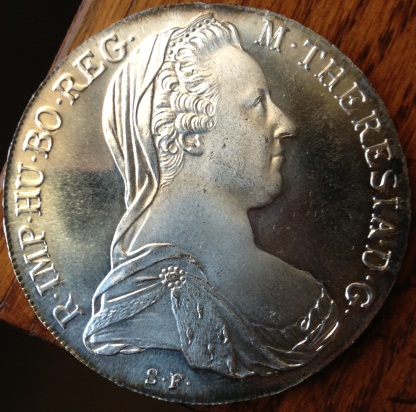
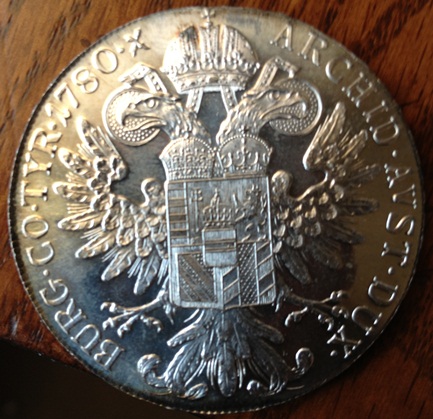
Compare with my London Mint MTT, I agree with the first coin is also a London Mint specimen (1936-61). Just so there is no confusion I would agree its London mint...but My earlier post acknowledges the possibility of doubt. Bombay and Calcutta examples were produced from dies supplied by The Royal Mint. Now the next photos were taken very quickly and are posted to provide some assistance( if needed) the photos are of an 1888 commemorative medal commissioned by the Vienna Numismatic society. The medal is struck on an MTT blank and this example has the standard MTT edge. Mintage 250. An auctioneer a couple of years ago suggested that the MTT edge is rare on these medals but every example I have seen so far ( three) has the MTT edge. Obviously the medal is important as it provides a specific date to a particular edge design. 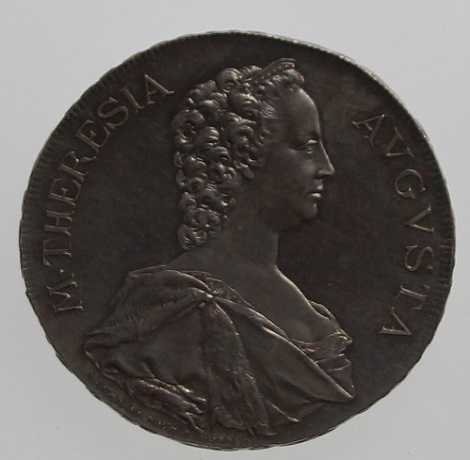 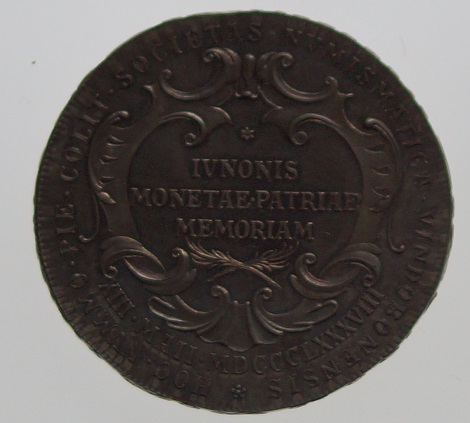   |
|
Pillar of the Community
Hong Kong
1270 Posts |
Quote:
the medal is important as it provides a specific date to a particular edge design. Absolutely agreed! Thank you your useful information, austrokiwi.  |
|
Pillar of the Community
 United States
3499 Posts |
|
|
Pillar of the Community
2087 Posts |
to be honest I have looked much at the claws so I can't comment I suppose its something I am going to have to look at, But for now I am not much help.
|
|
Pillar of the Community
Hong Kong
1270 Posts |
Archraz,
the first coin you posted on 2/19/2013 is a London Mint MTT, struck between 1936-61.
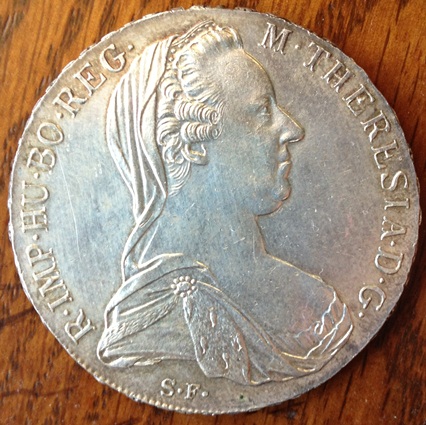
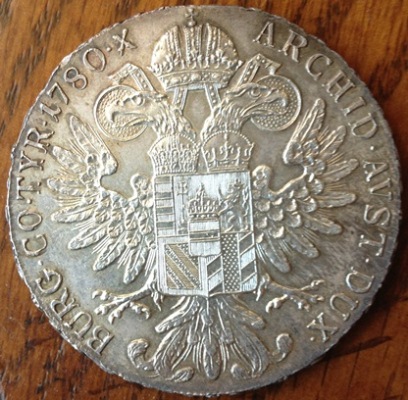
the second coin you posted is believed to be H61a (but I am not sure for the saltire observed), if true, might be struck between 1960-80s.
austrokiwi said:
'the top coin is most likely older than the second'
is true because the top one is London Mint specimen, older than the bottom one, the H61a. This is also what I agree with.
Archraz, you said:
'the longer claws were a feature only on very recent strikes'
I agree with this assertion because I really observe this fact when you compare those recent 1980s (and later souvenir MTT) with those older MTT, you can get this conclusion. Do you agree, austrokiwi?
|
|
Pillar of the Community
United States
3499 Posts |
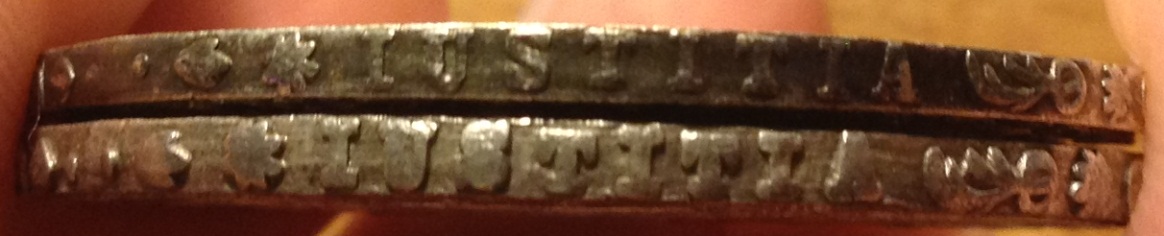
wonghinghi- Yes, I agree that the London-struck coin is the older of the two that I showed on 2/19/2013. However, all of the edge shots that I posted do not include an edge view of the London coin. Rather, I posted my possible H61a coin beneath a MTT that I'm fairly sure is an H62. So my above post from 2/20/2013 compares the edges of the H62 and H61a.
Edited by Archraz
02/21/2013 12:34 pm
|
|
Pillar of the Community
2087 Posts |
At this stage I won't comment. Tomorrow or Saturday I will go through my coins and have a close look. I have some modern counter marked coins which can act as markers. I will see if they can suggest an answer.
|
|
Pillar of the Community
United States
3499 Posts |
austrokiwi- Great! Thanks. I would be very curios to hear your findings on how the length of the eagle's claws indicate the date of striking.
|
|
Pillar of the Community
2087 Posts |
Opps I will do it today. First the edges. In the two photographs following from top to bottom: 1741 strike (EF) 1780(Original/non re-strike) strike 1963 Missouri Numismatic society Counter-mark 1980 Mel Wacks Bicentennial thaler (Archraz I just realized base coin is a proof) 1995 Austrian Numismatic society counter-mark 1996 Union Numismatique d'Alsace Millenum Austria counter-mark 2005 Ernst Neumann private Overstamp 200 years since the closure of Guenzburg mint 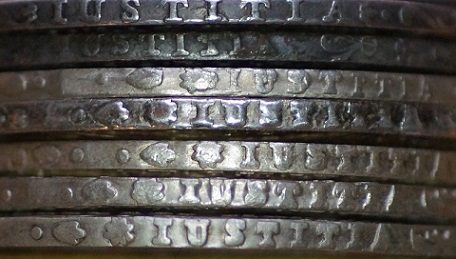 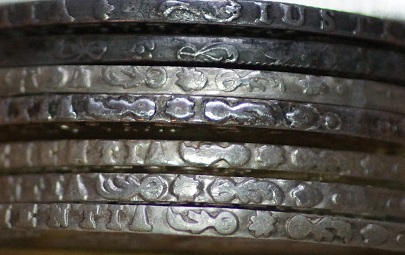 Edited by austrokiwi
02/24/2013 03:37 am
|
|
Pillar of the Community
2087 Posts |
Getting a range of known date edges is easier than for the other two sides of the coins. the counter-stamps too often obliterate details Archraz you wanted to look at the claws. Of the coin edges posted only three can give information on the claws 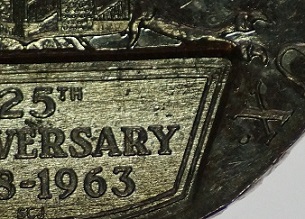 Next one is Melwacks 1980 counter-mark 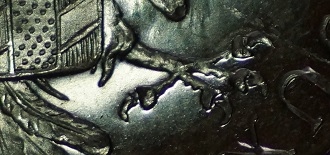 And then the 1995 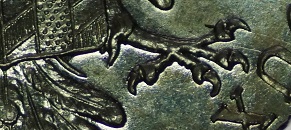 Edited by austrokiwi
02/24/2013 04:18 am
|
|
Pillar of the Community
United States
3499 Posts |
austrokiwi- Thanks! Your images are of great help. I am quite surprised to see that the 1963-struck coin seems to have long claws. Does this mean that the claw length varied from die to die since the 1960s? If so, that does raise the question as to why this is the case. Is it possible that longer claws were standard for a period, and then shorter claws were more common for a number of years, and then longer claws were later common again? In sum, I do think that claw length is a variation of note in the overall design of the coin.
|
|
Pillar of the Community
2087 Posts |
Wow what a hard question to answer. for the 18th early 19th century the answer would be easy as each die was hand cut ( although there was some uniformity created by the use of Piece punches for the main design elements. the rest of this is thinking as I write. The modern die making techniques first involved a large positive plaster( or similarly suitable material) model of the coins face which is then placed in a reduction machine. That reduction machine then cut the reduced reverse image into the die. in the later part of the 20th century Plaster was replaced with an Electrotype ( to make the model.) In the 18th century dies would a best last for 25000-50000 strikes and then new dies would be cut by . In the 20th century you a looking at well over 100,000 strikes before the die needs to be replaced. That brings us back to the model used to cut the dies.....If plaster I am sure it was not overly durable and after a while a new model would need to be made this would see a set frequency of minor changes in form occurring. However an electro type would last even longer ( creating more uniformity for longer periods of time. So there would still be variations but we would see them less and less frequently. So in answer to the question we see variations so they must have occurred how frequently and when is much harder to track. Those variations would be simply a result of the medalists slight variation from the norm. Yes claw length may be a variation but with restike post 1960s MTT it is IMHO a lot less important than those seen pre 1960s which are also less important than the pre 1853 restrikes.
|
|
Pillar of the Community
United States
3499 Posts |
austrokiwi- Thanks for the input. This in indeed a rather frustrating but fascinating conundrum. I was under the assumption that very modern MTTs had the long claws, but most that I own actually have short talons. In fact, the proof coin that I posted at the start of this thread has short. So I just wonder if there are any other ways to address this question. *scratches head*
|
|
Pillar of the Community
2087 Posts |
Archraz you might want to get a hold of Walter Hafners book the lexicon of the MAria Theresa thaler. MY research has made some of the attributions in that book look very questionable( but only for a very few varieties) but still there is nothing better. It is still available here in Vienna ( last time I looked it cost aprox €21.00)
Edited by austrokiwi
02/27/2013 02:44 am
|
|
Pillar of the Community
United States
3499 Posts |
austrokiwi- I actually just got ahold of a copy of Clara Semple's 2007 monograph, "A Silver Legend: The Story of the Maria Theresa Thaler."Do you have any thoughts on this particular book? I'm just wondering how it compares to Hafner's work in terms of information pertaining to thaler varieties.
|
| |
Replies: 416 / Views: 99,890 |








 First Page
 Previous Page


 Posted 02/20/2013 09:17 am