| Author |
 Replies: 416 / Views: 99,888 Replies: 416 / Views: 99,888 |
|
|
|
Pillar of the Community
Hong Kong
1270 Posts |
IMHO, I think an error coin cannot be regarded as a variety because the number of coins produced for this type must be very less so it is meaningless to make a classification of it.
autrokiwi, your coin is awesome, it must be very expensive for the reason of rarity. I think your coin was from a die at the same time frame of my MTT and Archraz's MTT because the difference between all the three MTT is very small. The font of your MTT is close to Archraz's so maybe your coin was struck first and was recognized as an error, Archraz's coin was then struck after the die amendment. My coin may be struck before or after you and Archraz's. Probably, all three are belonged to same catagory.
autroskiwi, can you tell me the number of dots in the eagle's beak?
|
|
Pillar of the Community
2087 Posts |
Wonghinghi I was actually thinking yours was struck first simply because the quality of the Font and the well formed and struck letters suggested to me that it was more likely to be first and the less well formed letters were a later strike. in the left beak there are 9 dots ( possibly eight as the ninth is very faint)
|
|
Pillar of the Community
 United States
3499 Posts |
austrokiwi- This is proving to be a very interesting thread that is really getting me more and more into this wonderful coin series.
I do have another question about modern MTTs. Nowadays these coins are still sold and produced by the Austrian Mint, but are these mainly just tourist pieces that are available directly from the mint, or are they still produced as trade bullion? Do they still circulate anywhere on earth as a part of daily transactions?
|
|
Pillar of the Community
2087 Posts |
HI
I think in the main the current strikings are really now just out of nostalgia. I was talking with one academic ( I just can't recall his name) at the Vienna University Numismatic institute who was clearly of the opinion the striking of the Silver Philhamoniker was the real end of the MTT.
As for does the coin still circulate any where in the world Word in the African studies department is that in Bornu ( Top end of Nigeria ( I think) the MTT though not legal tender is still used in every day transactions. Interestingly it is reported they only accept shiny new MTT: Hence the use of the phrase " in the main" above. I suspect it is still used in the more rural regions of Ethiopia and Somalia ( last documented use in Ethiopia was 1982) and possibly Yemen. The last country to demonetize the MTT was Oman in 1971. It is possible that in the inland regions of Oman the coin is still used. The reason I say this is that typically the Ruppee was used in Coastal areas while inland away from the main population centers the MTT was used
|
|
Pillar of the Community
Hong Kong
1270 Posts |
Clearly the proof at 1980s MTT are struck for souvenir with some premium above silver price, I suppose. Remember 1980 is the 200 anniversaries of Maria Theresia's death.
|
|
Pillar of the Community
Hong Kong
1270 Posts |
Austrokiwi, I find a feature that can be used to identify a post-1960s MTT pieces. The edge letters of 1960s or 1980s MTT are all in inverted position when compared with those older MTT pieces. See the following pictures. I think this is a 1960s or post-1960 piece 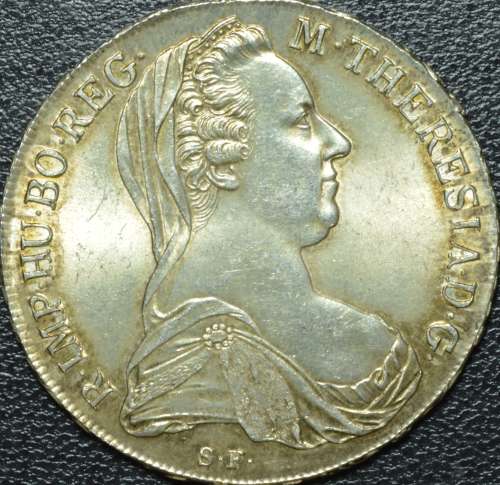 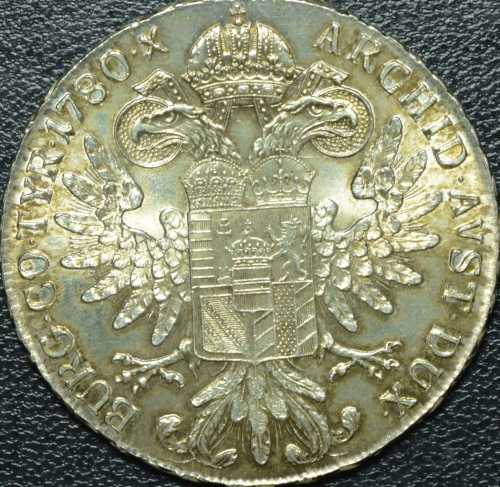    The edge letters are struck in this direction, which is in opposite to that of those older MTT pieces. 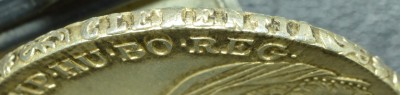 Below is a post-1865 piece. 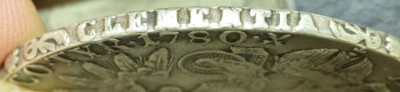 |
|
Pillar of the Community
2087 Posts |
If I understand you correctly I am unfortunately going to recount a discussion I had a few years ago with another MTT collector. That collector thought you could define differences in the edge to face orientation of MTT unfortunately for most of the last 200+ years the edge is struck on the blank and then the blanks are loaded into the Actual minting press as a result the edge orientation ends up being random. The only exception to this rule is pre 1930s when Vienna mint used a minting technique that saw all three sides struck at once. I also understand that yours is more likely pre 1960s simply because the edge is so well formed (Not as good as the 19th century but better than post 1960. Post 1960 coins have heavy blurred edges I suspect that the post 1960s strikes were struck in a collar and that is the cause of the blurring: Now I have a question that hopefully someone can help with. Sometime in the last 2-3 years I read an article about the US gold confiscation and the allowance for ownership by collectors. I recall the article noted that gold reproductions(ie: restrikes) of earlier European gold coins were specifically banned by US customs ( or was it secret service) circa 1935. I gained the impression that to get round the gold ownership ban some collectors had been importing European gold restrikes ( such as Netherlands Ducats, Austrian 1 and 4 Ducats etc. However I noted the wording of the ban was that it was gold copies of gold coins what the rule didn't ban was the importation of gold copies of earlier dated silver coins. Can any one recall reading that article and can refer me to it ( May have been World coins, the numismatist, or KP publications news letter? The reason I ask is in 1937 in Switzerland 300 Gold Abschlag ( there is no comparable English Word) of MTT were produced for the American market. I think many of you will see the importance of the question as it would be nice to confirm the gold Abschlag was a gold ownership ban avoidance method. The coins were 900 standard gold, 42mm and weighed 73.04 grams. Here is low res photos of the one I own: 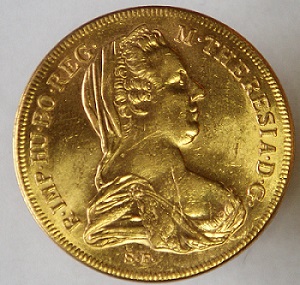 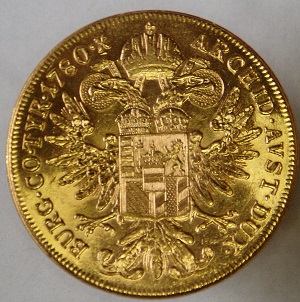 The coins were supposed to have the standard MTT edge but early on in the minting run the edging equipment failed so most of the mintage has a blank edge. Mine has the blank edge. Its a heavy impressive lump of metal!! It would be brilliant if someone knows which article I am referring to. Edited by austrokiwi
01/30/2013 08:49 am
|
|
Pillar of the Community
United States
3499 Posts |
Hi everyone, so just today I acquired two more MTTs. I believe that the first one is a London mint thaler since it has a 1-2-1 tail feather formation and is 39mm. However, I am not certain as to the Hafner number. What is the number for London mint MTTs? The second coin appears to be minted in Austria due to the tail formation as well as the dots in the central shield on the reverse. But I'm not sure as to when it was minted. Since the eagle has shorter claws and is 40mm, I suspect that it might be Hafner 61a and was minted 1960-86. Might this be the case? Thanks! 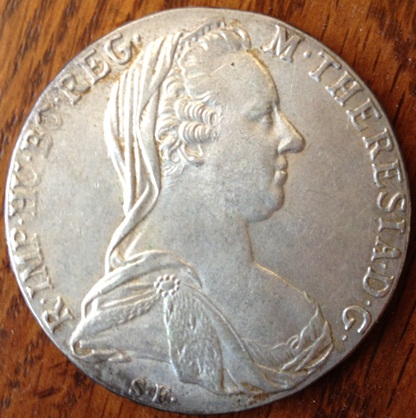 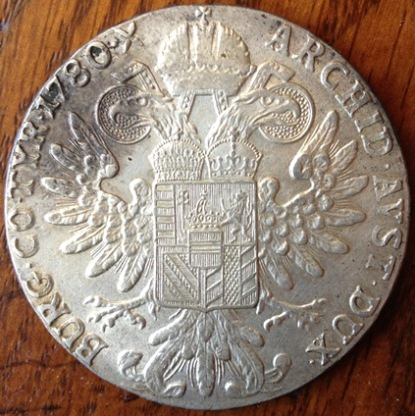 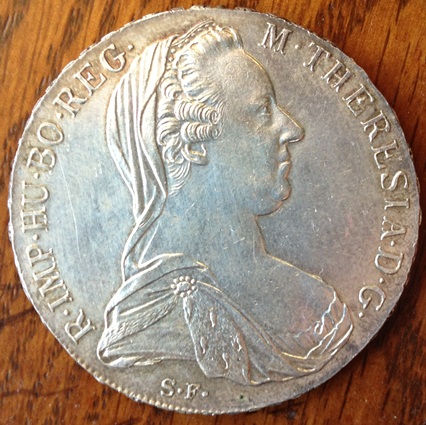 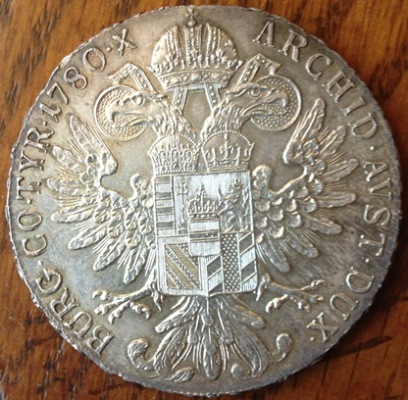 Edited by Archraz
02/19/2013 6:27 pm
|
|
Pillar of the Community
United Kingdom
2490 Posts |
Austrokiwi, if it's a specific article you're seeking try the Numismatic Bibliomania Society. They have a magazine, The E-Sylum which reaches a world wide audience of numismatic bibliophiles, mostly with very long memories. https://archives.binhost.com/lists/listinfo/esylum
|
|
Pillar of the Community
United States
3499 Posts |
Also, here are some edge pictures that may help with identifying the second coin that I posted above. In each of these images the coin on top is a Hafner #62 (which is from 1986-persent), and the lower coin is the second coin that I have posted above. As you will notice, the MTT in question has edge lettering and arabesques that are much bolder and seemingly malformed than the edging of the Hafner #62 coin. Thanks!   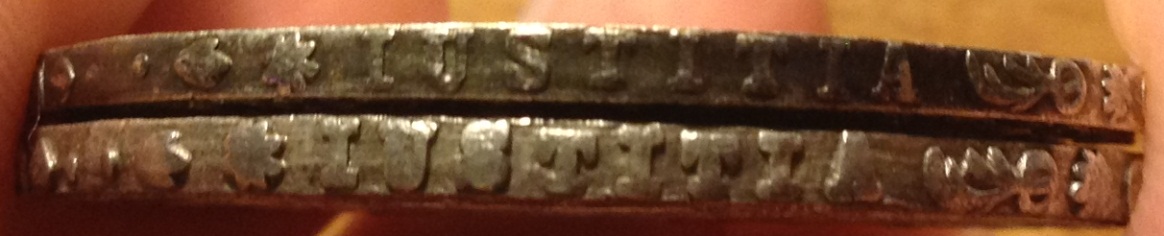 |
|
Pillar of the Community
2087 Posts |
ON the london mint coin. I am still wanting to Assess a group of these with XRF. Your coin looks like a true london mint strike except the Letter M is thick and heavy almost like that expected on an Indian minted MTT ( Used London mint dies) As yet I have suspicions about the identifiers but am not satisfied the the Currently accepted ones ( hence XRF). With the edges All I can say is the top coin is most likely older than the second. The Heavy bold and blurred letters on the bottom coin are typical of post 1960s strikes. Post 2000 strikes are even worse!!!
|
|
Pillar of the Community
United States
3499 Posts |
austrokiwi- Thanks for the input! I must say that I'm a bit surprised that the bottom coin in the edge pictures seems as though it would be the more recent of the two. Frankly, based upon other details, it seems like the top coin is from the last decade or so.
|
|
Pillar of the Community
2087 Posts |
I can understand the surprise. I have to admit that I know less about the MTT than when I started collecting the coin nearly 10 years ago! What I can say for sure is I know a lot more about what I don't know!!. The most modern MTT in my collection should explain why I think the bottom coin is the more recent example. Its an edge error coin dating to 2003 - 2004. Some one in the Vienna mint installed one of the edge irons (dies) upside down. In the photo below you can see the tail end of CLEMENTIA if you were able to see more of the edge to the right the next script you would see would be an upside down "ET" Normally you would expect to see a right side up "JUSTITIA" Of course the error is interesting but more importantly; as this error can be narrowed down to a couple of years it is a very good reference coin. The coin is actually a very high MS grade but the edge is abysmal!.....not from wear but rather that is how the edge came out of the mint. I suspect ( Because it would be very easy to confirm I haven't done so yet. Partly for the silly reason that I have been researching more interesting puzzles) that modern examples have been struck in a blank collar, this would see the coin expanding as it was struck and the edge detail would end up being squashed by the collar. I do know for sure that the Vienna mint strikes the edges first.  I hope the photo shows my logic. Generally the older a MS MTT is the better the edge definition and execution. Edited by austrokiwi
02/20/2013 03:39 am
|
|
Pillar of the Community
2087 Posts |
Here is the reverse of that 2003/2004 edge error. The photo just doesn't do justice to the mint bloom evident on the coin. Also the two small dots in the center shield are present. 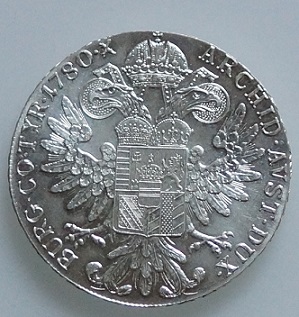 Edited by austrokiwi
02/20/2013 06:15 am
|
|
Pillar of the Community
Hong Kong
1270 Posts |
Compare with my London Mint MTT, I agree with the first coin is also a London Mint spceimen (1936-61).
|
| |
Replies: 416 / Views: 99,888 |








 First Page
 Previous Page


 Posted 01/27/2013 06:29 am


