



Coin Community Family of Web Sites Join Thousands of Coin, Bullion, & Money Collectors
300,000 items to help build your collection! Royal Estate Auctions - $1 Coin AuctionsVancouvers #1 Coin and Paper Money Dealer Royal Canadian Mint products, Canadian, Polish, American, and world coins and banknotes. Join Thousands of Coin, Bullion, & Money Collectors Coin, Banknote and Medal Collectors's Online Mall Specializing in Modern Numismatics


Username:
Password:
Save Password
Forgot your Password?


This page may contain links that result in small commissions to keep this free site up and running.

Welcome Guest! Registering and/or logging in will remove the anchor (bottom) ads. It's Free!

A Madras Rupee - Was It The Model Of Modern British Rupee?

To participate in the forum you must log in or register.
Author Previous TopicReplies: 3 / Views: 1,787Next Topic  
Pillar of the Community
wonghinghi's Avatar
Hong Kong
1270 Posts
 Posted 02/03/2013  05:25 am Show Profile   Bookmark this topic Add wonghinghi to your friends list Get a Link to this Message Number of Subscribers
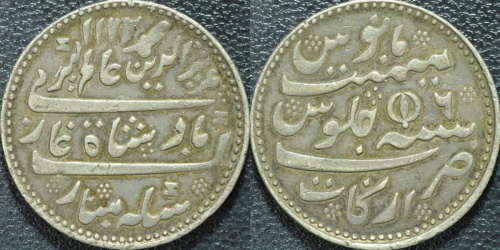
I have studied for a while about this Madras rupee. This (KM#410 probably) is a cheap coin for me; I bought it by US12.80 in 2011 or 2012 but it might be an important rupee to the birth of the modern rupee in 1835 in accordance to "A History of Currency in the British Colonies" by R. Chalmers. I try to bring my points here and see you agree or not.
A-Madras-Rupee---Was-It-The-Model-Of-Modern-British-Rupee?

The mint year of it from World Coin Catalog is AH1172/6 forzen at the reign of Alamgir II (r.1754-1759), AH1172=1759AD. But this coin could not be minted in 1759 because it was definitely machine-struck, the mint year might be some years around 1818 for my guess.

Besides this KM$410 silver rupee, others KM#415.1, 415.2, 427, 436 are of similar appearance but same mint year because the year had been frozen.

According to R. Chalmers in his book (P.338) :"The type chosen for the new Company's rupee of 1835 was the Madras rupee of 1818, weighing 180 grains (11.66 grams), 11/12th fine (91.7% silver finess), and therefore containing 165 grains of fine silver. The weight and fineness of this standard coin have remained unaltered to the present day...

The book: http://archive.org/details/historyo...nc00chaluoft

Could my Madras rupee be struck in 1818? If it was, this should be a very meaningful coin - a structural model for 1835's modernized British rupee. It can't be so cheap if it was really struck in 1818.
Edited by wonghinghi
02/03/2013 05:29 am
New Member
kaubhai's Avatar
United States
28 Posts
 Posted 02/10/2013  02:55 am  Show Profile   Bookmark this reply Add kaubhai to your friends list Get a Link to this Reply
Interesting history... didnt know before.. thanks for posting.
Pillar of the Community
austrokiwi's Avatar
2087 Posts
 Posted 02/10/2013  05:55 am  Show Profile   Bookmark this reply Add austrokiwi to your friends list Get a Link to this Reply

Quote:
But this coin could not be minted in 1759 because it was definitely machine-struck, the mint year might be some years around 1818 for my guess.


I don't know that much about India minting technology, and I agree the coin looks as if it was struck using a modern press. However I am conscious that in Europe from the 1600's Coins were "Milled" meaning struck by machine, accordingly it seems to me it is possible that machines were used to strike coins in the 1750s India. That said the coin does look as if it has been struck by a much more modern press( Boltons type at the earliest) so really I am just discussing semantics.
Pillar of the Community
wonghinghi's Avatar
Hong Kong
1270 Posts
 Posted 02/11/2013  08:48 am  Show Profile   Bookmark this reply Add wonghinghi to your friends list Get a Link to this Reply
Not until 1758, British rule never held firmly on the Indian colonies. Prior to 1835, there are 3 main types of rupees producted by British, they are Sicca rupee in Bengal, the Surat rupee in Bombay and the Arcot rupee in Madras. The mints were believed to come across same development pace in minting technique. According to "The Coins of the Bengal Presidency" by Dr Paul Stevens, 'it was not until 1802 that this part of the process (production of silver blanks) was executed with machinery.' The book stated that most of the major minting processes started using machines at the start of 19th Century in Calcutta.

By this rationale, I will tend to believe all other British mints in India started to use machine at the same era.

The Madras rupee shown here had a frozen year in 1759, the edge of this coin is of indented cord minting, it could only be struck in 19th Century by machine rather than in 18th Century. Sadly, the World Coin Catalog can't tell the actual minting year of this coin.
  Previous TopicReplies: 3 / Views: 1,787Next Topic  

To participate in the forum you must log in or register.


Disclaimer: While a tremendous amount of effort goes into ensuring the accuracy of the information contained in this site, Coin Community assumes no liability for errors. Copyright 2005 - 2026 Coin Community Family- all rights reserved worldwide. Use of any images or content on this website without prior written permission of Coin Community or the original lender is strictly prohibited.
Contact Us  |  Advertise Here  |  Privacy Policy / Terms of Use

Coin Community Forum © 2005 - 2026 Coin Community Forums
It took 0.19 seconds to rattle this change. Forums