| Author |
 Replies: 7 / Views: 1,829 Replies: 7 / Views: 1,829 |
|
|
Pillar of the Community
United States
1812 Posts |
|
|
|
|
Pillar of the Community
United States
6429 Posts |
My 1878-CC appears to have the identical looping scratch through the top of the second L in DOLLAR. Other scratches may also line up but I can't seem to get them to image clearly in my photos. Anyway, this shot shows the L scratch. Some others show very faintly but are more clearly visible on the coin. I haven't determined a VAM for my coin so I'd like to know which number you eventually decide. 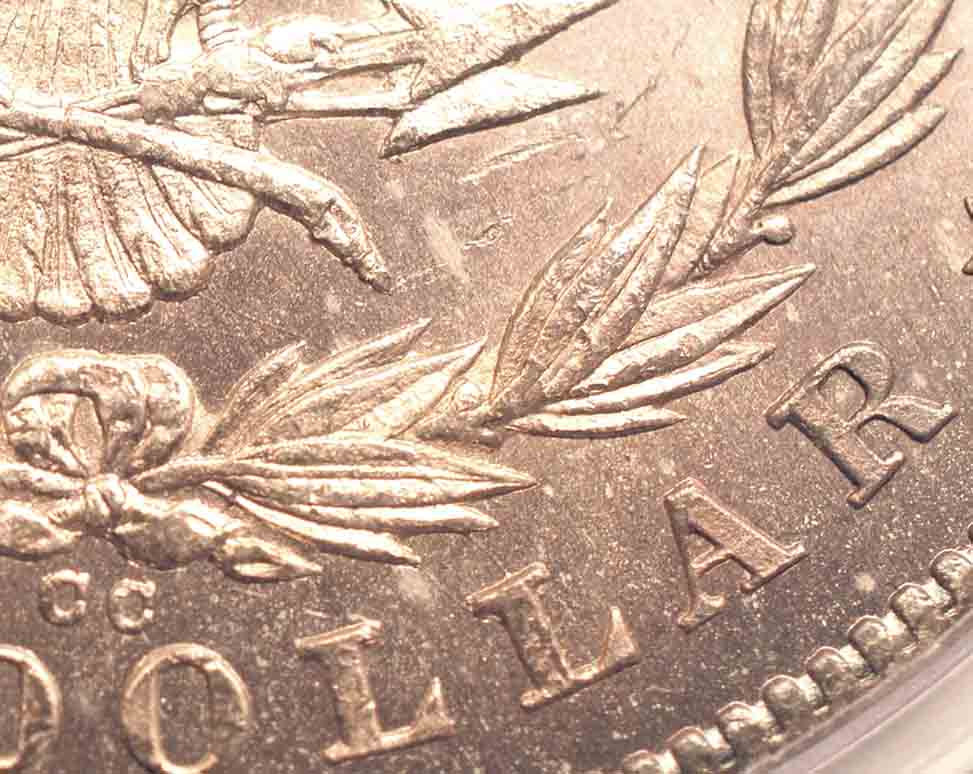 Here are the whole-coin shots for my PCGS MS-61 example: 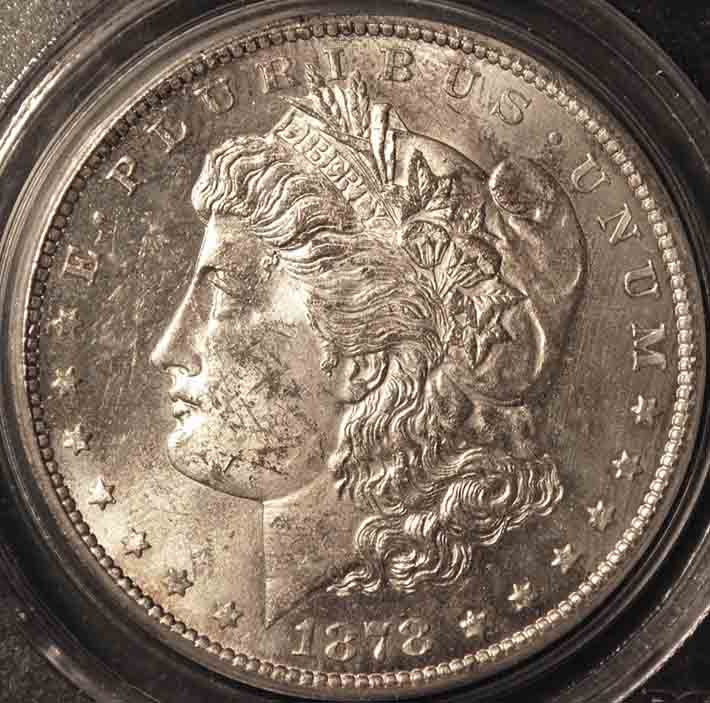 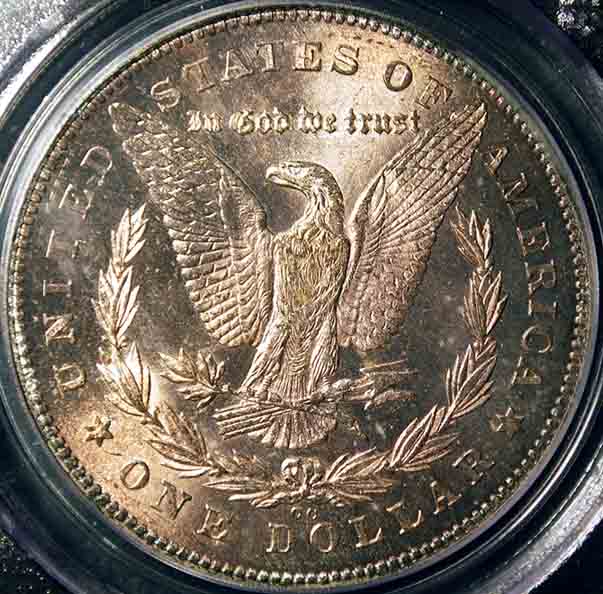 |
|
Pillar of the Community
 United States
1812 Posts |
Did you check the pittng in "IGWT" and the "O" in "OF" on this coin in the 1st thread ?
I zoomed in on your coin and that area looks clean.
Waiting for SsuperDdave to comment on the additional photos and what looks like a double tip on the leaf.
|
|
Pillar of the Community
United States
1812 Posts |
I just checked your photo of the reverse side (with my little tablet) and you may have a earlier die state of the same reverse die I have.
|
|
Moderator
 United States
23522 Posts |
Die scratches such as this aren't too uncommon on Morgans; they're neat but not relevant for attribution, only for completeness of data. Based on the things I suggested you look for in the other thread, we still don't have an attribution nor will we until those two areas are studied.
|
|
Pillar of the Community
United States
1812 Posts |
SsuperDdave, Since I don't know how to highlight and post from previous CCF threads, I use the old copy & paste system I'm used of doing... Below is what I copied from your post on #1 and pasted it here below... "Have a look at your coin for that straight scratch; it'll run from the denticle directly under the right stand of the N, to about 2/3 of the way up the left side of the E." Answer; I did check these areas and found nothing out of the norm... When I added the above photos on this thread, I noticed what looks like either PMD or a doubled flower tip (photos #13 & 14 above), and between that and the mis-shapped "O" in "OF" is not a variety or sub-variety of a known VAM, and yet Wamworld lists varieties so minor, like a small dash under the date on other Morgans, I guess I'll never understand what makes a listed variety and what variety is of no interest... Thanks for taking the time checking this out, and while the above may seem a bit sarcastic on what makes a VAM Number and what doesn't, it is not, and I hope to pick your brain in the near future as I have what I would assume would be VAMs but are not listed as so (ie; eagle has double beak), that I purchased back when Silver Dollars were selling for eight to ten dollars each... |
|
Pillar of the Community
United States
1812 Posts |
 ☼ ☼ SsuperDdave, I didn't realize your post "What is a VAM" was listed above all this time, and had I been somewhat normal, I would have noticed this a year back and saved both you (and I) time, and after finding the link listed in another members thread recently, clicked on it and learned about sub-variety VAMs, and now realize all the die scratch photos here has nothing to do with VAMs in of itself, and now believe the reverse die used that struck this coin was close to the end of it's die life. My next question is; Would the value of this coin struck with late stage dies be worth less then a earlier die with no die scratches, or pitting around "IGWT"? Thanks again for your input.  |
|
Bedrock of the Community
United States
14454 Posts |
I don't think the die stage would matter as far as value unless the die was just about to fall apart or struck a coin after it fell apart (the 1921-D VAM-1X comes to mind) and then the reason is because there are probably only one or two going to be found in that condition. As far as I know the VAM-1X is a 1 of 1 coin
|
| |
Replies: 7 / Views: 1,829 |
|









 Posted 03/12/2013 12:14 am


