| Author |
 Replies: 26 / Views: 3,293 Replies: 26 / Views: 3,293 |
|
Pillar of the Community
United Kingdom
2943 Posts |
This might be worth a debate. What is "rare" when describing a coin. In another thread I posted the following... I think something that appears on the market once every 5 years or so could be considered rare, more frequently.... scarce.... something that you can buy at anytime...common. This is, of course a very broad statement and everyone's opinion will be directed by their collecting area. Being used to ancients (see my thoughts above) will give you a completely different perspective from someone who collects modern money or even NCLT and the like. There, for example, rarity will probably encapsulate "condition" a lot more. There again, as stated in another thread, the importance of condition varies from collecting area to collecting area and from country to country. Europeans tend not to bother with minute variences at the upper end of the scale so condition based rarity is much less a consideration. I remember reading somewhere that grading companies promote this artificial form of rarity as it keeps them in business - perhaps this is true. There is no linear relationship between rarity and value. The relationship is between "desirability" and "availability" and that is how value is determined. I'm sure this has been discussed before but a search of "rare" lists a lot of threads - just like a search of ebay lists just about every coin on it :) |
|
|
|
Pillar of the Community
United Kingdom
856 Posts |
I think rarity can be a slightly fluid concept, but generally I tend to refer to a copy of the Sheldon scale I found some time back. That says:
•R8 = 1-3 known (estimated), 'Unique or Nearly Unique'
•R7 = 4-12 known, 'Extremely Rare'
•R6 = 13-30 known, 'Very Rare'
•R5 = 31-75 known, 'Rare'
•R4 = 76-200 known, 'Very Scarce'
•R3 = 201-500 known, 'Scarce'
•R2 = 501-1250 known, 'Uncommon'
•R1 = over 1251 known, 'Common'
Consequently most of the 'rare' coins I have would be R7 or R8. Oddly, I know, but personally I tend to refer to coins where there are more than 20 known examples as 'scarce', though I don't use either of the terms very often!
Obviously that doesn't account for conditional rarity. There's one particular coin I'm looking for at the moment. I pulled together all the information I had and now have records of 56 examples which have been available to buy at some point, 35 or so in the last year. But none of those coins is what I would call an acceptable example. Hence I'd say it's pretty scarce, or rare in better condition. How rare remains to be established by how long it takes me to find an example I want!
Now I've used the term 'condition' above and you might think I mean 'grade', but with what I collect (hammered coins) the degree to which the coin has been subjected to wear is only part of the picture.
Being individually made coins are also subject to the possibility of having been struck off centre, on an oddly shaped flan (planchet/blank), having jumped between strikes and hence having parts of the design doubled, or on an uneven flan where the design doesn't take as well on the thinner areas and so appears weak.
And that's just production problems! After leaving the mint a coin might be clipped, pierced, 'sweated' (worn down to remove small quantities of metal - in this case silver), unpleasantly toned from how it was stored or badly cleaned after discovery!
So what I'm looking for in a coin is not just less than average wear but 'eye appeal'. In other words, do the sum of its good points outweigh the flaws? And as mentioned above, that can make a commonly encountered coin in top condition very rare indeed.
The interesting thing for me is that (at least in my area) 'appeal' (and hence whether a coin is desirable and so to the collector rarer than average) can vary. I can use three decent collections for example. In one the collector was particularly keen on 'oddities'; legend variations, striking errors or overmarks and clearly sought these out.
In another all the coins were decent examples but the most striking thing was all were on very full, round flans - clearly something he preferred.
And the final collection, all the coins are good VF or better with minimal wear visible anywhere. But the number of odd shaped flans and weak patches where the design wasn't properly struck up makes many of those coins less attractive to me.
I'm sure in each case, the collectors would have been prepared to pay a premium for coins they found met their criteria. And so it might be considered that those examples were rarer as it is clear each strove to build the best collection they could.
But what was desirable (and potentially 'rare') to one was not always so to another. I guess that's another thing I like about the coins I collect. They are as individual as the tastes of those that collect them.
(Sorry if I've gone off track a bit there Bacchus! But I find 'what makes a coin desirable' a most interesting subject!
|
|
Pillar of the Community
United States
3486 Posts |
To add a complementary explanation to the one given by Tom, the following description for Barber dimes is offered: 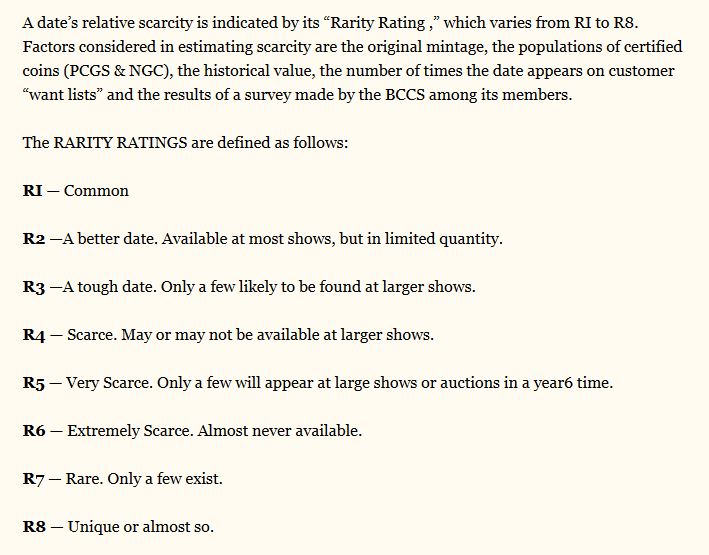 What this adds is the concept of availability to the rating of absolute scarcity. To address the concept of "condition rarity " a breakdown by individual dates can be assembled: 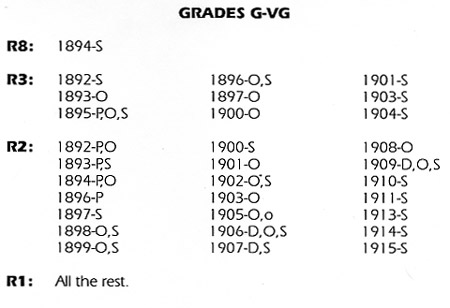 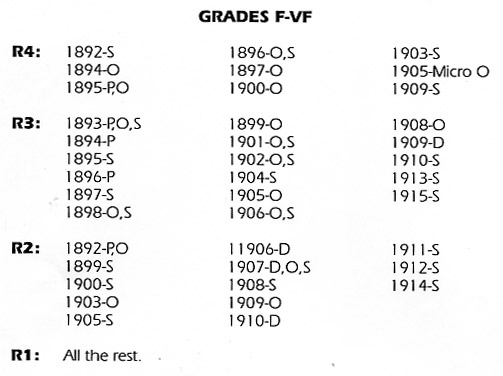 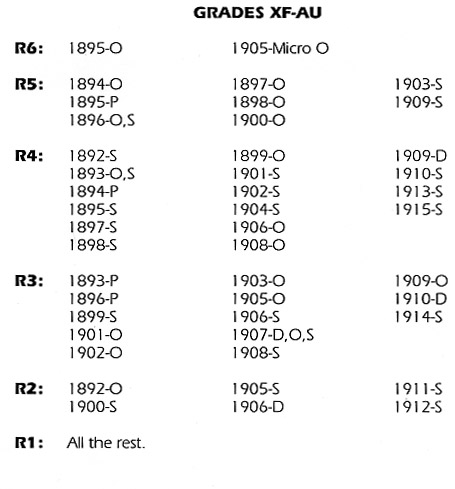 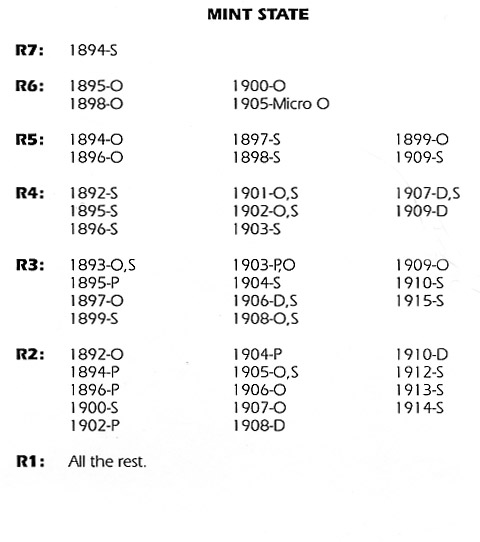 What is much more difficult to assess is the rarity/accessibility of a coin that has riveting eye appeal. Tom has touched upon this and I totally agree. Whatever our area of interest, serious collectors define each ones' criteria for eye appeal. In my example, a complete set (74) of Barber dimes in Fine to AU WITH EYE APPEAL remains an ongoing quest. As it stands currently, my set draws attention from dealers and collectors alike when I display it. To reach this state of affairs, I spent what was needed to obtain those examples which were of outstanding overall appeal as well as high grade. Tom touched upon this point as well. Where we must part ways is the problem of using this Sheldon Scale to ancient coins. To establish the data provided required the combined efforts of a specialist and collectors who used their own collections to create the population reports. Perhaps the challenge would be for collectors of ancient coins to do the same. Under the auspices of an organization or maybe here on the CCF. Something to think about. I hope that my contribution adds positively to the "debate!" |
|
Pillar of the Community
 United Kingdom
2943 Posts |
I think we are all in broad agreement and I seem to have used the word condition rather than grade sub conconsiously because I really think about "eye-appeal" rather than some other imposed criteria. Again, because my background is more with ancients (ie, man made) I consider eye appeal to be how a coin was struck up - and I guess collectors of modern coins consider eye appeal to be a factor of how much a coin has worn down.
That Sheldon scale does bear close resemblance (broadly speaking) to the works relating to ancients rarity - there are quite a few so I think a lot of work in this area has been done. In my own book I shied away from indicating rarity because it was such a niche field (a bit like Tom's) where most coin types were limited to under 100 known and it only takes a horad find to completely upset the availability. I believe a similar analogy could be made to the cashe of Carson City morgans which were released into "the wild".
That must be an impressive set of dimes!
|
|
Pillar of the Community
United Kingdom
856 Posts |
Quote:
I consider eye appeal to be how a coin was struck up - and I guess collectors of modern coins consider eye appeal to be a factor of how much a coin has worn down. I think this is a good point. With modern coins we can see near perfect examples as they were designed to be. OK, not always of that date or mint, but an example of most designs can be found with which we can compare our coin (or one we might buy) to assess how much damage (wear) there is to reduce it from 'perfection'. With older coins, if we're lucky, we might have access to the best known examples (or photos), but there's still variation which is where 'eye appeal' comes in. Sometimes it's frustratingly difficult to find a nice example, even when actual numbers of coins available are relatively large! And of course, the reverse is true in that some series are generally well struck/preserved making it possible for pretty much everyone that wants one to have a reasonable example. So if there are sufficient coins to satisfy the market, even though the number available is small ... maybe rarity is less of a factor. |
|
Pillar of the Community
United Kingdom
2943 Posts |
This reminds me of the Elizabeth I series of silver. Nearly all examples you see for sale have a very poor bust - I think through a combination of wear and being poorly struck in the first place. To have a smashing example both those factors need to be kind - eye appeal again.
I have a good number of Diadumenian provincials from places such as Aelia Capitolina, Byblus, Berytos, Edessa and other eastern "Greek" city states that are all in terrible condition - but there just aren't any in decent condition so we work with what we have - condition can't be an issue above and beyond attribution. For some examples no-one knows what the correct legends should be. In these cases - are they rare, absolutely. Are they desirable - yes, to me and perhaps a few others only. Are they valuable - that depends on how much someone is prepared to bid if it's an auction - really an unknown for a lot of the time. It seems that you are in a similar position with your Charles collection.
|
|
Bedrock of the Community
United States
20753 Posts |
For me rare is in coinage, one that is not in my collection.  So many place numbers, letters, names on a coin or object that is really expensive or almost impossible to acquire. In reality I just consider RARE in coins to be anything less than a few hundred either minted or supposed to still be in existance. The real problem with placing a number of existing anything, is that the population on Earth is growing massively. A coin, for example, of a few million minted a hundred years ago, wouldn't be rare at all back then. Today, with so many Billions of people on Earth, such coins become rarer and rarer. And a coin that is the only one in existance becomes insanely rare now. |
|
Bedrock of the Community
13014 Posts |
Quote:
I remember reading somewhere that grading companies promote this artificial form of rarity as it keeps them in business - perhaps this is true. I would say yes and no. Obviously they deal in grading things that does create condition rarities and that keeps them in business. However I dont think its them exploiting anything or even adding an element that wasnt there. As a buyer youre always trying to talk the price down where a seller is trying to talk it up. Condition is one of the most common negotiating aspects for that. The grading companies are more an an independent arbitrator that kind of sets the terms of how much wiggle room there will be. Youll still be able to move the price some either way but no one is going to pay MS67 money for a coin in an MS64 slab for instance but like you likely wont be able to pay MS64 money for a coin in a MS67 slab. The one exception to that would probably be things that are both a rarity and a market rarity. We all know being rare doesn't mean valuable, being market rare usually adds a premium since its popular, but if you get something rare that usually doesn't see the market all price guidelines go out the window. |
|
Pillar of the Community
United Kingdom
856 Posts |
Quote:
You'll still be able to move the price some either way but no one is going to pay MS67 money for a coin in an MS64 slab for instance but like you likely wont be able to pay MS64 money for a coin in a MS67 slab. Just out of interest I searched for pics of an MS64 and MS67 coin for comparison. I found two 1880 dollars, both graded by PCGS and I'm afraid, to my 'British' eyes ... I couldn't see a difference. Well, OK, I could. The MS64 looked nicer! But that might just have been a whim of the photographs. Not sure if this is an example of Bacchus' "Europeans tend not to bother with minute variences at the upper end of the scale" or .. I just don't have an eye for the subtleties yet! But I suspect there are differences in the US and (at least) UK markets which mean that, although our scales of absolute rarity may be similar, when we assess coins there may be (possible subtle) differences in what makes a coin particularly desirable, or not. |
|
Pillar of the Community
United States
3486 Posts |
Ha! My American eyes cannot see a difference either. Bacchus2, Yes, my dimes are my babies. I did not mean to suggest in any way that the Sheldon Scale could not be used. Only that it be tailored to the special requirements for measuring ancients. The Carson City dollars do not compare to a cache of 100 ancient coins, for these, the CCs, were stored in $1000 bags in vaults and much less exposed to the elements. Compare a cache of Roman coins found in Britain with a cache of the same coins found in Egypt. Which environment would have been "kinder" to the coins? A further exploration of eye appeal, and I apologize for relying upon the modern Barber coins. David Lawrence, in his book, goes on to cover each date and mint. Along the way he made comments such as : Poorly struck with lackluster surfaces Comes well struck with nice luster Good strike ... Sharply struck ... Typical ... Fairly well struck ... A decent strike ... Often poorly struck ... But wait, we are not talking about eye appeal yet: this is all about the mint's equipment! Would a favored city in ancient Rome receive better equipment than a city in a far-flung province? I do not know, so tell me please. But strike is much more objective than eye appeal. Still, could not folks such as yourselves not categorize your holdings into such an objective category? True, with so few surviving examples in many cases it would be a challenge. But I say, "TRY!" (Or at least, give it some thought.) Tom, "Sometimes it's frustratingly difficult to find a nice example..." Only SOMETIMES? ALWAYS! Be it "modern" or ancients coins, we who know a particular series of coins understand just how difficult certain examples can be to find. Now, Bacchus2 and Tom, I want both of you to take a deep breath and to realize that both of you have knowledge to document and to share. Bacchus2 says: " In my own book I shied away from indicating rarity because it was such a niche field (a bit like Tom's) where most coin types were limited to under 100 known and it only takes a horad find to completely upset the availability." I respond: "NO! DO NOT SHY AWAY! Write what you know." Other ancient collectors will appreciate your opinions. Look, Gents, I have been most forward to presume upon you your indulgence in commenting about ancient coins. Until now I have had to admire from afar. But now I see that we share a similar frustration, and to such an end as we may all learn from each other I offer my humble observations. (Imagine - the topic of 'demand' has yet to be adressed in this debate. That will open another can of worms [as we say in the Colonies!] "The one exception to that would probably be things that are both a rarity and a market rarity. We all know being rare doesn't mean valuable, being market rare usually adds a premium since its popular, but if you get something rare that usually doesn't see the market all price guidelines go out the window." SO TRUE! Great discussion. |
|
Pillar of the Community
United Kingdom
2943 Posts |
Hi Matthew.
I think my difficulty arose in that nearly everything in that particular niche area could be described as rare - ie less than 100 examples known. When fiddling around with very small numbers such as these the only thing to be certain of is that I'd be wrong. There is not that much difference between 20 and 50 examples known when only so much is sold openly or is held in museums - the rest just doesn't pass through the obvious venues - I sure I've missed some of those too! And again - there is probably only about 50 people in the world at all interested (judging by book sales anyway :) ) - so one each.
If we stay on ancients for a second (more so than with medieval hammered) there is another factor to be taken into account - beyond striking, centering and presevation and that is the die engravors ability. There probably wasn't much difference in the facilities available in Rome and in the outflung stretches of the empire - A big hammer would cover most of it - but there certainly was a difference in the availability of good craftsmen to design and cut the dies in the first place.
At different times coins were either minted centrally where this wasn't an issue or deligated to outposts (again depending on Imperial or Provincial type coingae - and the general problem would be true for Greek or any other big empire). So some collectors look at the quality of the die used in striking the coin and will only collect high quality ones - which reverts back to eye appeal again.
There seems to be more of a cross over between art and coinage when considering the ancient world than is true for more modern times so rarity can also encapsulate, strike, centering, presevation and die quality (some Greek ones are signed). This is why I think it's so difficult to put a grade or a number on an ancient (or medieval) - just too many possible varients from a perfect norm.
So someones concept of rarity is certainly a product of how deep they want to delve into a particular area. Lets say I want a Charles 1 shilling - are they rare - no. But I want a Charles 1 shilling with full flan and strike, and I want it for under £50. Is that rare - again, the coin isn't rare it's only my tight-walletness that is the problem - so my preception is that it is rare. So I drop my price restriction and hey presto - they are obtainable again.
After all that I suspect that 95% of rare coins aren't rare at all if you have deep pockets.
|
|
Pillar of the Community
United Kingdom
856 Posts |
Quote:
After all that I suspect that 95% of rare coins aren't rare at all if you have deep pockets. And connections, whether other collectors or dealers. Because the more specialised the area of collecting, probably the fewer collectors and as we all probably know, collectors vary. Some are keen to talk to others while some play everything very close to their chests. Hence it can be very difficult to know if a coin is very rare, if most examples are in long term private collections, or if they are out there unrecognised in more generalised collections. So having others keep an eye out for coins for you can be a distinct advantage. Unless of course they have competing interests! Personally, while most of my coins were from dealers or ebay, some of the rarest were via private treaty from other collectors. One coin has passed through two other collectors and a dealer, but hasn't been on the open market since the 1970s and is now unlikely to unless I can find an upgrade! For someone that wants one and doesn't know me, it may as well have disappeared off the face of the Earth! I'm not sure about 95% since there are undoubtedly some coins that really don't exist in any significant number either through loss (in my field it has to be remembered that we have had two recoinages, primarily in 1696 but also 1816, when old (including hammered) coins were called in and melted down for restriking) or experimentation (some varieties of Charles I coinage seem to have only been struck from one or two dies, though why is unclear). But experience has shown me that scarce/rare coins I'd not expected to see do turn up eventually, so I agree, if you are known to have a specialised interest and the money to fund it, you're more likely to be offered coins that others won't see. And of course, technology is still advancing. I'd guess 20, 30 years ago many coins found were larger denominations, discovered during farming or building excavations. But look on ebay and it's amazing to see the number of tiny silver farthings, halfpennies and cut fractions. Almost all because of metal detectorists and their ever fancier machines! So what in some cases was scarce, or at least not common, has become almost commonplace. Though of course, some previously unknown varieties have come to light as well, making it hard to be absolute about 'rarity' even with the benefits of the internet and learned journals and museum collections being viewable online. Good thread (despite my slightly rambling posts!) |
|
Bedrock of the Community
13014 Posts |
Quote:
But I suspect there are differences in the US and (at least) UK markets which mean that, although our scales of absolute rarity may be similar, when we assess coins there may be (possible subtle) differences in what makes a coin particularly desirable, or not. I think there definitely are differences in the market for what is considered deseriable. Even within a single market different people have different like. Some like toning some don't, some people don't care if a coins been cleaned if it looks better ect. The differences with the high ms coins are really small especially to someone not used to looking for them which to me is one of the greatest values of the grading companies for new collectors. Even with seasoned ones there can be huge jumps in price between grades were if you buy a coin on the higher end of the jump raw you may not get that money back if time came to sell. Having it graded at least protects that price for the most part. It also creates another type of rarity in grade rarity. Something may not be rare at all but scare in the higher grades. Depending the coin that can lead to huge premiums and maybe a small market, but it seems those grade rarity coins usually don't have to much of a problem selling. In a way it plays into competitive nature of everyone wants the best or wants to find a way to get more for the item they have. To me grade rarity and mintage rarity are the real things that make something rare. You can't go back and mint more coins from the 1800 or undo circulation on coins but a market could change where people lose interest and those market rarity coins are no long rare. |
|
Pillar of the Community
United Kingdom
2943 Posts |
That's a very good point - about some of the choicest examples not apparing on the open market - I know this to be true too because that's how I obtained some of mine. Just letting it be knownto a circle of the right people what your interests / goals are can bring to light those examples. Toning is another aspect that I hadn't considered thus far, but you are right - that's another factor - closely related to preservation but still another factor in eye appeal. For ancients that would translate to patina and the soil type that the coin was buried in. And, absolutely, metal detectorists (particually in the Balkans and near east for me) have greatly influenced what is currently available. I can understand the thrill of the hunt for those interested in slabbing coins - that is, find a good raw one and slab that for a profit. Possibly, on this side of the Atlantic, that same thrill can be found looking for rare varieties in some of the older coins. I don't think there are many cheap US coins available for, say, before 1800, (I may be wrong) but there are lots and lots of coins that old to be obtained here very reasonably - maybe that's where the knowledge and "treasure hunter" elements come to the fore. Different cultures hunt for the "rarity" in different places. |
|
Bedrock of the Community
13014 Posts |
I think the slabbing trend will make its way world wide as were already starting to see more world coins in them even if its for no other reason to authenticate them. Maybe well see some tweeks in the grading systems depending on location. I've been seeing a lot more ancients in them too, NGC seems to have gotten that market moving. You guys definitely have a much longer history of coins that can be sought after. As far as I know you can get 1700 coins on the cheap sometimes but they won't be in good shape. I'm sure you can get a lot better for the same price. That could also be why we nit pick more since we only have a couple hundred years of coin history. You guys have a few thousand counting the romans and with a smaller country and that many different coins I'd imagine most things are probably not too difficult to track down. Then again with the internet most stuff isn't to hard to track down anyway. The internet and more specially ebay seems to have really brought transparacy to what really is rare and what someones just blowing smoke about. |
|
Pillar of the Community
United Kingdom
2943 Posts |
We are certainly lucky to have a long history to pick from (or dig up) - that's for sure. I'm not so sure TPG will make that much headway here - not in the short term anyway. It might be interesting to do a straw poll on here and canvas opinions, though perhaps this has been done before. Nearly every collector of ancients I know like to physically handle their coins - and if they have to buy a slabbed one, will crack it out. You should have a perusal at some of the discussions on the Forvm ancient coins site - very, very anti slab and mostly folks from the US too. For high value coins - that's more likely if only for protection, but for middle of the road coins, perhaps less likely. |
| |
Replies: 26 / Views: 3,293 |
To participate in the forum you must log in or register.
Disclaimer: While a tremendous amount of effort goes into ensuring the accuracy of the information contained in this site, Coin Community assumes no liability for errors. Copyright 2005 - 2026 Coin Community Family- all rights reserved worldwide. Use of any images or content on this website without prior written permission of Coin Community or the original lender is strictly prohibited.
Contact Us | Advertise Here | Privacy Policy / Terms of Use
|
| Coin Community Forum |
© 2005 - 2026 Coin Community Forums |
| It took 0.78 seconds to rattle this change. |
 |
|







 Posted 05/08/2013 06:57 am


