Here are some tips to help you work out Chinese coins.
1. Work out which way is up. As I said yesterday, this seller has a problem with this. After a while, you will get the feel for how Chinese characters are supposed to look, but until then, here's a general rule: we Westerners are taught that, when trying to figure out which way up a coin with Arabic script is supposed to be, imagine water falling "down" from the top of the coin, then hold it so that it "catches the most water" - all the bowl and cup-shaped letters should have their bowls facing upwards. For coins with Chinese script, it is the opposite: the letters should be like little Chinese houses, with the water hitting the roof and flowing off to the sides rather than being trapped inside in large pools. This picture might help illustrate this principle:
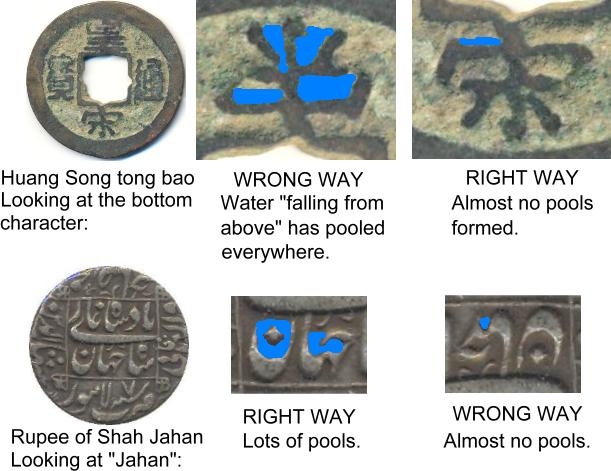
Alternatively, the character on the left side of Chinese coins is almost always the same character - "bao", meaning "coin" or "money". Almost every single cash coin produced since the AD 600s has this character in this position. Find the bao, and you'll know which way is up.
2. Working out a very approximate dateUsing ID sites like zeno.ro or the site Sander linked to above doesn't help much if you have no idea when, in the 2000 year history of Chinese cash coins, your coin might have been made. You could randomly flip for hours, or start at one end and work through until you find it... but there are some shortcuts to help you narrow down your search.
First, what is on the reverse? If there are two squiggly, almost-Arabic-looking characters, this is Manchu script and your coin is Qing Dynasty, no earlier than the 1600s. If it is blank, then the coin is either Vietnamese or Ming Dynasty China or earlier - most likely Song Dynasty, since their coins are extremely common. If there are rainbow-shaped wavy lines, then the coin is Japanese. If it is a drawing or picture, then the coin is a charm and not an actual coin. If there are Chinese characters, then things gets complicated: the coin might be Vietnamese, or Korean, or Japanese, or Qing, or Taiping Rebellion, or any of several other possibilities.
Second, look at the script - the "font" used to draw the writing. "Classical" Chinese characters like on the coin I depicted above are used from the Tang Dynasty (AD 600) onwards, while the "seal script" seen on earlier coins disappears from the Yuan (Mongol) Dynasty; dynasties in between such as the Song issued coins using both scripts. Seal script is differentiated by the use of rounded and circular elements, rather than the "paintbrush" strokes of regular Chinese script. If the script looks neither Seal nor Regular, it's probably a Song Dynasty coin; they did lots of experimenting with different scripts.
Finally, size: as a very general rule, bigger coins are older coins. Certainly within a given Dynasty or even within the reign of a long-lived ruler, the larger coins are generally the older ones.
Don't say "infinitely" when you mean "very"; otherwise, you'll have no word left when you want to talk about something really infinite. - C. S. Lewis






 Posted 07/08/2013 08:53 am





