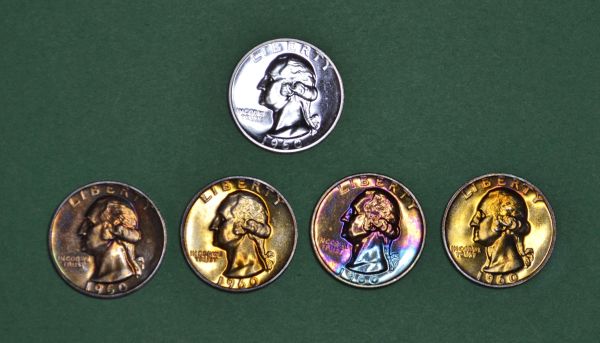
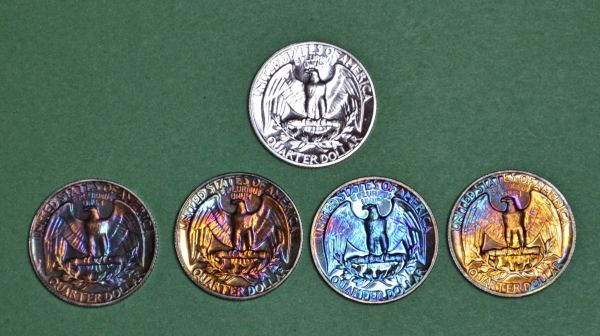
Yep these are all AT. I took a really great class from Bob Campbell at an
ANA Summer Seminar. He is one of the best when it comes to deciphering AT vs real toning. His class is on video/DVD and I've seen it on
ebay for sale, might want to look into a copy. It is also available from the
ANA Library for free if you are a member.
Following is a little excerpt from another web page;
--
In his video How to Tell Artificial Toning on Coins, available for loan from the American Numismatic Association, Campbell says the following are AT tip-offs:
Circular toning spots resulting from the beading of the toning liquid that was used.
Colors that blend together out of sequence. With naturally toned coins, the progression is yellow then magenta (pinkish red) then cyan (blue-green).
Toning that appears only on the tops of the lettering and devices and not in the coin's recesses.
Wild "circus" colors -- on 90 percent silver coins, for instance, army green, bright pumpkin orange, and robin-egg blue.
According to PCGS's book Coin Grading and
Counterfeit Detection, the following are other indications of artificial toning:
The toning floats on the surface of the coin rather than having depth and being bonded to the metal.
The toning occurs over hairlines or other marks.
The toning exhibits bright "crayon" colors.
The toning has a yellow-brown, smoky appearance, indicating it was caused by cigarette or cigar smoke.
--
Hope that helps somewhat.
"Buy the Book Before You Buy the Coin" - Aaron R. Feldman - "And read it" - Me 2013!
ANA Life Member #3288 in good standing since 1981, ANS, Early American Coppers Member (EAC), Colonial Coin Collectors Club member (C4), Conder Token Collector Club member (CTCC), Civil War Token Society (CWTS) member, Liberty Seated Collectors Club (LSCC) & Numismatic Bibliomania Society member (NBS), USMex, Member in good standing, 2¢ variety collector.
See my want page:
http://goccf.com/t/140440







 ')
')


 Posted 08/18/2013 11:54 pm


