| Author |
 Replies: 11 / Views: 12,021 Replies: 11 / Views: 12,021 |
|
|
Valued Member
United Kingdom
240 Posts |
Sap posted in his image gallery a guide for reading ottoman coins. The idea is that the year at the bottom represents the year when the sultan mounted the trone, while the other year is the year of reign. Here is my example: 1223 (Mahmud II) + 30= 1253 (Hejira age, that is 1837 AD)  My question is where do I find the reign year on other coins, which do not respect this rule. First, this one, from Abdul Hamid, where I think I found a number on the reverse, but I am not very sure I'm correct. If I'm right, it should be like this: HA1187+3=HA1190=1776AD 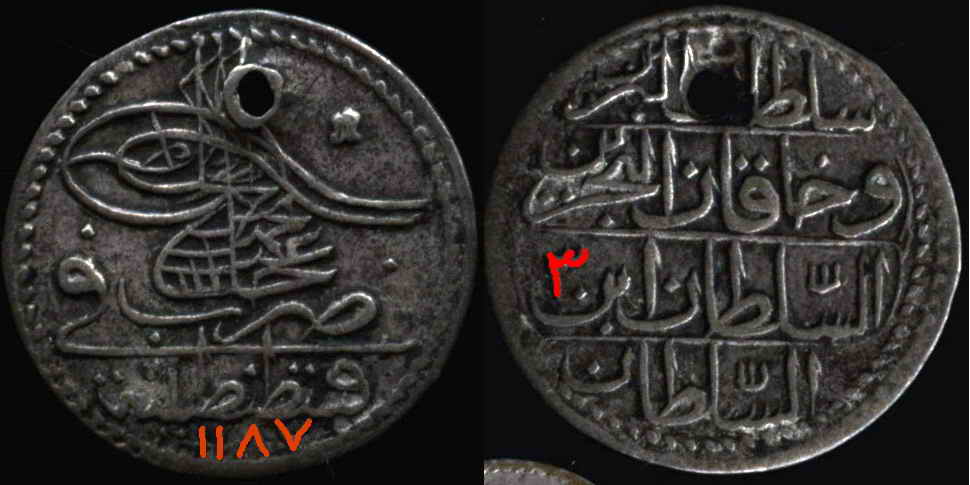 Here is a tougher one, 10 parale from Muhammad V. I identyfied 1327, the accession year, but I can't find the reign year. 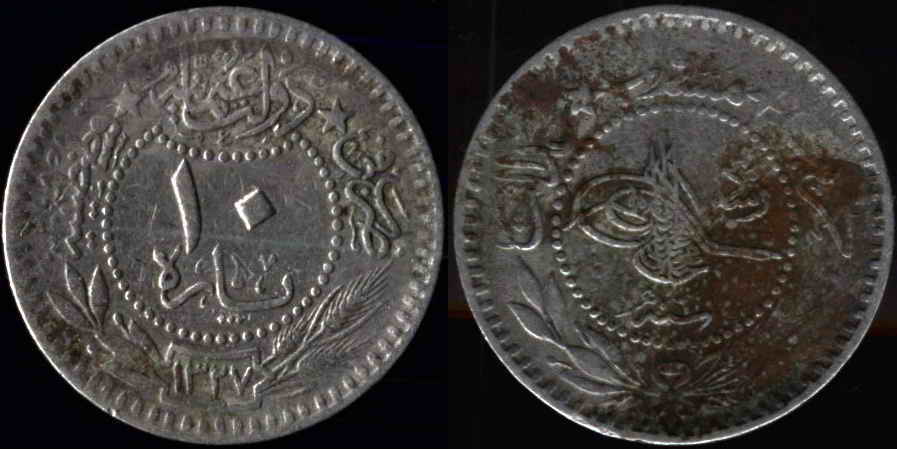 Murad V or Abdul Hamid II? How can I make a difference? Is there the name of the sultan written in the legend? Where is the year of reign? 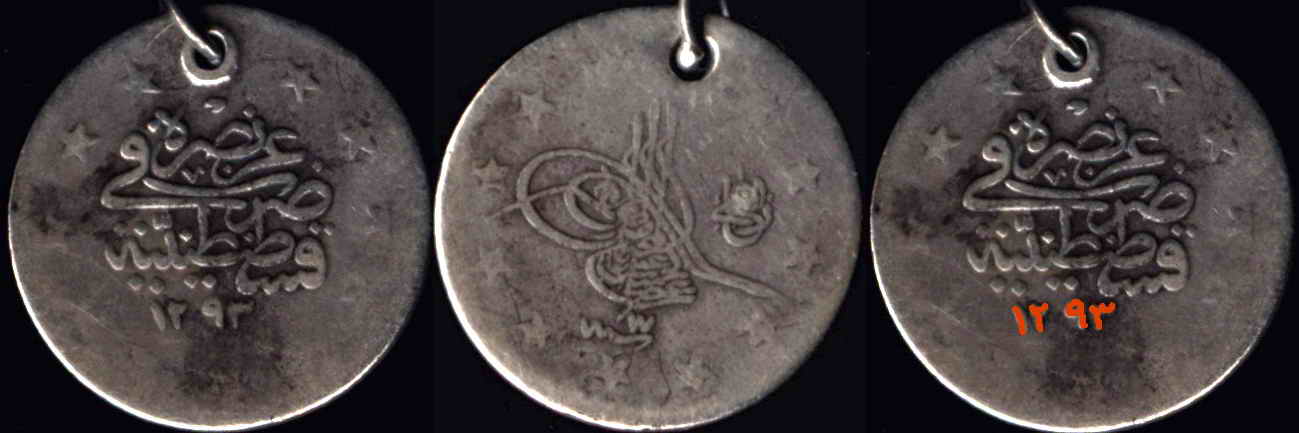 Another piaster, this one with Abdul Mejid(HA1255=1839AD).Same problem with the year of reign: 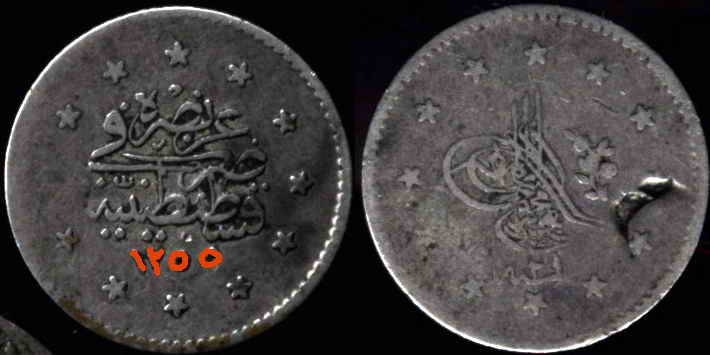 Sorry for the poor quality scans. |
|
|
|
Pillar of the Community
United States
4589 Posts |
|
|
Pillar Of The Community
Turkey
1205 Posts |
Well, I'm not an expert, but I think the year of reign I s on the obverse just under the Tughra (the signature) For instance the last coin you have there,  I believe that is a 2 (or a worn 3) I tried to show in blue. Edited by RenaL
06/05/2007 5:06 pm
|
|
Pillar of the Community
Egypt
3470 Posts |
RenaL  stratocaster the year of reign is written on the obverse just under the Tughra. If you can post pics for the part under the Signature I may be able to read it (please dont mark it with red) |
|
Moderator
 Australia
16982 Posts |
Hi all, The picture in my image gallery stratocaster found was placed there mainly for the benefit of someone over on the Aussie coin & banknotes forum, which doesn't have image hosting. I'm glad someone over here found it useful, too. He was having trouble finding the date on Ottoman Egyptian coins. Two things to note: "Ottoman" coins cover a wide variety of designs from different parts of the empire; Egyptian coins are quite different to Turkish, Libyan or Tunisian ones. The location of the various parts of the date varies from place to place, as well as with time. With the calculation of "actual date of issue", don't forget to subtract 1 before converting to AD - that's because the sultans began their reign in Year 1, not Year Zero (in other words, a coin dated "1223 year 1" is actually struck in 1223, not 1224. The only other thing to watch out for is sometimes, particularly on more modern coins, the denomination is given with a numeral, as well. It can easily be confused with a regnal year. quote:
stratocaster asked:
Murad V or Abdul Hamid II? How can I make a difference? Is there the name of the sultan written in the legend? Where is the year of reign?
The toughra, the "ornate squiggly thing" that appears on all Ottoman coinage, is the signature of the sultan, written in a very ornate style. On coins with a toughra, the sultan's name doesn't normally appear elsewhere on the coin. It takes a keen eye to be able to actually read a toughra, even for native Arabic speakers. I'll check the Krause catalogues when I get home later today and see if there's any other way to tell the difference between the coins of these two sultans, or even if any coins at all were struck in the name of Murad V - he only reigned for a few months. Don't say "infinitely" when you mean "very"; otherwise, you'll have no word left when you want to talk about something really infinite. - C. S. Lewis
|
|
Moderator
Australia
16982 Posts |
OK, just checked the Krause - and Murad V did issue coins. Coins of Abdul Hamid II have either a small flower or an Arabic word in the field to the right of the toughra; coins of Murad V are plain.
Don't say "infinitely" when you mean "very"; otherwise, you'll have no word left when you want to talk about something really infinite. - C. S. Lewis
|
|
Valued Member
 United Kingdom
240 Posts |
You really don't stop amazing me with all your knowledge guys. My questions won't stop here though. Got it with the name of the sultan. And with the reign year too: What I can't figure out now is the reign year in the 1293 Abdul Hamid II. Under the Toughara, theris something that looks like a "W".Could that be a 1V (17?) Moreover, where can I see the denomination? I know that the small ones are para, like this one: 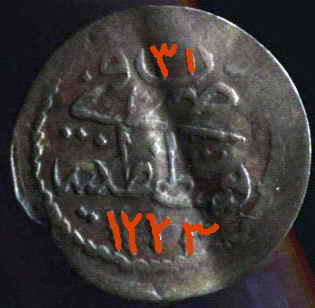 But which is the difference between 10,20, 15 5 para , 1 piaster, 2 piaster and so on? |
|
Moderator
Australia
16982 Posts |
quote:
Under the Toughra, there is something that looks like a "W". Could that be a 1V (17?)
That would be my guess, yes. The "W" is located where the reign-date should be on these coins. quote:
Moreover, where can I see the denomination? I know that the small ones are para, like this one... But which is the difference between 10,20, 15 5 para , 1 piaster, 2 piaster and so on?
That's not an easy question to answer. Turkish coins changed a lot during the 1800's, as the fortunes of the empire went up and down (down, mostly). A coin that was a big, solid silver coin in one reign might be a thin base-silver piece in the next. Coins of Ottoman Egypt normally have the denomination written on the coin, with the denomination value. For example, a 5 qirsh will have Arabic 5 above the Arabic letter "sh"; a 5 para will have the Arabic "p" instead. Unfortunately, Turkish coins don't seem to follow this convention, with the "empty spaces" filled with patriotic phrases like "may his victory be glorious" rather than useful stuff like the denomination. You pretty much need the catalogue, to look up what coins were being made in what year and then compare the pictures. That's how I identify Ottoman coins, anyway. Don't say "infinitely" when you mean "very"; otherwise, you'll have no word left when you want to talk about something really infinite. - C. S. Lewis
|
|
Valued Member
United Kingdom
240 Posts |
Thanks a lot Sap!
How bad do coins which have holes drilled through them lose their value? How about other types of damage?
I know that the coins I showed here are virtually worth the bullion value, but the question is available for other coins too and I don't talk here about very scarce pieces.
By the way, I payed a little less than 4 US cents in romanian currency for each coin. What do you think?
|
|
Moderator
Australia
16982 Posts |
Depending on the size and nature of the hole, a holed coin would probably drop at least two whole grades in value, probably more. For instance, a coin with VF details but a small, clean hole would probably only be worth what you'd pay for an undamaged coin on VG condition. A larger, ragged hole would knock it back even further - probably down to bullion value, unless it's a scarce date or type. Much the same could be said for other serious damage, such as dents, warping, partial drilling (a hole only going halfway through a coin) or some kind of jewellery mount (like a brooch pin or pendant loop) being attached and later removed. Still, 4¢ each for small silver coins, even ones with holes in, sounds like a very good deal to me!  Don't say "infinitely" when you mean "very"; otherwise, you'll have no word left when you want to talk about something really infinite. - C. S. Lewis
|
|
Valued Member
United Kingdom
240 Posts |
Thanks a lot Sap!  |
|
Valued Member
Netherlands
376 Posts |
Bellydancers use them after being demonetized in 1919 to make chains that rinkles around their stomach and hips, thats why you see them with punched wholes in it.
Also in Anatolia they are used for vails during weddings.
You can always find the year at the right under the toughra.
If you see a flower in the right space of the coin it means Egypt.
If you see a large 'dot'in the right space, then you see the title El Ghazi (the Victorious) , which appears at the end of the Ottoman Empire in between Year 7/8 1917-1918. Before that, this dot has more the shape of an L, which means Reshat, and appears in between year 2 until 7 (1912-1917); Only El Ghaza appears at all 1293 and 1327 dated coins in year 1 of Muhammad V, former rulers always bear El Ghaza.
Counterstamped Turkisch ottoman coins can be found in Saudi Arabia under the chapter of Hejaz & Nejd.
|
| |
Replies: 11 / Views: 12,021 |
|








 Posted 06/05/2007 5:05 pm


