









 Posted 06/09/2007 09:45 am


Welcome to the forum, Rick. I certainly hope your username refers to your collecting habit, as opposed to some other habit. 
Before I speak my piece, be aware that I tend to "market grade", basing my opinion on what is found in the marketplace and conferred by the major TPG's. This tends to be a somewhat more generous system than the stricter practice of members such as Forum Mom, who bases her opinions on traditional standards pre-dating the TPG system.
Who's right? We both are. Susan's grades are more accurately descriptive of the actual condition of the coin. My grades more accurately reflect what your coin is worth in the open market. Her standards will not change with time and market conditions. Mine will.
She will call this coin F15, I think. I call it VF20 or maybe a little better. I've seen pics of similar stuff in VF25-30 holders.
The toning is suspect, but not out of the realm of "natural" possibility. I'm guessing it toned in a "natural" fashion (as in, not being deliberately caused by the owner at some time), but at an accelerated rate due to whatever conditions existed to cause it.
My gut feeling is that the coin is genuine. That opinion is based on incomplete information, because one set of fairly small photographs doesn't give enough detail to be definitive. I don't see any of the gross indicators of a fake - the denticles are clean and regular, the surfaces don't show any characteristics of a cast fake, the lettering is correct for style and placement....
Jaobler, I think the A in STATES is more of a photographic artifact than anything. It's been my experience that the T's historically appear slightly larger than they should, mostly because of the optical illusion of height caused by so much whitespace below the crossbar. The A, being of opposite orientation, tends to look shorter and fatter than it should. I've noted this illusion in many of my pics, especially when the coin is tilted away at the top, foreshortening the A.
Anyways, I see nothing that immediately catches my eye as obvious fakery. Again, I repeat, this isn't a definitive opinion. Too little data.
Here's an image, shamelessly ripped from the archives of Heritage Auctions, of an ANACS-authenticated 1893. It was Net graded VF20, and shows a similar appearance about the date to Jaobler's comments. The reverse, not shown, is weaker than Bottleguy's coin, which I think is obverse-limited like most Morgans.
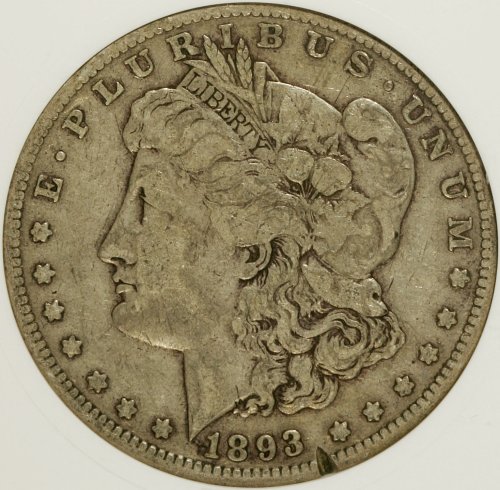
Image courtesy of Heritage Coins, http://coins.ha.com/default.php
Before I speak my piece, be aware that I tend to "market grade", basing my opinion on what is found in the marketplace and conferred by the major TPG's. This tends to be a somewhat more generous system than the stricter practice of members such as Forum Mom, who bases her opinions on traditional standards pre-dating the TPG system.
Who's right? We both are. Susan's grades are more accurately descriptive of the actual condition of the coin. My grades more accurately reflect what your coin is worth in the open market. Her standards will not change with time and market conditions. Mine will.
She will call this coin F15, I think. I call it VF20 or maybe a little better. I've seen pics of similar stuff in VF25-30 holders.
The toning is suspect, but not out of the realm of "natural" possibility. I'm guessing it toned in a "natural" fashion (as in, not being deliberately caused by the owner at some time), but at an accelerated rate due to whatever conditions existed to cause it.
My gut feeling is that the coin is genuine. That opinion is based on incomplete information, because one set of fairly small photographs doesn't give enough detail to be definitive. I don't see any of the gross indicators of a fake - the denticles are clean and regular, the surfaces don't show any characteristics of a cast fake, the lettering is correct for style and placement....
Jaobler, I think the A in STATES is more of a photographic artifact than anything. It's been my experience that the T's historically appear slightly larger than they should, mostly because of the optical illusion of height caused by so much whitespace below the crossbar. The A, being of opposite orientation, tends to look shorter and fatter than it should. I've noted this illusion in many of my pics, especially when the coin is tilted away at the top, foreshortening the A.
Anyways, I see nothing that immediately catches my eye as obvious fakery. Again, I repeat, this isn't a definitive opinion. Too little data.
Here's an image, shamelessly ripped from the archives of Heritage Auctions, of an ANACS-authenticated 1893. It was Net graded VF20, and shows a similar appearance about the date to Jaobler's comments. The reverse, not shown, is weaker than Bottleguy's coin, which I think is obverse-limited like most Morgans.
Image courtesy of Heritage Coins, http://coins.ha.com/default.php


