| Author |
 Replies: 9 / Views: 2,777 Replies: 9 / Views: 2,777 |
|
|
Pillar of the Community
Canada
2805 Posts |
I thought this was interesting. In Croatia, the larger coins need both the Latin and Croatian names of the animals on the back. Instead of both languages being incorporated on the same design (the reason why Canadian and Swiss coins are usually pretty sparse - space runs out fast!), or making coins with both single languages in one year, every odd year is Croatian and every even year is Latin:   |
|
|
|
Moderator
 United States
14463 Posts |
That is an interesting solution to being bilingual  |
|
Pillar of the Community
Australia
9815 Posts |
|
|
Pillar of the Community
Thailand
1509 Posts |
I don't think it's a matter of them needing the Latin. There can't be that many Croatians (or us) can even understand it.
Perhaps the authorities just tried to make it easier for us world coin collectors and not wanting to upset anyone went for academic Latin rather than English.
|
|
Moderator
Australia
17002 Posts |
South Africa briefly (1965-1969) did the same as Belgium, issuing separate coinages in English and Afrikaans. I'm not sure if it was intended to be part of the Apartheid system, with different coins intended to be used by different races.
Don't say "infinitely" when you mean "very"; otherwise, you'll have no word left when you want to talk about something really infinite. - C. S. Lewis
|
|
Pillar of the Community
Thailand
1509 Posts |
Since 1970 the South African (10, 20 and 50) Cents have alternated year by year with different tribal names (including Afrikaans) for the country but they seem to have dropped the English name.
The Rand and higher denominations still use the English/Afrikaans legend.
I don't think (as Sap suggested) that they were produced to be used exclusively by one sector or another of the ruling races at the time.
|
|
Pillar of the Community
Thailand
1509 Posts |
New info on South African coins (that will teach me to do my research before I jump in)!
Apparently there are 10 different legends for the common ciculation coins (but I'm missing on one in my list).
1 Cent (1997-2000) Ndebele legend ISEWULA AFRIKA (This is Mandela's tribe)
2 Cents (1996-2001) Venda legend AFURIKA TSHIPEMBE
5 Cents (1996-2001) Tsonga legend AFRIKA DZONGA
10 Cents (1996-2003) English legend SOUTH AFRICA
20 Cents (1996-2004) Tswana legend AFERIKA (or AFORIKA) BORWA
50 Cents (1996-2003) Sotho legend AFRIKA BORWA
1 Rand (1996-2000) Afrikaans legend SUID AFRIKA
2 Rand (1996-2000) Xhosa legend UMZANSTI AFRIKA
5 Rand (1996-2000) Zulu/swati legend ININGIZIMU AFRIKA
After those years it seems to be a mix and match for the denominations.
Aha, found the missing one because Zulu and Swati have been combined.
Edited by thai-vic
09/28/2013 04:46 am
|
|
Moderator
United States
14463 Posts |
In my Birth Year Set from South Africa, I have 1 & 2 Cent coins with English legends and recently bought a 5 Cent coin with Afrikaans legend  |
|
Pillar of the Community
Germany
1238 Posts |
Quote:
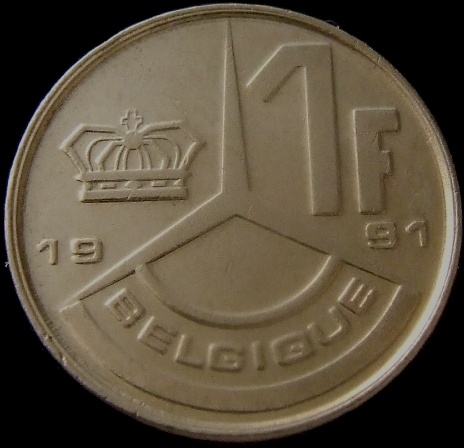
In Belgium they have the name of the country in two languages, on separate coins. Yes, they used to do that on older coins. These days the circulation coins (and most commemorative €2 coins) simply have the "BE" country code. The collector coins usually have the country name in the three languages (Dutch, French, German). As for the alignment, current Belgian coins (like most modern coin in the world) use the parallel alignment ... Christian Edited by chrisild
09/28/2013 06:33 am
|
|
Valued Member
Israel
423 Posts |
In Israel all coins are trilingual
English, Arabic and Hebrew
|
| |
Replies: 9 / Views: 2,777 |
|










 Posted 09/27/2013 11:56 pm


_One_Franc.jpg)


