Coin Community Family of Web Sites Join Thousands of Coin, Bullion, & Money Collectors
Coin, Banknote and Medal Collectors's Online Mall Specializing in Modern Numismatics Royal Canadian Mint products, Canadian, Polish, American, and world coins and banknotes. 300,000 items to help build your collection! Vancouvers #1 Coin and Paper Money Dealer Join Thousands of Coin, Bullion, & Money Collectors Royal Estate Auctions - $1 Coin Auctions


Username:
Password:
Save Password
Forgot your Password?


This page may contain links that result in small commissions to keep this free site up and running.

Welcome Guest! Registering and/or logging in will remove the anchor (bottom) ads. It's Free!

1953 Lincoln Head Cent-Ddo ?

To participate in the forum you must log in or register.
Author Previous TopicReplies: 3 / Views: 1,325Next Topic  
Pillar of the Community
mdpmedia's Avatar
United States
3546 Posts
 Posted 10/31/2013  03:25 am Show Profile   Bookmark this topic Add mdpmedia to your friends list Get a Link to this Message Number of Subscribers
Hello,

I put together some of the steps I had to use to produce helpful photos for the investigation of a possible DDO.

Since much of the narrative analyzing this 1953 LHC addresses the applicable USB camera, clamp, and tripod stand employed to produce the required information to make an informed decision, the following URL will take you directly to the appropriate section within the CCF photography thread, entitled 'USB Microscope Photographing Coins':

https://goccf.com/t/88598&whichpage=6

In other words you will skip the majority of the rather lengthy 'USB Microscope Photographing Coins' thread that precedes the entry of this newly-inserted '1953 LHC DDO' issue etc:

Please post your comments/responses, however, related to the DDO analysis to this thread located within the 'US Modern Variety and Error Coins' thread section.

Any comments geared toward the related 'USB Microscope Photographing Coins' thread centered around photography or associated subjects can again also be posted to the same thread referred to above:

https://goccf.com/t/88598&whichpage=6

Thanks much for your input.,

mdpmedia
Bedrock of the Community
coop's Avatar
United States
62064 Posts
 Posted 10/31/2013  11:35 am  Show Profile   Bookmark this reply Add coop to your friends list Get a Link to this Reply
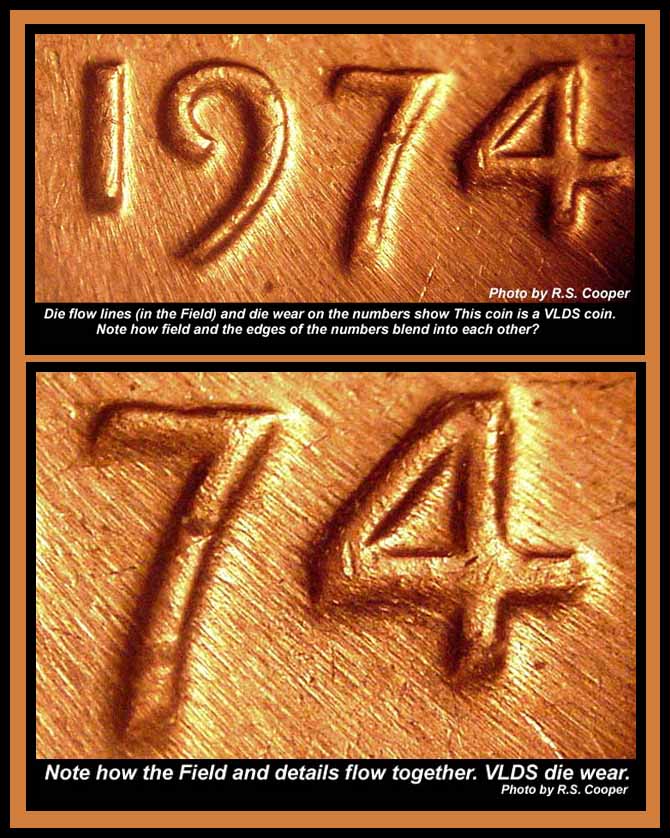
The die that struck your coin as in a VLDS condition. It is not a DDO. It is like the "so called" poor mans doubled die. it is a worn die. The devices near the rim show the most Die Deterioration. Here is another example:
https://www.coincommunity.com/forum...ATION_01.jpg
https://www.coincommunity.com/forum...M_answer.jpg
https://www.coincommunity.com/forum...-FAN3_14.jpg
https://www.coincommunity.com/forum...EAR_CENT.jpg
The die wear appears on the edges of the devices toward the rim. The rim devices always suffer the most.
Pillar of the Community
mdpmedia's Avatar
United States
3546 Posts
 Posted 10/31/2013  3:16 pm  Show Profile   Bookmark this reply Add mdpmedia to your friends list Get a Link to this Reply
Very cool example photos Coop.

It almost appears as if the obverse stars on the attached 1812 Capped Bust half example are bleeding or melting into the outer rim.

Thanks for providing an explanation with color shots: very helpful.


I guess I have never been aware of this phenomenon occurring before since the resulting adverse effects of a very worn die had never occurred previously on a coin in my possession that had significant or potentially significant value.

A couple of remaining questions follow below:

1)a.

Being that additional premium (a.k.a greater value) is added to some coins when a die 'chip', for example, presents itself (ie VAM 72 , 1878-S Morgan dollar, die chips under the eyelid...), why would not the end results of a particular stage of a worn die add some additional $ value to a coin like a 1953 Lincoln Head cent?

1)b.

Are not the end results seen on both of these coins (LHC & Morgan dollar) the result of a failing die?

2)

Would it be correct to assume that a higher degree of Die Deterioration usually begins at the outer circumference of 'most' coins and ‘usually' works its way inward toward the center of the coin and not in the reverse direction: inward area out to the rim...?

mdpmedia
Bedrock of the Community
coop's Avatar
United States
62064 Posts
 Posted 10/31/2013  4:15 pm  Show Profile   Bookmark this reply Add coop to your friends list Get a Link to this Reply
1)a.Being that additional premium (a.k.a greater value) is added to some coins when a die 'chip', for example, presents itself (ie VAM 72 , 1878-S Morgan dollar, die chips under the eyelid...), why would not the end results of a particular stage of a worn die add some additional $ value to a coin like a 1953 Lincoln Head cent?

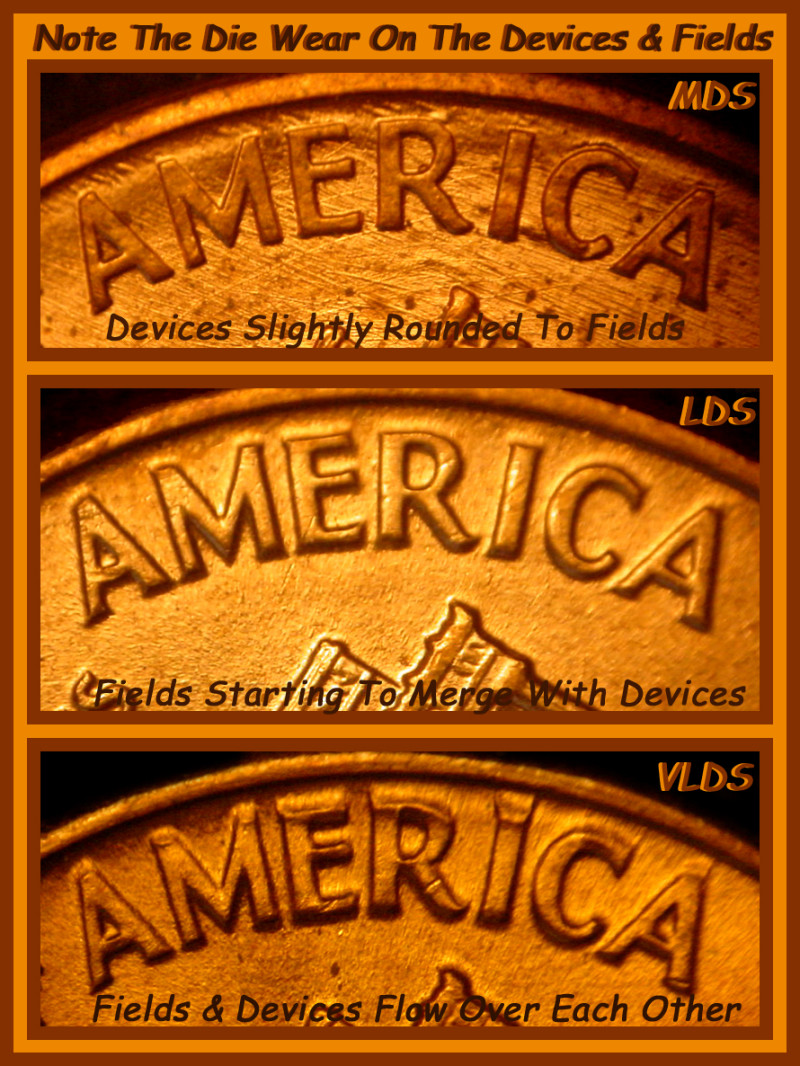
The VAMs are the only group that recognizes and die cracks/chips and other events calling them varieties. There is listings by other groups of die stages. (events that happen to a known die they are tracing) Coppercoins denotes EDS/MDS/LDS die states. But on a normal coin, it would need to be a one of a kind (error) before they get collectable. Die cracks that fall across the whole coin become collectable. Grease Filled Dies that have 75% of the devices missing start to get interesting to collectors. Cuds (Which happen on later die states) are collectable. The life time of the die may be follow and only certain events may catch interest. A lot of items get names added to it and some collect them. (People collected beany babies at one and now see what they are worth?) But as far as a worn out die being collectable, I've never heard of that before?

1)b. Are not the end results seen on both of these coins (LHC & Morgan dollar) the result of a failing die?
They are products of the dies old age. Even happen that make some fail faster than others, polishings,, clashings ETC. But I'm at a loss to think it is a good thing for a coin to be struck from a worn out die. Even variety cents get struck with worn/extremely worn dies before they are retired.

2)Would it be correct to assume that a higher degree of Die Deterioration usually begins at the outer circumference of 'most' coins and ‘usually' works its way inward toward the center of the coin and not in the reverse direction: inward area out to the rim...?
That is true. The metal stretching to fit into the collar during the strike make the dies wear. It may seem slow at first, but seems to accelerate as the die ages. Kind of like a car. When the car is new the tires last a long time. But when the car start to get past 100,000+ miles the tires last a shorter amount of time. The life of a die may be just hours till it is retired, or longer if taken off to remove a clash. How long they last we don't know. The wear on the die starts to be seen on the outside edge first removing just edges of the out devices. Later in late MDS die state the flow line start to appear. On the LDS they are stronger. On the VLDS they flow over the devices. It is an aging process, just like we go through.
1953-Lincoln-Head-Cent-Ddo-?
Edited by coop
10/31/2013 4:20 pm
  Previous TopicReplies: 3 / Views: 1,325Next Topic  

To participate in the forum you must log in or register.


Disclaimer: While a tremendous amount of effort goes into ensuring the accuracy of the information contained in this site, Coin Community assumes no liability for errors. Copyright 2005 - 2026 Coin Community Family- all rights reserved worldwide. Use of any images or content on this website without prior written permission of Coin Community or the original lender is strictly prohibited.
Contact Us  |  Advertise Here  |  Privacy Policy / Terms of Use

Coin Community Forum © 2005 - 2026 Coin Community Forums
It took 0.3 seconds to rattle this change. Forums