











 Posted 11/15/2013 9:20 pm


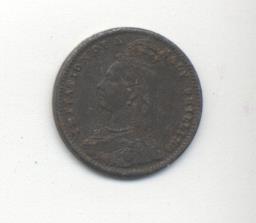
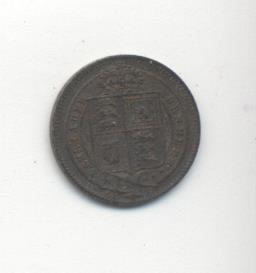
Correct. It's a piece of Victorian-era play money. The Lauer family were the last and largest of the token-making families of Nuremberg, Germany. Prior to WWI, their toy coins were exported in considerable quantity.
On genuine coins, the legend on the belt around the shield is the Old French motto of the Order of the Garter, as seen on the current Coat of Arms of Britain, while the obverse legend gives Queen Victoria's name and titles. Example on Vcoins.
This particular type of sixpence was withdrawn shortly after issue, because the coin has a similar size and design to a gold half-sovereign, making it all too easy for the criminally minded to gold-paint a sixpence and earn a nice twenty-fold profit. So on that basis I would assume that this particular piece of play money would indeed date from not too long after 1887.
On genuine coins, the legend on the belt around the shield is the Old French motto of the Order of the Garter, as seen on the current Coat of Arms of Britain, while the obverse legend gives Queen Victoria's name and titles. Example on Vcoins.
This particular type of sixpence was withdrawn shortly after issue, because the coin has a similar size and design to a gold half-sovereign, making it all too easy for the criminally minded to gold-paint a sixpence and earn a nice twenty-fold profit. So on that basis I would assume that this particular piece of play money would indeed date from not too long after 1887.
Don't say "infinitely" when you mean "very"; otherwise, you'll have no word left when you want to talk about something really infinite. - C. S. Lewis


