| Author |
 Replies: 475 / Views: 53,621 Replies: 475 / Views: 53,621 |
|
|
|
Pillar of the Community
United States
551 Posts |
There is a common language for grading--it is called a photograph. Pros agree that the technical term "grade" refers to wear alone, regardless of original strike or current surfaces (which are factors listed separately by NGC). I use the term "condition" to encompass all relevant factors. There are so many that it is hopeless to try to put them on one scale of worse to better. If one really wants a common terminology to discuss value/cost (which is what the US slab grading system is), then that is much different in the context of ancient coins. If you want a US Seated Liberty dollar they is a good chance you want only one. They the question is appeal versus price and both appeal and price are closely tracked by MS-system numbers. In US coins it would be heresy to prefer a MS-53 to a MS-55. There are very many similar coins around so you can buy the MS-53 for $900 if that is the appeal/price balance you want. In contrast, if you want a DE SARM denarius of Marcus Aurelius (a very historical type) the many factors discussed elsewhere come into play and if you don't have years to wait you may have to settle for a little off-centering or some other detraction because there are not many similar coins around to pick from. You might well prefer a "good VF" to an "aEF" because of factors other than wear (often called "eye appeal"). Fortunately, my enjoyment of a coin is not tracked closely by the exact same factors as everyone else (for example, I dislike off-centering more than most, but don't mind wear as much as most). I'd bet that a psychology experiment could prove (with eye-movement-tracking) that US collectors presented with a slabbed coin look at and process the MS-number *before* they look at the coin itself. It is almost hard to look at the coin--the grade-number is so prominent and eye-catching. US collectors know the number is more important than the coin, and frequently high-end coins are broken out of slabs and resubmitted to attempt to get a higher grade on the new slab, because the next buyer would buy a new slab's higher grade for a lot more money--even though it is the same coin. Those are perils of a single-scale grading system. Be glad that your opinion about condition need not agree with some scale dictated by the establishment. You can appreciate what you like without so single "grade" telling you how much you should like the coin. |
|
Pillar of the Community
United States
3229 Posts |
"Grading" is an attempt to designate condition. Grading can done from a technical perspective or a market perspective and often times includes more than P-MS designation in its overall description because of the great variety between coins. What can make grading useful is if there is general consensus on what the "Grades" and "descriptions" mean. If walk up to a dealers table and say I want to see VF coins and better, he/she knows "about" what I am looking for.
I am certain that I do not know what the general consensus for grading ancients is. I do know I am following along so I can learn.
|
|
Pillar of the Community
United States
3499 Posts |
In general I am in agreement ..... with one small caveat. Photographs can lie !
I have been able to spot more than a few bronzes over the past few years where the 'pics' were obviously lacking. Often as this can greatly effect the bottom line I go out of my way looking for inferior photography. This does not have to be out of focus amateur stuff either. I have sold more than a few early Canadian tokens and large cents on a well 'auction' known venue. Sometimes when I am a bit rushed I don't take the time to do several shots and/or pick the best one. With the lighting 'off' just a bit very often insignificant blemishes can be magnified by shadows. Think of the old flashlight under the chin ..... not the best way to look like a 'smooth' character. Coins are the same.
I recently posted a Caracalla sestertius which had gone for the 'cure' (a bit of BD needed elimination) I posted one of two photos I had. Some adjustments for color and contrast had been made and I actually selected the wrong one for the post. The coin appeared very yellowish instead of the slightly darker brownish/green it really is. The photo was being less than completely honest.
With some practice you can ofetn spot those "Better in Hand !" deals fairly easily.
|
|
Pillar of the Community
United States
3229 Posts |
I know we ancient coin collectors really dislike slabs (evil coin coffins created by evil empires  ), but here is NGC's grading criteria. Disclaimer: The following is in no way intended to reflect the views of the OP. Note that the NGC grades different for "bulk" grading vs. individual coins.  Quote:
NET GRADE. Coins submitted for "bulk" grading at NGC Ancients will be evaluated in accordance to familiar standards: all of the independent factors will be taken into account to arrive at a "net grade." Thus, the coin just described would be netted as Choice VF.
A "net grade" takes into consideration all of the merits and faults of a coin, and expresses it in the form of a single grade. Just as with regular- and express-tier coins, NGC Ancients will use an adjectival grade for its net grades rather than the 70-point Sheldon scale. Oftentimes our net grades will be lower than the grade that would be assigned in our regular grading system because the contributing factors to the appearance of the coin (other than circulation wear) are taken into consideration. Thus, a coin that suffered little or no circulation might be net graded VF or EF because it was poorly struck, was struck with heavily worn dies, or because its surface was damaged.
Quote:A coin's state of preservation is expressed using a grading system. The adjectival system in use today is fairly universal throughout the world, with only minor variations in the terminology. Adjectival grades are often used in tandem with the Sheldon Scale, a 70-point scale formulated in 1949 to assign collector prices for US Large Cents. In recent decades Sheldon's system has been transformed from its original, narrow function to a numerical grading scale for all US coins, which now has gained acceptance for many World coins. Rather than Sheldon's 70-point scale, NGC Ancients will use the adjectival system. In the circulated grades the terms will strictly describe the amount of wear a coin has suffered...The grades of NGC Ancients will in some cases be higher than the "net grades" assigned elsewhere in the marketplace. Some coins described as Choice VF in an auction catalog might be graded EF or AU by NGC Ancients if the absence of detail is caused by worn dies and / or a weak strike rather than by actual wear. In such cases, the grade will be assigned accurately and the negative aspects of strike weakness and / or worn dies will be reflected in a low score for Strike...The Three S's of Ancient Coin Grading: Strike, Surface and Style |
|
Pillar of the Community
United States
3229 Posts |
Please grade. Tetricus I. Portrait looks VF to me but the legend isn't full (like a lot of these)and it has a bit corrosion (like a lot these). Net F? maybe 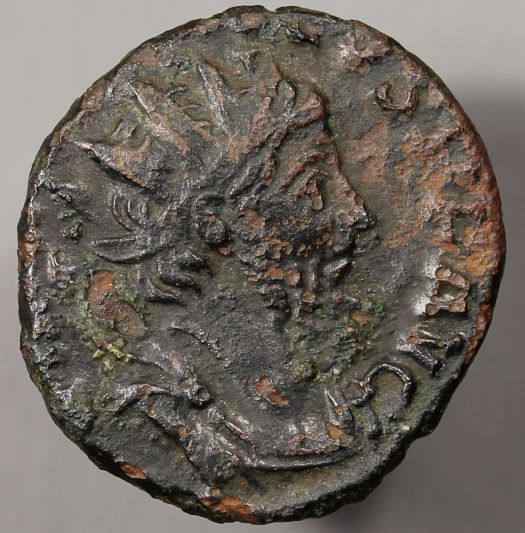 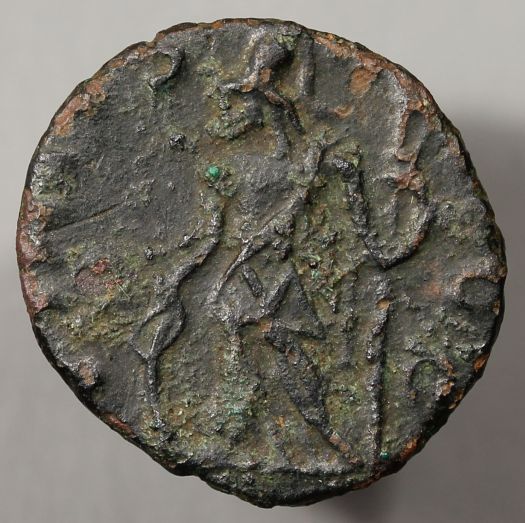 |
|
Pillar of the Community
United States
3499 Posts |
To be honest the pitting looks like it may have had BD and gone through a cure. While some corrosion is always tolerated on a two thousand year old 'man' these are more like pock marks. Overall though calling it a low end F would be fair as Tetricus was minting during a definite downward trend in the quality of the base issues.
|
|
Pillar of the Community
United States
3499 Posts |
This is one of my recent "better in hand" purchases. They generally come with significant wear. Apparently they were made to be used ....... And quite a bit at that. I grade at high end F AE As Castulo 2nd century BC Rv Sphinx walking right 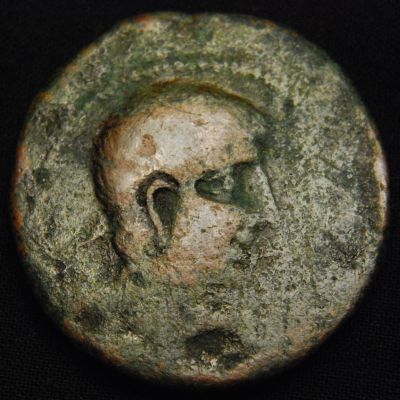 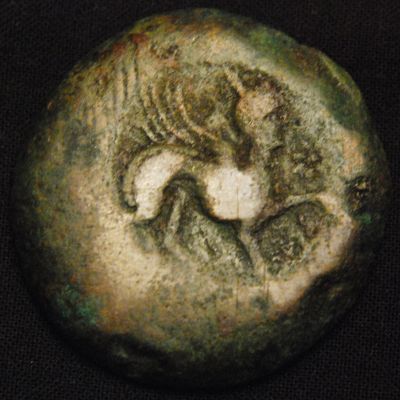 At 33mm over 31 grams and a final price tag of $7.54 I will say one thing Better in my hand than someone else's ! |
|
Moderator
  United States
23731 Posts |
TJ, I would grade your coin a Vgood due to the wear, pitting and missing legend.
|
|
Moderator
United States
23731 Posts |
FR, I really like your coin, I haven't seen many of these with much more details than this one so my best guess for a grade would be Fine.
|
|
Pillar of the Community
United States
3229 Posts |
That Nero is rockin!  EF+ Rudrashima - VF Septimius Severus - EF, nice one Castulo - VG-F, slider I agree that my Tetricus has a few problems and nets more of a VG than an F:) |
|
New Member
Italy
25 Posts |
First I appologise for my poor English, but I need to speak on the 'photo being a grading system'. rubbish. I have posted before as to this and to grade any ancient coin to precise is not possible.
I have collect and sold ancient coinages for 55 years now and have seen so much 'grading' that most is wrong.
if to you wish to grade I have a few rules that are very simple if you wish to read them.
work on a 0 to 5 grade ok.
1. centre of strike = 1 point
2. full strike - full legend - full portrait = 1 point
3. strike type to body thickennes, straight die hammer, hinged die hammer should see reverse type thick than obverse = 1 point
4. tooling, acid clean, salt rencid = - 1 point
5. size as struck = 1 point
6. double strike = 1 point if clear strike - 1 point of cast over strike
7. clarity of emperor message = 1 point.
is not a difficult scale as rare does not matter to scale as is grade only, I am hope helps
|
|
Moderator
United States
23731 Posts |
I think we all realize that any grading that we do here is very subjective at best. I'm not a professional grader so any grade that I give is made by what I have seen of other coins of the same type in various conditions and my personal opinion. This thread was made to see how we viewed the condition of our coins and to get an idea what others thought about them using whatever grading system they prefer.
|
|
Pillar of the Community
United States
3499 Posts |
While on the subject of Geta portraits .... This is my favorite from my vault Geta AE32 Pisidia Antioch (Anatolia) Rv. Victory walking left with wreath 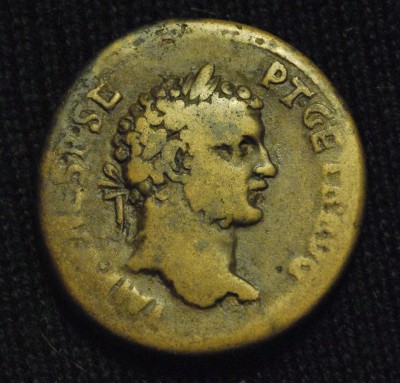 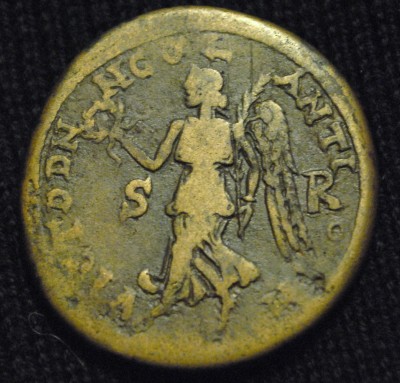 I give it a low end VF. I saw a better one once offered by Lanz with beautiful patination. Seriously concidered the upgrade. After it soared past $300 I quickly changed my mind. I 'stole' this one thirty years ago for $75 from a dealer who was liquidating his inventory. No regrets here. |
|
Moderator
United States
23731 Posts |
Very nice provincial, Based on overall wear I would grade it at Fine+.
|
|
Pillar of the Community
United States
3499 Posts |
Actually more accurately a 'Colonial' issue. Pisidian Antioch became a veterans colony in the time of Ausgustus and remained a 'Latin' city with the honorific of a "Caesaria" until the time of Constantine when Latin faded away for good in the east. I assume this coin was intended to be the equivalent of a sestertius being of similar size and weight.
Obv. reads IMP CAES P SEPT GETA AVG
Rv. reads VICT DD NN COL ANTIOCH S-R
I never quite figured out the "S R" abbreviation. Perhaps someone here wise in the ways of east might know. SENATVS (something) I am guessing
|
| |
Replies: 475 / Views: 53,621 |





 First Page
 Previous Page


 Posted 01/02/2014 09:43 am


