| Author |
 Replies: 26 / Views: 2,432 Replies: 26 / Views: 2,432 |
|
Valued Member
United States
160 Posts |
Howdy once again! What are your thoughts on possible grade and value of this 1830 Capped Bust dime? It's pretty well-worn, but it's the oldest in my "collection" and would like to hear an estimate of grade/value. 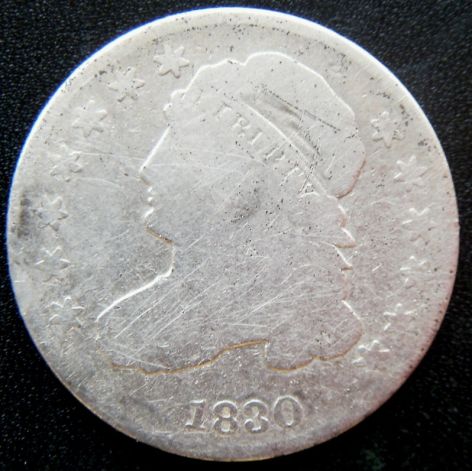 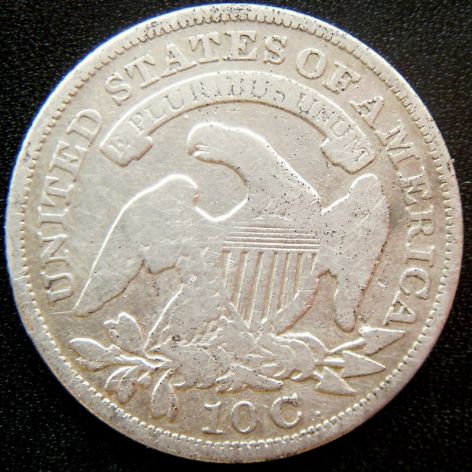 Thanks in advance, Steve |
|
|
|
Pillar of the Community
United States
4897 Posts |
G4 details. Harshly cleaned. Value? Maybe $10? Nice way to start an inexpensive type set....
Edited by amida17
12/22/2013 3:13 pm
|
|
Valued Member
 United States
160 Posts |
amida17 --
Thanks! You just described my whole "collection" -- an inexpensive set! :) I don't think I have much of anything with any real value, unfortunately!
A question -- can you tell me what you mean by "harshly cleaned," and what you see that suggests that to you? Reason I ask is, I can tell you with certainty that the coin has NOT been "harshly cleaned," but at the same time it's clear that it appears that way to you, and so there's something you are seeing (that I'm not educated enough to understand) that suggests that to you.
Thanks!
Steve
|
|
Pillar of the Community
United States
4337 Posts |
Steve, look at the hard lines that exist in the obverse relief. Those are harsh scratches caused by some sort of wire brushing or hard scrub. Secondly, the extreme washout effect left on the surface indicates the coin was scrubbed clean of any patina and therefore is designated as a harsh, not market acceptable cleaning.
A light market acceptable cleaning is a completely different coin than this.
|
|
Pillar of the Community
United States
4897 Posts |
It simply could not be 184 years old and be that color in that condition. Most of the Bust series coins that have survived have been cleaned. Remember, cleaning coins was standard practice until about 50 years ago. Not saying you cleaned it but its has definitely been stripped of its natural patina.....imo  Edited by amida17
12/22/2013 3:45 pm
|
|
Valued Member
United States
160 Posts |
dsfreeworld -- OK, gotcha. It's partially the scratches that make it look "harshly cleaned;" that makes sense. I also get what you are saying about the "washed out" look.
amida17 -- you are pointing at the same thing, no patina on the coin, and thus -- harshly cleaned. Gotcha.
Guys -- here's the deal.
I dug this coin, from the site of a church built in the 1850s that then burned down about 50 years later around the turn of the century, and the piece of land has been just a forest ever since. SO, I am fairly certain of the history of this coin since it was dropped (though it had been in circulation for roughly 25 years before being dropped). I believe this coin laid in the ground from roughly the 1850s or 1860s onward, and then ended up in my "collection" ever since.
So, the scratches on the obverse -- though appearing to expert eyes as being the result of wire-brush cleaning, MUST have happened before being dropped -- i.e. while in circulation.
As for the "patina" issue, it came out of the ground looking almost as it does in the picture; the only thing I did to it "in the field" was pour a little water on it to rinse off the dirt. After doing so, it looked essentially exactly as it does in the picture.
The only other thing I did once I got it home (and which I absolutely would NOT have done, had it been in better/less worn condition) was to rub it gently with a solution of water and a bit of baking soda. Again, NO WAY would I have done that if it weren't already so worn from circulation, but that's the only "cleaning" that was done. I didn't want to state that I dug it, up front, as I didn't want to bias any remarks toward everyone immediately saying "environmental damage."
BUT -- here's my question, and this seems to be a real dilemma. It seems like, for a really old coin to have any value in the eyes of a collector, it MUST have a "patina," period. And along those lines, you are obviously absolutely right that this coin has none of the beautiful patina that I have seen in pictures of nice, old coins. But the problem is, the reason that it has no patina, is that it was in the ground! No silver coin I have ever dug, has that nice patina. So, here's my question...does a coin that was "in the ground" and thus has no patina, AUTOMATICALLY therefore make it a non-valuable coin? I would really like to understand this a little better, is why I ask. It seems like a dilemma -- in that a brand-new coin has NO patina, but then that patina forms over time. On an old coin, that SHOULD have patina, collectors like that. BUT -- if a coin is in the ground, and thus acquires NO PATINA, then does that mean it automatically has very little collectible value? EVEN IF such a coin is NOT CLEANED aside from rinsing with water, would it still be "penalized" by a grading company by being called "damaged" or "cleaned" -- just because of a lack of patina?
I'm trying to learn how this works -- because if I ever dig a REALLY nice coin with super-sharp details, I want to make sure I know what I need to do so that the coin maintains the maximum possible value...
THANKS!
Steve
Edited by sgoss66
12/22/2013 4:24 pm
|
|
Pillar of the Community
United States
4897 Posts |
A dug coin is always going to be a "details" or damaged coin. So yes, being dug, will always lower the collector value of a coin. BTW, using baking soda is "harshly cleaning" a coin. Given it was dug I understand the method...very cool find I have NEVER even come close to digging something this cool!
|
|
Pillar of the Community
Canada
5417 Posts |
|
|
Valued Member
United States
160 Posts |
amida17 --
Gotcha. So, what you are saying is, no matter HOW NICE a coin comes out of the ground, since it will lack the "patina" it will automatically be "hindered" as far as collector value? Even if it is not cleaned at all, the lack of patina is the issue?
Steve
|
|
Pillar of the Community
United States
4897 Posts |
lack of original surfaces is what lowers the value. "Patina", Toning, as coin collectors call it, or tarnish is a form of oxidation that develops on the surface when coins are exposed to environmental factors. This layer of oxidation protects the original surface lustre of a coin. When it is removed, through being buried or cleaned it becomes a damaged coin.
|
|
Valued Member
United States
160 Posts |
Hmm...gotcha. Lack of oxidation means damage to the surface of the coin...
So, sounds like a "dug" coin, even in really good condition otherwise, will never be very valuable to a collector, unless, I presume, it's a REALLY REALLY rare piece, like a '16-D Merc. Is this a reasonable conclusion?
Steve
|
|
Bedrock of the Community
Canada
11922 Posts |
|
|
Valued Member
United States
160 Posts |
Thanks all, for the thoughts. Sounds like "G-4, cleaned" is about where this coin would be, without any appreciable value to a collector. That's what I figured...
Thanks!
Steve
|
|
Pillar of the Community
United States
1261 Posts |
G-4 details. All coins like this have some value and it might be more valuable to you since you know the history and where you found it. I personally would have left it the way it was after a water soak but, then again, I didn't see it so that is just speculating on my part. Either way, cool story and coin. It probably is only worth $10 to another collector but I wouldn't sell it if I were you. You may regret it later.
|
|
Valued Member
United States
160 Posts |
chesterb --
Thanks for the thoughts, they are much appreciated. No, I will not sell this coin. I have never sold a coin that I have dug. I recognize that each has a story (how I found it, where I found it, etc.), and that story has meaning for me, whereas it would not, for anyone else. This one in particular has quite a story with it; among other things, I now live 1000 miles from where I grew up, but on a trip back home, found this coin within a couple hundred yards of where I attended elementary school (and at that time, as a 6 or 7 year old kid, I never would have DREAMED that there could be a 185-year old coin in the ground nearby, nor that there was ever an old civil war-era church there). So yes, this coin means far more to me than to another person, and I don't intend to sell it. I just like to know the approximate value of the coins in my "collection." Most of the coins in my collection are "dug coins," so they will never have much value, but I still like to know what some of the better pieces in my collection might be worth.
All that being said, I appreciate also the advice to just rinse a dug coin, nothing else. Again, if this coin had been in nicer/less worn condition, I would have done just that; from now on, perhaps I'll just water-rinse ANY older coin that I manage to dig.
Thank you!
Steve
Edited by sgoss66
12/23/2013 01:22 am
|
|
Pillar of the Community
United States
1959 Posts |
Regardless of how it came to appear this way, it just doesn't have the "look" a collector is after. Improper storage in the dirt for 160 years didn't allow this coins surfaces to evolve and tone in a desirable way. G-4 details.
The value here is all in your personal history. Had I been the one to find it, $10 wouldn't even come close to buying this coin. I would keep it to remember how it made you feel to dig it up! Excellent find. I agree with the value also. $10-$15.
|
| |
Replies: 26 / Views: 2,432 |










 Posted 12/22/2013 3:35 pm


