| Author |
 Replies: 55 / Views: 17,075 Replies: 55 / Views: 17,075 |
|
Pillar of the Community
United States
842 Posts |
I'd like to dedicate this thread to coinage produced in medieval Europe by the many kingdoms that existed there during the time period. Any information (random facts, coins, etc.) is welcome, including discussions of medieval European history.
I have been collecting U.S. coins alongside ancient coins for some time, but I have never gone into the medieval era. I'm hoping this thread will increase knowledge to all who read and post here, and aid others in finding an unknown coin's attribution.
I have been closely watching recent auctions for English kings. For some reason I am most interested in them at the moment, but I intend on looking into Spanish coins, as well as coins from Hungary and France. I guess my personal end-game is to have a coin from as many of the kings in each country as I can. As far as the English kings go, I'm going to try to get coins from Edward I, Henry III, and Richard I first. Does anyone have any English coins to post?
|
|
|
|
Pillar of the Community
United Kingdom
4208 Posts |
Ive got at least 1 medieval spanish coin in the lot I bought earlier today.
In my time cleaning, I have come across non roman stuff. The best (and only one I retained) is a Charles Rose Farthing. Its tiny and I have no idea where I wouldve put it, but ill try and find it.
|
|
Pillar of the Community
United States
4778 Posts |
I definitely have some, mostly post-Roman Germanic of the early medieval era and early Byzantine. I even have a Carolingian on its way to me. Quote:
Does anyone have any English coins to post? I have a Northumbrian styca of the 800s AD. Does that count? Edited by VisigothKing
12/23/2013 5:07 pm
|
|
Moderator
 Australia
16985 Posts |
As this particular subforum is titled "Ancient, Greek, and Roman Coins" and we don't have a "Mediaeval coins" subforum, I'm always ambiguous about where exactly to post or move threads about mediaeval coins. Technically, they don't belong here in Ancients, but they don't really fit easily anywhere else, either, unless they are British in which case they belong in the British forum. There "should" be a separate Mediaevals forum, but there simply hasn't been enough interest in the past to justify creating one. As a general rule, if someone posts about mediaevals here in the Ancients forum, I leave it here. I do the same if someone posts them in the World or Main forums: leave them where they are posted. But if someone posts them in the American, Welcome or ID Required forums and the coin is successfully IDed as a mediaeval coin, I'll usually move it to the World forum.
Which moves me on to the next obvious question: What, exactly, is a "mediaeval" coin? People have different definitions, depending on their collecting interests. Just as with the debate about the definition of "ancient" (there are many threads here about where to draw the line between "ancient" and "mediaeval"), the question arises as to where to draw the border between "mediaeval" and "modern". Some point to specific historical events, such as the fall of Constantinople, the discovery of the Americas, the invention of the printing press or the Protestant Reformation. Others look to the coins themselves, seeing any hammered coin as "mediaeval" and any machine-struck coin as "modern". Yet others look to the published reference works and say, "if it's older than the time period the Krause catalogues cover (pre-1601), then it's mediaeval".
Personally, I like nice round numbers. The nice round numbers that fit best for me, in defining the mediaeval period, are AD 500 to AD 1450. It creates some anomalies - there isn't really any good reason to split the English Hammered series at 1450, for example. But I choose to be consistent, rather than logical - it makes things easier for me to remember.
Don't say "infinitely" when you mean "very"; otherwise, you'll have no word left when you want to talk about something really infinite. - C. S. Lewis
|
|
Bedrock of the Community
Australia
21789 Posts |
Different coinage cultures have different significant dates.
Nevertheless, I agree with Sap's nominal time dividers to allow a time period for 'medieval' coinage.
Most of us here in the CCF who collect and study non machine made coins have what I would nominally call a 'western' culture, and two significant dates of that culture are 1452 (the fall of Constantinople) and 1789 (French Revolution). Neither of them mark a sharp change in coinage technology, although 'medieval' coins normally implies 'hammered' coins.
There was another development in coinage technology after the demise of 'hammered' coins and that is commonly referred to as 'milled' coins. It is equally hard to set early and late date limits for this period of coinage technology as well.
The development of coinage technology in China, the Middle East and India follow completely different different time lines, as regards dating.
That almost forces us to follow historical and cultural date dividers by which we define broad developments in coinage technology.
|
|
Pillar of the Community
 United States
842 Posts |
Here is a list of all of the English kings that fall into the medieval category:
Alfred the Great (880s-899)
Edward the Elder (899-924)
Ælfweard (924) *disputed
Æthelstan (924-939)
Edmund I (939-946)
Eadred (946-955)
Eadwing (955-959)
Edgar the Peaceful (959-978)
Edward the Martyr (975-978)
Æthelred the Unready (978-1013)
Sweyn Forkbeard (1013-1014)
Æthelred the Unready (1014-1016)
Edmund Ironside (1016)
Cnut (1016-1035)
Harold Harefoot (1035-1040)
Harthacnut (1040-1042)
Edward the Confessor (1042-1066)
Harold Godwinson (1066)
Edgar the Ætheling (1066) *claimed, never crowned
William I (1066-1087)
William II (1087-1100)
Henry I (1100-1135)
Stephen (1135-1154)
Matilda (1141) *disputed
Henry II (1154-1189)
Henry the Young King (1170-1183)
Richard the Lionheart (1189-1199)
John (1199-1216)
Henry III (1216-1272)
Edward Longshanks (1272-1307)
Edward II (1307-1327)
Edward III (1327-1377)
Richard II (1377-1399)
Henry IV (1399-1413)
Henry V (1413-1422)
Henry VI (1422-1461)
|
|
Valued Member
United States
104 Posts |
|
|
Pillar of the Community
United States
5008 Posts |
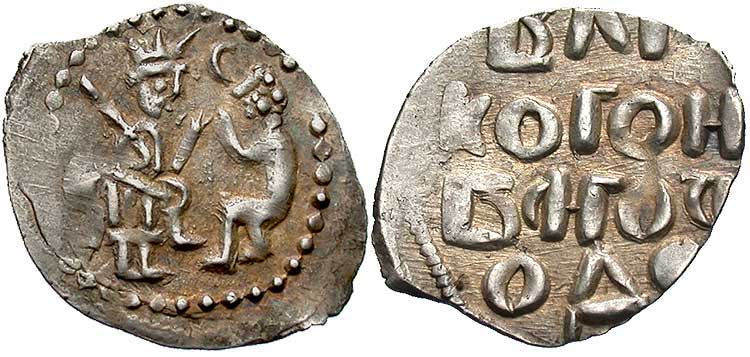
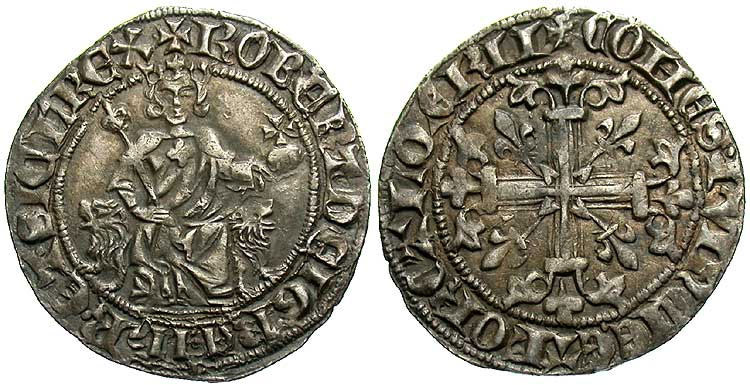
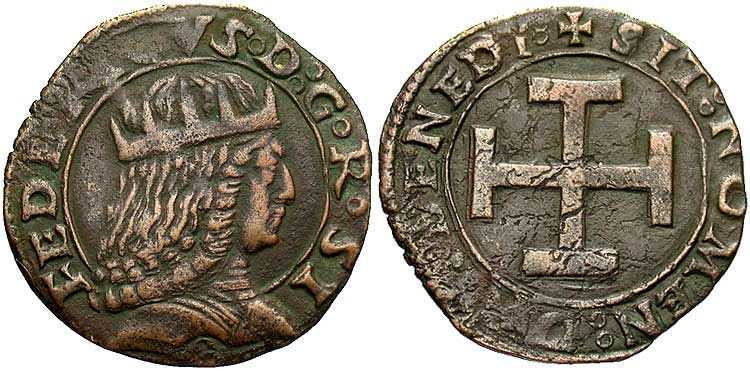
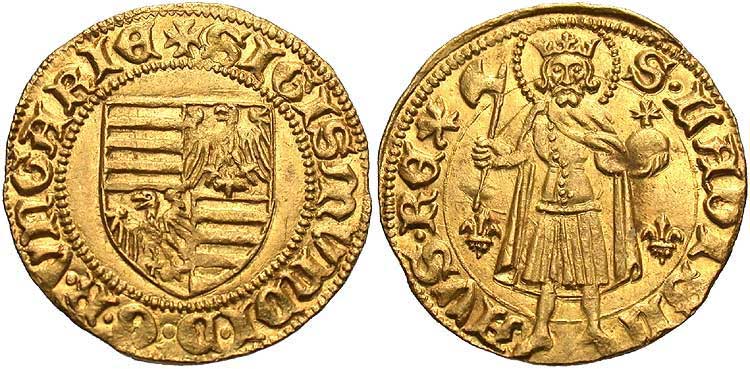
those are fantastic coins john! what's the middle(ish) coin with the king reaching to the man annd the text on the reverse? I'm glad this thread was started, I got this coin today and wouldn't have posted it here otherwise. I personally cut off my medieval/modern collection around 1500...so this guy goes withe the old coins.   giovanni maria vsiconti duchy of milan ar grosso 1402-1412 st. ambrose biscione (emblem of house visconti...a snake devouring a man) Edited by chrsmat71
12/23/2013 8:21 pm
|
|
Moderator
United States
23731 Posts |
Beautiful coins. I wish I had some of those.
|
|
Valued Member
United States
104 Posts |
Ooh, I always wanted a grosso from Milan but never got one. Nice coin!
The middle-ish one is:
Principality of Novgorod. 1420-1456. AR denga (16 mm, 0.79 g). Prince, holding sword, standing right and receiving hommage from subject kneeling left / Four-line Russian legend. Spassky fig. 66, 2 var. (crosses in left and right fields of obv.); Petrov -.
John
|
|
Pillar of the Community
United States
870 Posts |
I only own a few coins of this period.
Those above are fantastic!
|
|
Pillar of the Community
Russian Federation
5186 Posts |
That's one of the best pre-unification Russian coins I've ever seen. Great example! How much it cost? I myself only have one "feudal" Russian coin: a teensy tiny copper pulo of Tver (one of the latest issues of this incredibly small denomination - very roughly, 1520-1550). I probably couldn't afford a silver coin of that period  |
|
Pillar of the Community
United States
870 Posts |
This is the extent of my English coins. Not all of them Medieval. Richard I 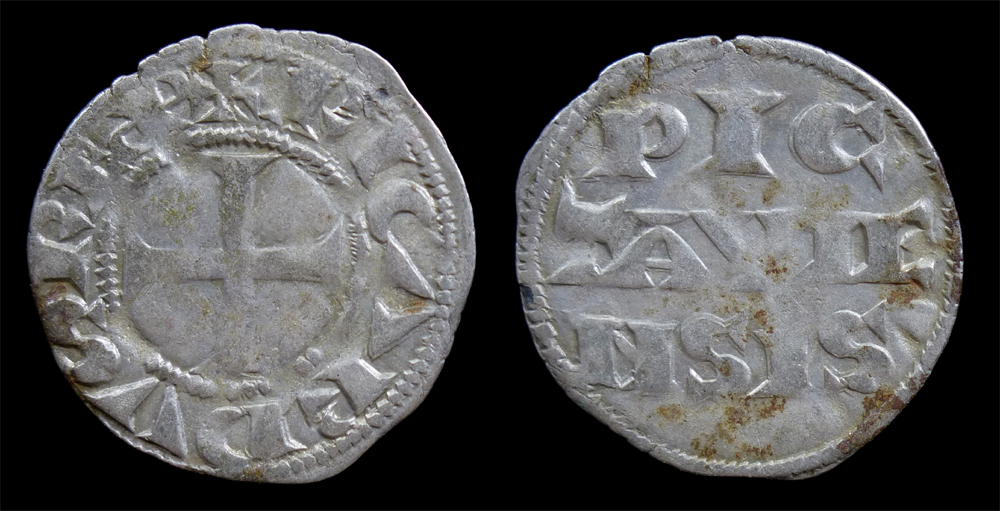 Edward I 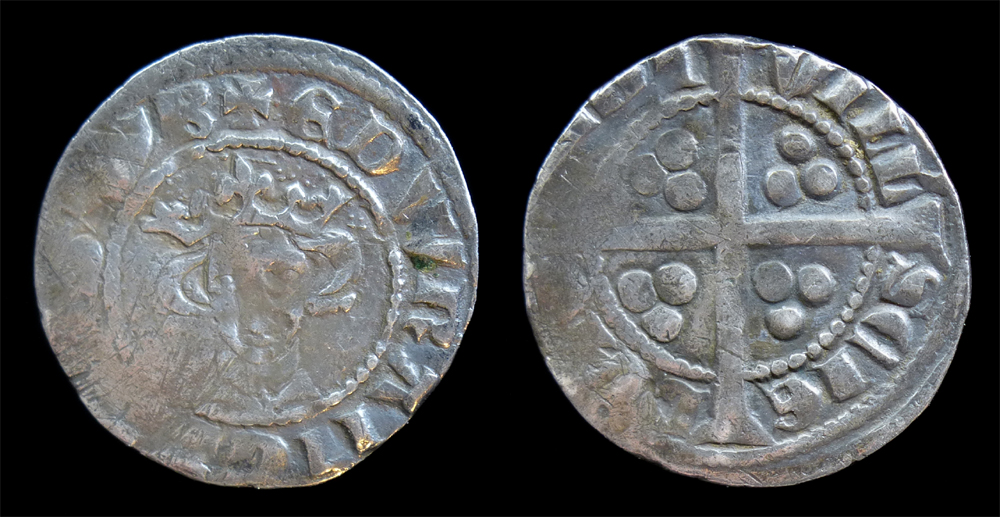 Elizabth I 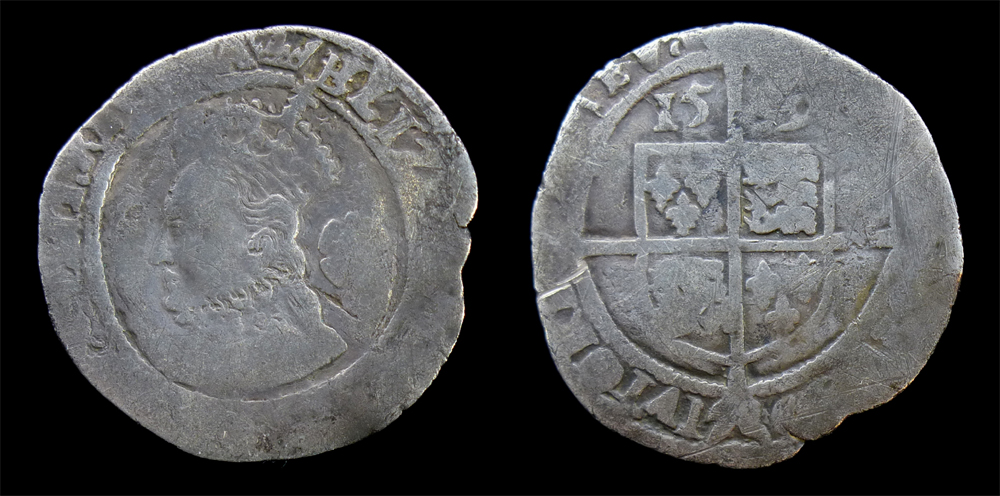 George III 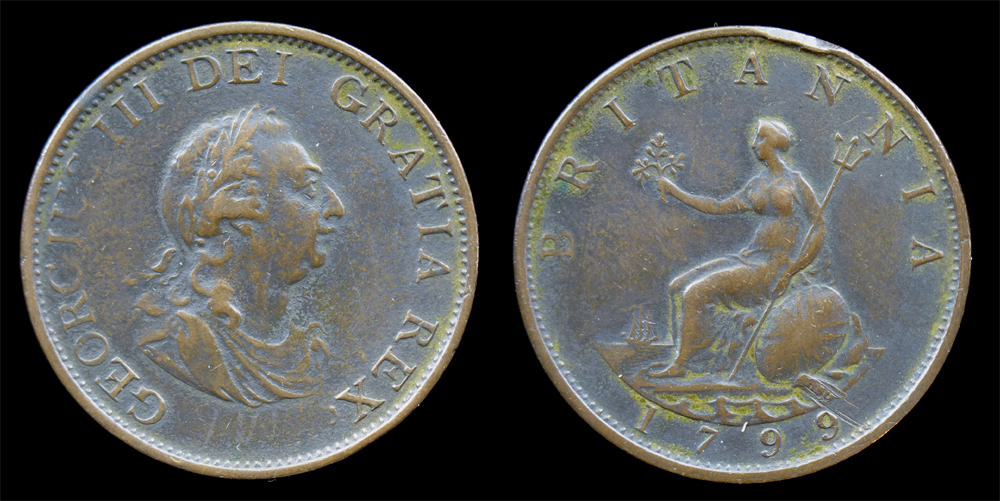 Victoria  Elizabeth II 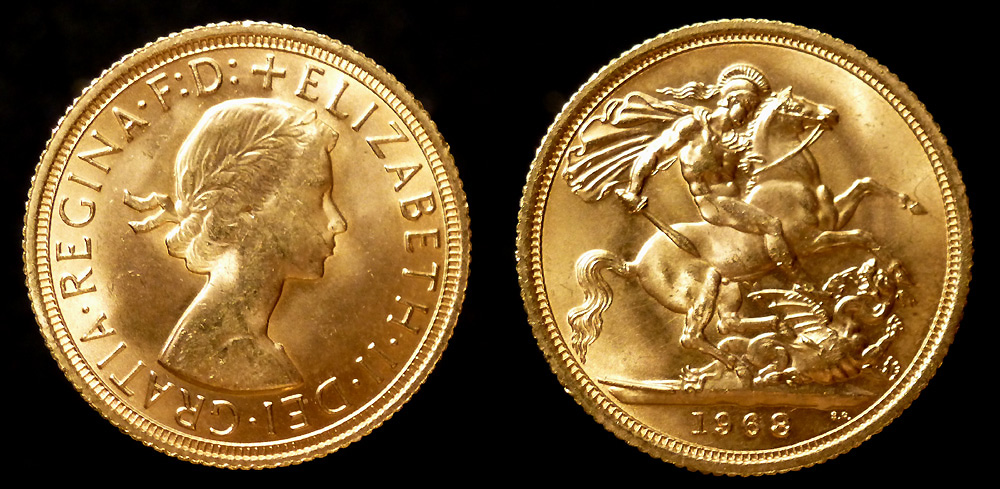 |
|
Pillar of the Community
Netherlands
1204 Posts |
amazing (medieval)coins, new interesting period for my coincollection perhaps
|
|
Bedrock of the Community
United States
10045 Posts |
Quote:
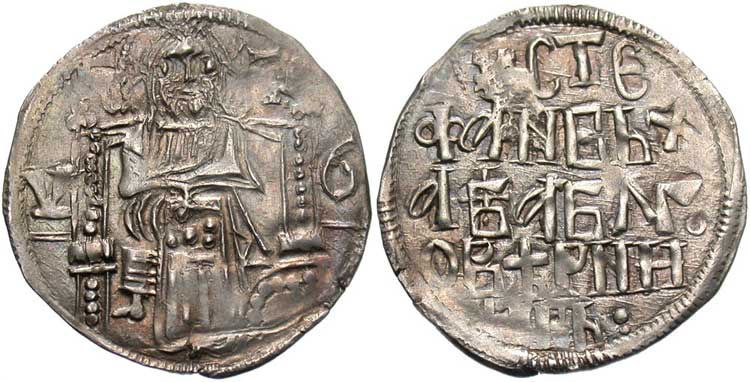
Principality of Novgorod. 1420-1456. AR denga (16 mm, 0.79 g). Prince, holding sword, standing right and receiving hommage from subject kneeling left / Four-line Russian legend. Spassky fig. 66, 2 var. (crosses in left and right fields of obv.); Petrov -. I noticed the Cyrllic text immediately, but could not place the coin. This may not be the best place to discuss this, but what's the story behind this coin with Cyrillic text? It looks very old, almost Byzantine...  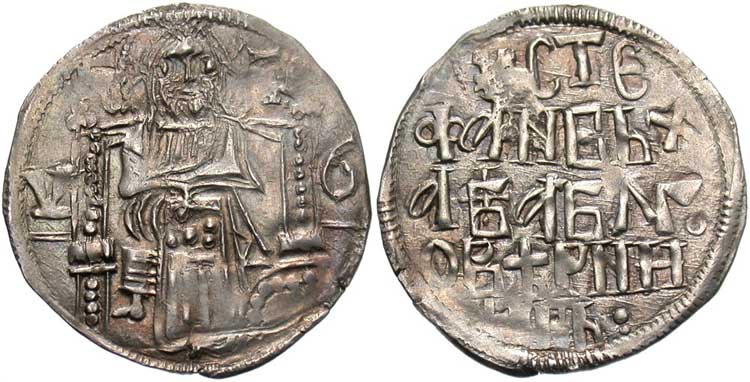 |
|
Moderator
Australia
16985 Posts |
Just to clarify: the coin DVC posted is not the Novgorod coin mentioned in the quote. The Novgorod coin is #5 in the selection posted above by Triskeles. The coin in DVC's post is a silver dinar from Serbia, Tsar Stefan Dusun (1331-1355).
As with many Balkan States issues, they imitated either the contemporary Byzantine or Venetian coinage designs.
Don't say "infinitely" when you mean "very"; otherwise, you'll have no word left when you want to talk about something really infinite. - C. S. Lewis
|
| |
Replies: 55 / Views: 17,075 |










 Posted 12/23/2013 5:00 pm