| Author |
 Replies: 6 / Views: 3,539 Replies: 6 / Views: 3,539 |
|
|
Pillar of the Community
Netherlands
847 Posts |
Dear Forum members, I have an coin in my collection which I can't identify. I am hoping that someone here can help me maybe? On one side there is an long cross and the other side an shield. I think this coin is dated between 1400-1530? And possible From france because of the Lelie inside the shield. Diamter is around 17mm and weights 0,48 Gramms Material is copper/bronze . Looks like silver because of the light when I took the picture. Hope someone can identify this one.. 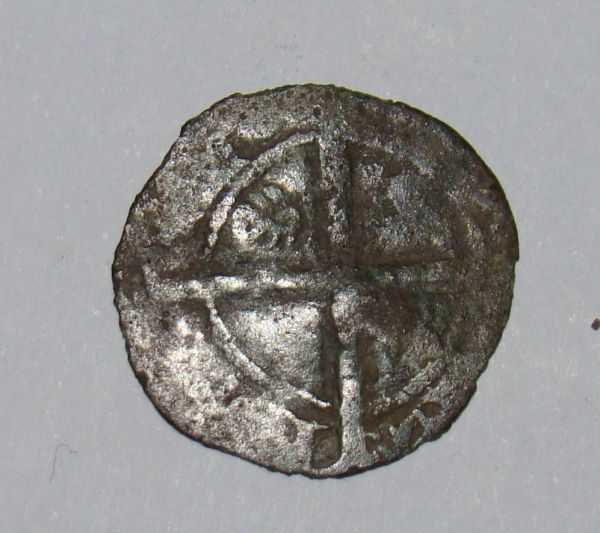 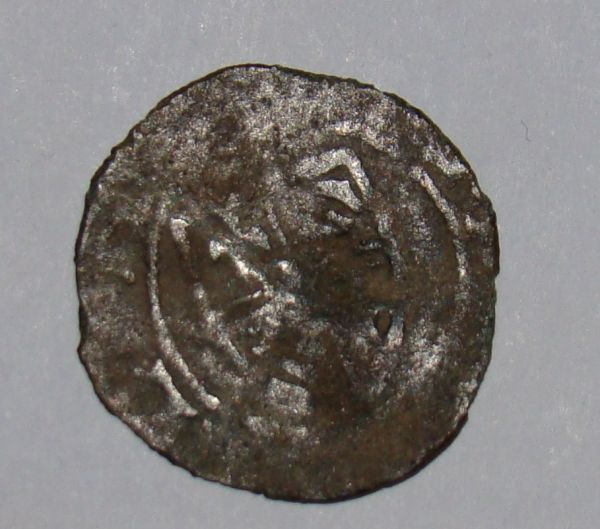 |
|
|
|
Pillar of the Community
United States
3253 Posts |
A coin with arms with the single fleur-de-lys in the first and fourth quarters (upper left and lower right) means one thing: the Valois Dukes of Burgundy, descended of Philip the Bold, who reigned 1363-1404, and took the lys from the arms of his father, the king of France. In the main line of the Dukes of Burgundy, the second and third quarters should feature a bendy of six, or six diagonal stripes; I'm not sure that's what we're seeing here. Anthony, younger son of Philip the Bold, became the first Duke of Brabant, Lotheir, and Limburg of the House of Burgundy in 1406. He changed the second and third quarters of his arms to Brabantian lions. Five Valois Burgundian Dukes of Brabant bore these arms. Take a look at this billon prixsken of the third Duke in that lineage, Philip of Saint-Pol (1427-30). It also features the long cross on the reverse. Your coin also seems to have an L in the obverse legend on the left side, which may fit well with the rendering of the title DVX BRABA ET LIMB. http://www.coinarchives.com/w/lotvi...a115b191cb33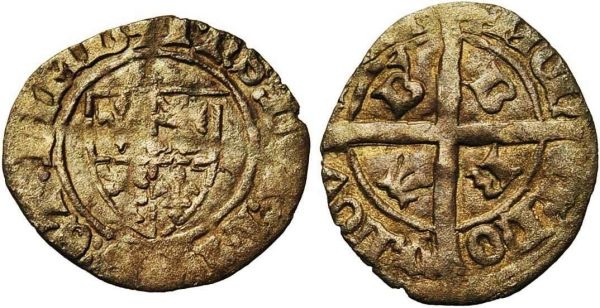 Edited by philadelphian
12/29/2013 12:08 pm
|
|
Pillar of the Community
Belgium
506 Posts |
The coin having no monarch face depicted is consistent with the period it's supposed to originate from.
French deniers/double tournois... usually have three lilies in a triangular pattern: two above & one below.
The shield with four compartments is not consistent with that line-up. The coin doesn't include a crown either (as it should for a king).
So I agree with the previous posting, assigning this coin to on of the Burgundy dukes, likely, Philips the Good or Charles the Bold. This pinpoints your coin to the mid 15th century.
The low weight may indicate it is a billon coin (a low fineness copper/silver alloy).
|
|
Pillar of the Community
 Netherlands
847 Posts |
Thanks alot for the Explanation of the coin. Philip And Gwyde. Verry helpfull and also interesting to know something new about frensch coins from this period.
It looks also like this one. Trying to translate a bit.
Mijt z.j , 1410 , Jan with no fear ( 1404-1419) , Graafschap Vlaanderen
Minted in Gent
Ref.nr. : Deschamps de Pas VIII-9
|
|
Pillar of the Community
United States
3253 Posts |
You mean this coin: 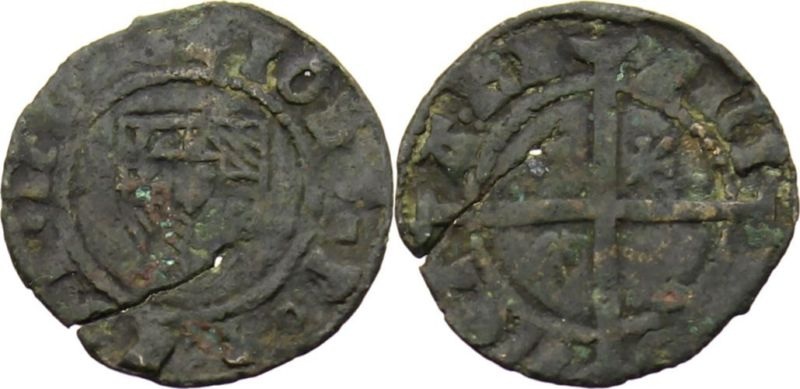 John the Fearless was Duke of Burgundy after his father Philip the Bold. He also inherited the County of Flanders from his mother, and so his arms, and those of his descendants, had an inescutcheon (a small shield in the center of the shield) with the rampant lion of Flanders. If you can see a miniature shield in the middle of the shield on your coin, it would very likely make this a coin of the early Valois dukes of Burgundy, and rule out the line of the Dukes of Brabant that started with Anthony, the brother of John the Fearless. |
|
Pillar of the Community
Netherlands
847 Posts |
Hello Philadelphian,
Thank you for your reaction. It is hard to see the shield. Because of the bad quality of this coin. I though that this coin looked more alike because of the sing alround the cross. It seems different then the signs around the coin you posted the first picture.
|
|
Pillar of the Community
United States
3253 Posts |
I know. The coin of Brabant I posted has the letters B R A B in the angles of the cross. I think yours likely has two lions and two fleur-de-lys, which seems to be common for the long cross style coins of the Dukes of Burgundy of this period.
|
| |
Replies: 6 / Views: 3,539 |
|










 Posted 12/29/2013 5:20 pm


