Quote:
Is it illegal for a jeweler to produce and/or sell replicas of Spanish colonial coinage in the USA? I have seen some on display.
I never pay much mind to the specific reqs. in that 1973 "COPY must be stamped ..." law... At the very least, I know it's legal to produce replicas if copy is stamped in the design (the Fishers, Atocha Treasure Co. - which isn't affiliated w/the Fishers, and similar outfits produce/procure gads of them). Mind you, sometimes the word COPY is well-hidden within the design (or sometimes just done with a tiny letter "C")... However, I've seen quite a pieces of a similar style that DON'T explicitly have COPY or "C" or "R" (replica) anywhere... Why/how that is, I don't know and it really doesn't matter to me for my purposes (though of course they shouldn't be produced like that b/c that makes it easy to try to pass them as real to people who don't know better... and that fact can't possibly be lost on those who manufacture them like that).
At any rate, I try to look at the piece and recognize what's there... and you should ALWAYS give extra scrutiny to pieces mounted as jewelry.
Quote:
...you'll be in luck if the bezel is real gold
Not impossible... ATC, for example, puts a lot of their cast reales replicas in solid 14K... It does seem disproportional to the value of the centerpiece, even if the piece in question here was a GENUINE 2R (you could justify that for a nice 8R replica, maybe), but nonetheless they do it...
Quote:
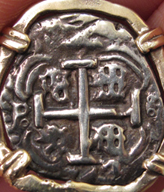
the upper right quadrant of the cross should be a lion, not a castle
Someone noticed!
Quote:
there are some cobs with inverted castle / lions
Very true... BUT how often have you seen 3 castles to only 1 lion, as we have here?! That's so egregious, it was what I figured might be an intentional "tell"...
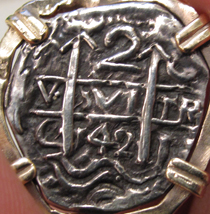
I'll note here that in my picture files, I have a similar copy using an iteration of this same pillars-side... but with a complete different cross side.
Quote:
It looks way too good to be real.....
Quote:
As for it being too good, I have some which are in a similar shape... although small denomination are scarce when complete like that, particularly in this late era.
That all has to be qualified a bit... I never like the blanket statements/assessments along the lines of "Real cobs aren't that well struck/aren't that nice"... or similar. There is way too much fluctuation between mints/eras to run with that premise AUTOMATICALLY. However, I also don't like the blanket generalization that "they were better-done early on, and then gradually saw a reduction in quality..." Perhaps more true than the "cobs aren't that good" thing... but also not always correct. Late 1600's Mexican cobs are much worse than late 1720s-1730s pieces... and while the very end of Potosi production was probably the lowest point of quality (dumpy planchets of terribly uneven thickness with blobbish design elements)... pieces right around 1740 were in general much nicer than ca. 1710 Potosi output.
Specifically, yes, this 1742 might look "really bold" compared to what our general concept of what 1700s Potosi cobs AS A WHOLE "usually" look like... BUT look up some other examples of 1742 2R... They happen to be VERY well done... fairly level planchets, full, centered strikes... often appear "semi-Royal".
See this composite... note that only that the piece lower right was called Royal. The rest aren't (incl. the semi-round one upper right, sold by Sedwick).












 Posted 01/06/2014 11:29 pm


