| Author |
 Replies: 9 / Views: 4,077 Replies: 9 / Views: 4,077 |
|
|
New Member
United States
9 Posts |
Hello all! I have recently discovered this site as well as my old childhood hobby of hoarding world coins and learning about them, which brings me here to see if anyone knows the story of two tokens I found in my junk drawer: 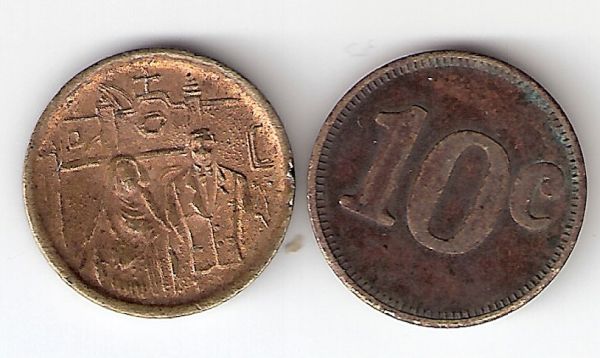 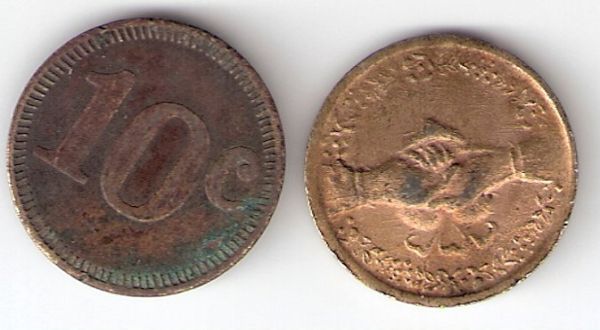 These are both the size of a US dime. As you can see the 10c token is identical on both sides. I'm not much of a token collector but as with any coin-like object, I like knowing why and where it was created. Thoughts anyone? |
|
|
|
Pillar of the Community
United States
4212 Posts |
|
|
New Member
 United States
9 Posts |
It is definitely the same token as one of my mystery ones, too bad the seller didn't give a backstory that would explain its source! Thanks though, I guess if anything, I can watch it and see if it's worth $13 or not.
|
|
Pillar of the Community
United States
1234 Posts |
The 10c one reminds me of military tokens, but it appears to be older than Viet Nam era, they were used in juke boxes and games, here is a quote I got from somewhere last year and have forgotten where I got it from. Quote:
This is typical of the Vietnam-era canteen tokens. Hundreds of different types are known.
The small "S-in-diamond" logo is the "mintmark" for the Sega Corporation, who made their money in pinball machines and similar distractions long before home entertainment consoles and Sonic the Hedgehog came along. Indeed, the company was originally founded in 1952 specifically to sell amusements to the US military; the name "SEGA" is short for "Service Games".
Which also explains what these tokens were primarily used for. Rather than being paid in US or local currency, military personnel were paid in MPCs - paper money. So to operate a pinball machine, vending machine or whatever, you needed to convert that paper money into something coin-like, and tokens were the method of choice. Yours doesn't have the "S-in-diamond" but not all of them did, some of mine say only '5' or '5 cents'. I may be totally off with this, like I said it seems older than the 60's. |
|
New Member
United States
9 Posts |
I like your theory Aslan, it is plausible as anything! Indeed, I do own a couple of definite US military Vietnam-era tokens, though both the ones I have bear words only and no denominations. This guy does feel and look older than 60's, but who knows. Thanks for the little SEGA tidbit, I may have not learned the true story of my token, but I did learn something!
|
|
Moderator
 Australia
17002 Posts |
Quote:
here is a quote I got from somewhere last year and have forgotten where I got it from. You got it from me, here on CCF.  As for the 10 cent token, the military canteen tokens generally don't have the denomination this big and bold. I'd assume this is a more generic slot machine token. Perhaps dating from the 1920s, when slot machines were a part of the whole Prohibition-era alcohol-and-gambling racket. An illegal gambling operation would not want to advertise their name and address on their tokens; they'd buy generic tokens like this instead. Don't say "infinitely" when you mean "very"; otherwise, you'll have no word left when you want to talk about something really infinite. - C. S. Lewis
|
|
Pillar of the Community
United States
3079 Posts |
Wedding tokens with a bride and groom standing in front of what looks like a Spanish mission. and the clasped hands and what looks like stylized hearts around them. http://en.wikipedia.org/wiki/Las_arras |
|
Pillar of the Community
United States
1234 Posts |
Someone once said if you are going to steal, steal from the best  Thanks Sap  It might have been Arthur C. Clarke or Groucho Marx, heck might have even been Dillinger. I said it looked too old to be 60's so 20's does sound a lot better. The extra flourish curl on the top of the C, the basic font type, makes me think of even older times like 1880's or earlier but no juke boxes then. Were there any special issue post Civil War reconstructionist tokens, probably not. |
|
Bedrock of the Community
United States
10045 Posts |
As a comparison, here's a token from the Australia Liverpool NSW internment camp during WWI.  Generally speaking, coinage styles changed markedly around WWI, and I've noticed tokens often reflect that. Once things move towards "Art Deco" or "Moderne" into the 20s, serifed lettering and denticles go too, unless one wants to appear old-fashioned. For instance, it's easy for me to forget what a dramatic change US coins underwent during this time--just one example:  Edited by DVCollector
01/20/2014 7:22 pm
|
|
New Member
United States
9 Posts |
Just wanted to say thank you everyone for the insights, I now have a much better idea behind the story of both of my tokens.
The folks at Numista had no clue. Just sayin' :)
|
| |
Replies: 9 / Views: 4,077 |
|









 Posted 01/19/2014 4:13 pm


