| Author |
 Replies: 18 / Views: 2,408 Replies: 18 / Views: 2,408 |
|
Valued Member
United States
218 Posts |
Got an odd one, at least for me, as I have stated before I have very little experience with error coins. I found the "E" on the reverse kind of odd. Any ideas on what it might be? 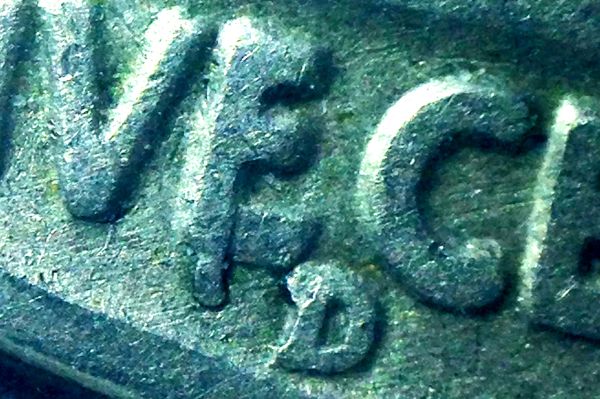 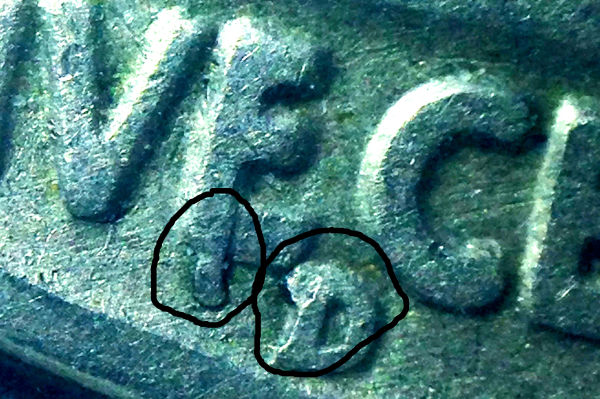 |
|
|
|
Pillar of the Community
United States
7724 Posts |
Post mint damage in my opinion
|
|
Valued Member
 United States
218 Posts |
Even the spot below the E? That looks like it was stamped in; it is raised not depressed. I can see the "D" being PMD but the E, that tail thing hanging down is raised. Edited by jolson
02/03/2014 8:15 pm
|
|
Valued Member
United States
337 Posts |
Notice the tail on he E starts above the bottom of the E, it goes through the bottom horizontal bar. But the D seems to have missing metal. I doubt the D was added with heat causing metal to flow, simply because the 1937 D is not worth adding the D to someone who does sch things.
|
|
Valued Member
United States
218 Posts |
I see the line on the E starts on the E... so your opinion is PMD? Or was this a minting error? The D does seem to be PMD, no doubt, but the theory that the metal from the D transferred over to the E doesn't seem to make sense as they are different shapes and the meal on the E appears to be a bigger mass then what is missing from the D? |
|
Pillar of the Community
United States
571 Posts |
The metal on the E could be a die chip, where a tiny piece of the die broke off and left a void on the die, so that when the coin is struck it would leave a raised area on the coin. It's so small though, that it probably would not add any value to the coin. The D is PMD, looks like it took a hit. |
|
Bedrock of the Community
United States
17884 Posts |
I agree with Dave42, the E could be a die chip and the D definitely looks like PMD. |
|
Pillar of the Community
United States
1291 Posts |
Odd. And if you look closely under the "C", you see what appears to be a nearly identically shaped outline of the same thing, almost if drawn by a pencil...
|
|
Pillar of the Community
United States
1137 Posts |
If the E took a hit, and moved copper, the piece getting moved would appear smaller than the metal missing from the device, and this extra metal being relocated would raise up off of the surface because, it will follow the path of least resistance. PMD all the way on this one. |
|
Bedrock of the Community
United States
62064 Posts |
If it is moved metal, it would be not really attached and could be removed. But if it is a die chip, it can't be removed.
|
|
Pillar of the Community
United States
1137 Posts |
I have seen lots of metal moved from a device but still attached to the same device. After wear and tear, it looks like it was always there.
|
|
Pillar of the Community
United States
1137 Posts |
Maybe pushed out of placed is the better terminology to us in this example.
|
|
Valued Member
United States
218 Posts |
Ok so anywhere from die chip to PMD... If this helps I got a Q-tip and tried to move it... What ever it is; it sure is fuzzed in. Plus I looked under a microscope and it seems to blend into the metal perfectly (as in being one part). What ever it is sure is fixed in that position... does this new info change anyone's mind? |
|
Pillar of the Community
United States
1137 Posts |
jolson, I did not mean to say this metal is a lamination peel or loose in anyway. What I was trying to say was that the letter E took a hit, from a solid object, not a Q tip. After the hit, ding, whatever it was, the force relocated a small piece of the device (letter E) in this case. This would be PMD IMO, but even if I am wrong and it is in fact a die chip, there would be no real value added to the coin. |
|
Valued Member
United States
218 Posts |
@chzman, I really appreciate your help as you obviously know about error coins then I. I do not mean to sound difficult, but I want to understand, are you saying that at some point in the past the "E" was hit and somehow "smashed" a little bit upward kind of like a pinch?
|
|
Pillar of the Community
United States
1137 Posts |
I know that you are not trying to be difficult, your good dude. That's what I believe happened, but I have been wrong before, and certainly do not know that much more than you, it is a constant learning process for me as well. But overall, for this particular coin, no matter if it was hit like I theorize, or if it is a die chip like others may suggest, the coin is not worth a premium to you as an error collector. If you are really interested in errors and varieties, then you must have a better understanding the minting process. To do this, get on youtube and watch some good videos on how the minting process works, this will help you understand how some errors, and varieties are created. Read this to- http://doubleddie.com/58201.html Then get a good book, read it cover to cover, make a cheat sheet, with the errors and varieties that you find the most appealing and start roll searching. A great starting book IMO is "Strike It Rich" written by Ken Potter and Brian Allen. |
| |
Replies: 18 / Views: 2,408 |










 Posted 02/03/2014 8:14 pm


