| Author |
 Replies: 14 / Views: 1,556 Replies: 14 / Views: 1,556 |
|
|
New Member
United Kingdom
16 Posts |
2 More coins here for this lovely community to help me ID :) Coin 1: Weight - 7.65g Width - 2cm   Coin 2: Weight - 2.80g Width - 2cm   *** Moved by Staff to a more appropriate forum. *** *** Moved by Staff to a more appropriate forum. *** to Ancients coins |
|
|
|
Pillar of the Community
United Kingdom
4208 Posts |
The first coin is a greek one, so I cant help you there. Second is Constantine II, VIRTVS EXERCIT from thessalonica, like this one:  |
|
New Member
 United Kingdom
16 Posts |
|
|
Pillar of the Community
United Kingdom
3626 Posts |
It might be this one, but I would rather someone else confirmed it, I an just learning these myself :) http://www.acsearch.info/ext_image.html?id=319756SYRIA - Seleucia AND PIERIA - ANTIOCH ( first century BC ) Bronze ئ 23 No v18_0132 Date: 90-89 AC . Workshop Name : Syria, Antioch Metal: bronze or copper Diameter: 21mm Axis corners : 12pm. Weight: 9.26 g . Rarity : R1 State of preservation: VF + Start Price : € 100 Estimate : 200 € Realized price : 100 € Comments on the state of conservation : Beautiful portrait with dark green patina . Strike a bit soft at the back , but well centered copy . Number in reference books : BMC.14 - GC.5853 var. - RPC . - Obverse Titulature : anepigraphic . Obverse description: Laureate head of Zeus right ; beading . Description setback Zeus naked to the waist , wearing himation seated left , holding Nike in right hand and long scepter in left, at his feet, a cornucopia , all in a crown . Reverse legend : ANTIOXEΩN THΣ / MHTΡOΠOΛEΩΣ / / Î"KΣ Comments: This series seems to have been struck between 92-91 AC . and AC 77-76 . This program includes two major series produced by two different standards. Our part is to the second and seems to have been struck by the Phoenician standard with a heavy duty and light . Our part is to small group. History : Antioch was founded in 300 BC by Seleucus I. . It was the capital of the Seleucid Empire before becoming one of the Roman province of Syria. Syria was annexed by Pompey in 64 AC . Three different eras seem to have been used during the first century AC: the Seleucid era began in 311 AC , the era of Antioch or Pompeian starts in 64 AC after the end of the Seleucid dynasty era Caesarean starts 49/48 AC . Caesar said Antioch, free city in 47 BC |
|
New Member
United Kingdom
16 Posts |
If you right does that mean my greek coin COULD be worth €100!?
|
|
Pillar of the Community
United Kingdom
3626 Posts |
Sorry but I doubt it. If you look at the picture and compare it with yours, it is a much superior coin.
Your coin also has some pitting that is reminiscent of a cast coin. It might be fine, but I would rather someone else gave their opinions.
|
|
Pillar of the Community
United States
3496 Posts |
It is worth what any darn fool will pay for it ! Condition of course is everything. Bronze coins were made to be used in everyday life. Silver and gold tend to get socked away for special occasions and so the standards for them are much higher than the AE issues. The one shown in the example is rather a rather nice one. Yours is pretty too ..... but has quite a bit of mileage on it. I tend to shy away from most 'Greeks' and I am famously cheap ! But I think $15-20 would be in the ballpark. By the time of Constantine II (second coin) the mints were operating 24/7 and the product was of lower quality. The fact that so very many of these type coins exist depresses the market for them. A gem will still bring in $25-30 but the one like you have are often offered in bulk (5-10-100-200-1000) for a few dollars apiece. Due to the output there are plenty of varieties to choose from and collect. If you are the sort that would collect a series of Lincoln or Indian cents then these coins may appeal to you as they will not break the bank (as long as you shop wisely) and have the newly added innovation of the 'mint mark'. In the late Roman Empire it was decided that the best way to keep all the various mints honest was to put a 'makers mark' so any funny stuff might be traced not only back to the mint but to the actual division (officina) within the mint so that those responsible might get their just deserts ....... one free haircut ! |
|
Pillar of the Community
United States
3496 Posts |
The 'Greek' looks fine to me. Suffers only from what my wife says about the women I once dated before we met.
"Too much mileage !"
|
|
New Member
United Kingdom
16 Posts |
I paid £5 for it and it was my first ever ancient coin and it was what got me into collecting ancients. I guess thats why I have a fair few Constantin II then. Thanks so much for the help guys I'm classing this as solved now. Will be posting 2 more coins later tonight! :)
|
|
Pillar of the Community
United Kingdom
3626 Posts |
You did really well for a fiver.
|
|
New Member
United Kingdom
16 Posts |
Thanks :) considering the greek was my first coin purchase I'm pretty pleased
|
|
Pillar of the Community
United States
3496 Posts |
Off the top of my head 5 sounds like around $7.50 ? You did not overpay ! A decent looking 2,000 year old AE with both front and reverse essentially intact ?
If you can find more like this you will have done well.
|
|
Pillar of the Community
Russian Federation
5186 Posts |
This Greek coin in the OP seems to look a lot like one of my own coins (which I mentally categorized as "Roman Provincial"). Could it possibly be the same type?  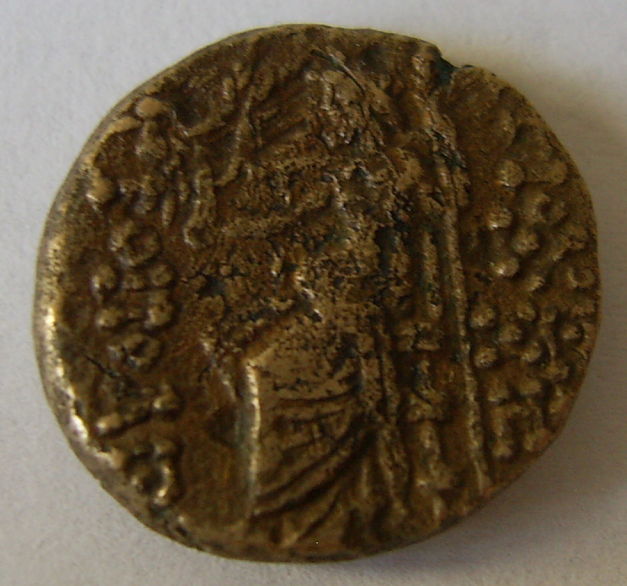 (sorry for the bad photos, I'm an awful photographer, and these were among my earliest coin photo attempts; I might try to get a photo of that coin again some day) |
|
Pillar of the Community
United Kingdom
3626 Posts |
I think it probably is, but I can't read the legends.
|
|
Pillar of the Community
United States
5010 Posts |
that sure does look like it.
|
| |
Replies: 14 / Views: 1,556 |
|






 Posted 03/06/2014 02:44 am





