| Author |
 Replies: 38 / Views: 8,293 Replies: 38 / Views: 8,293 |
|
Pillar of the Community
United States
4431 Posts |
I've done some reading about the origin of this token, and I see that the catalog value is into the five figure range. I have some specific questions about this issue:
1) How many 1825's are known? I read that less than 5 of the 1820/5 token exist.
2) Where is the plate token that Haxby pictures?
3) An 1825 sold at auction (Jeffery Hoare) in London, Ontario in October of 1989. What was its condition, and what was the price realized?
4) Have there been any recent articles published about this issue?
5) Who are the foremost experts in this area; this, to whom, these questions may be posed.
Any/all replies would be much appreciated ... Thanks!
|
|
|
|
Pillar of the Community
United States
840 Posts |
I am sorry but I can not be of much help concerning this information.
Your population counts are the same as my understanding.
I recall a couple recently (within the last year or so) passed hands
at a major auction. I do not remember when or where. The overdate
is the rarest of this series (R-10)and command much more than I can
afford. There are several other varieties within this series having
an R factor of 9.
doug
|
|
Pillar of the Community
 United States
4431 Posts |
Thanks for the reply, Doug. You say that the overdate is the rarest. I found that a very low grade overdate sold for about $5,900 CAN around seven years ago. Yet, both Haxby and Charleton value the 1825, non-overdate, much higher than the overdate. Haxby says $15.000 for the 1825 in VG, but I'm at a loss as to how that valuation was derived. There was a major token auction in New Brunswick, later last year, however, there were no examples of the 1820/5 or the 1825 therein. If these are trading hands at auction, I've been totally unable to find any online record of same.
|
|
Valued Member
Canada
496 Posts |
I was lucky enough to see one a month or two
ago,and it was a decent grade.
|
|
Pillar of the Community
United States
4431 Posts |
Quote:
I was lucky enough to see one a month or two
ago,and it was a decent grade. Hi, billfrak ... Did you see it at a show, a shop or in an auction? Was it the overdate or the 1825? Can you give any details? Thanks for chiming in! Edited by ExoGuy
03/28/2014 6:21 pm
|
|
Valued Member
Canada
496 Posts |
A fellow collector here in London has a
beautiful collection,and it was the over date.
It was the only one I have ever seen so nothing to
compare with.
|
|
Pillar of the Community
United States
4431 Posts |
|
|
Pillar of the Community
United States
4431 Posts |
Doug wrote: Quote:
The overdate is the rarest of this series (R-10)and command much more than I can afford. There are several other varieties within this series having an R factor of 9. Doug ... What is the source of these rarity assignments, may I ask? It seems contrary to both the Charleton and Haxby valuations. They both value the 1825 significantly more in dollars than the overdate. Doug ... A general question on rarity, if you will. You wrote that the overdate is an R-10 and the 1825 is an R-9. An R-10, stateside, translates to a unique or but one specimen extant. Is it not the same with Canadian tokens? As noted above, there are at least two overdates known. That would be an R-9 then, stateside. |
|
Pillar of the Community
United States
840 Posts |
The 1825 is Courteau variety 21 and the overdate is Courteau variety 22. Both are listed by
Dr. Courteau as having a rarity factor of 10. And yes, there are several others within the
series having a r factor of 9. Dr. Courteau makes reference to knowing of only 3 or 4 ensamples
of the 1825 and provides no further data concerning the population of the overdate.
Dr. Courteau did his work at the early part of the last century. But values of today are based
much upon popularity and availability. I would be interested in knowing the actual current
populations of both. How many of each remain in private collections. How many will never again
see the auction gavel. Have any become lost. I do not know.
As per population, one of a kind are references as unique. What is the rarity of a population
of 3, when two are in permanently entrusted in museums and only one is in private hands. Other
comparisons can be made. I recall reading a population comparison and I will endeavor to find it.
This is not a quotation, but the gist of what I recall reading.
R-10 1-5 Utmost rarity. You may know someone who knows someone who knows someone who says they have actually seen one.
R-9 6-12 Extremely rare If you are fortunate you may see one being auctioned within your lifetime.
R-8 15-25 Very rare You may know someone who owns one. Trading hands perhaps every 5 years.
R-7 26-75 Rare You may be fortunate to own one. Trading perhaps once a year.
R-6 76-200 Extremely Scarce They are available, but you have to do a lot of searching to find one.
R-5 200-500 Very Scarce You may have one.
R-4 500+ Scarce You probably have several.
R-3 1000+ Common You already have too many.
R-2 3000+ More common Stuff that is not worth keeping, but to valuable to throw away.
R-1 10000+ Stuff you do not want. Items that comprise 98 percent of most collections.
doug
|
|
Pillar of the Community
United States
4431 Posts |
Doug ... Thanks so much for taking the time to give such a detailed reply. You've given me a few more avenues to explore. The rarity scale, stateside, is very different then, it seems.
I've acquired what I suspect is a genuine 1825, and I'll eventually post some pics. Certification is a must. Meanwhile, the learning experience is occupying my interest. Thanks again, for contributing to my education!
|
|
Pillar of the Community
Canada
1984 Posts |
Since we are on the topic, here are a couple of pictures of a coin of my grandfather's. It looks pretty good, but Brian Cornwell was suspicious that the date was altered. I would take $15,000 if someone wants to pay it though!   |
|
Pillar of the Community
Canada
1046 Posts |
|
|
Pillar of the Community
United States
840 Posts |
I concur with Mr. Cornwell. The obverse portrait and the reverse harp and date are not consistent with known 1825's.
To quote Dr. Courteau "Obv. Slender bust with long straight nose; the wreath has three leaves at the top (the
others have only two;) the lowest leaf points backward and extends beyond the back of the head; connected shirt frill;
the cuirasse has only six flaps. Rev. dated 1825. The angel's head comparitively small; the date is much closer to
the edge than to the harp but well spaced; the top 5 is too high; dotted borders. Copper." Dr. Courteau continues
"This variety is much superior to others in workmanship..."
An excellent picture of a genuine 1825's can be found on page 122 of the 1st edition of "A Guide Book of Canadian
Coins and Tokens" authored by Dr. Haxby, and published by Whitman's. This photo clearly shews the doted rim of the
reverse and the date being much closer to the rim and distant from the Harp. The numeral 5 is noticeably higher.
The genuine 1825 shews nine strings to the Harp, whereas yours has 10 strings. Other reverse difference abound.
Concerning the obverse, the point of the bust of the genuine extends much nearer the rim. Your token shews 5 large
separated ruffles below the neck, whereas the genuine shews small connected ruffles. The laurel leaf pattern is
completely different. The placement of the eye is completely different. Numerous other obverse differences exist.
The host variety of your token is Courteau variety 7, having an r factor of 1.
Seeing the 1825 is highly collectable and sought, unscrupulous individuals sought to make a fast buck by duping
potential clients who were not fully astute concerning the genuine item. Your is typical counterfeit of the 1825.
Sorry.
doug
|
|
Pillar of the Community
Canada
1984 Posts |
Thx for the added thoughts Doug. Given Mr. Cornwell's comments I was pretty sure it was altered and I had seen that the number of strings was incorrect. Still a fun piece for me. In hand the "5" appears to be really well done. Whoever did it was very skilled. Assuming it is an altered date, I am guessing that this piece was manufactured about 100 or more years ago as it likely made its way into my grandfather's hands in the 1920s or 1930s.
|
|
Pillar of the Community
United States
4431 Posts |
That's a very detailed description, Doug. Much appreciated. As a newcomer to this series, the markers that I initially saw missing on the pics of the altered 1825 above were as follows: 1) A chubby bust; 2) No dentils; 3) No large die chip in field behind the bust; and 4) 10 harp strings instead of nine. The one I acquired has these four markers, including the nine strings. Here are is one of my amateurish pics: 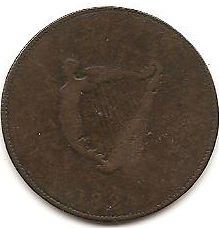 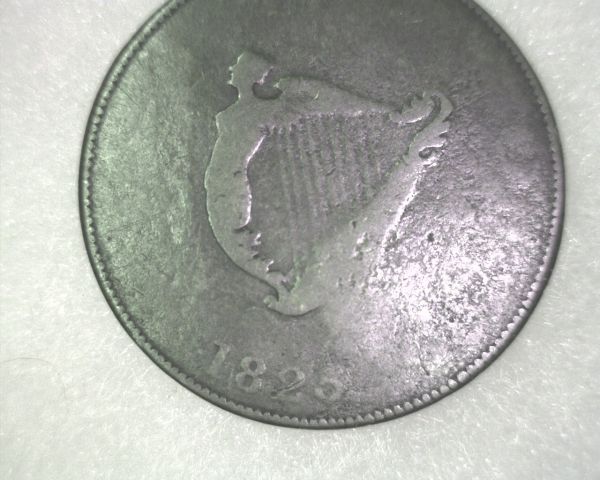 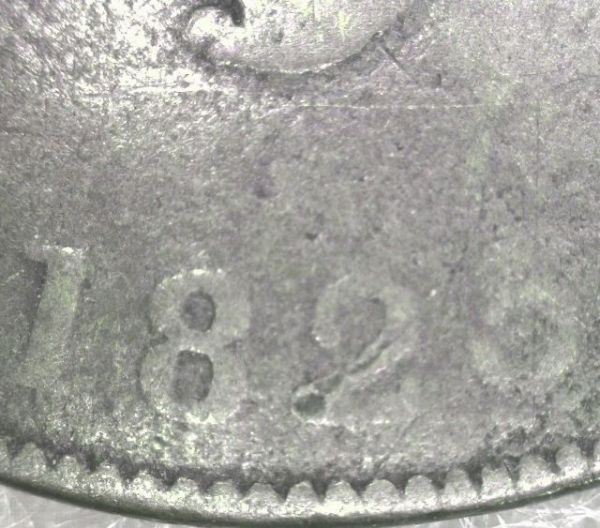 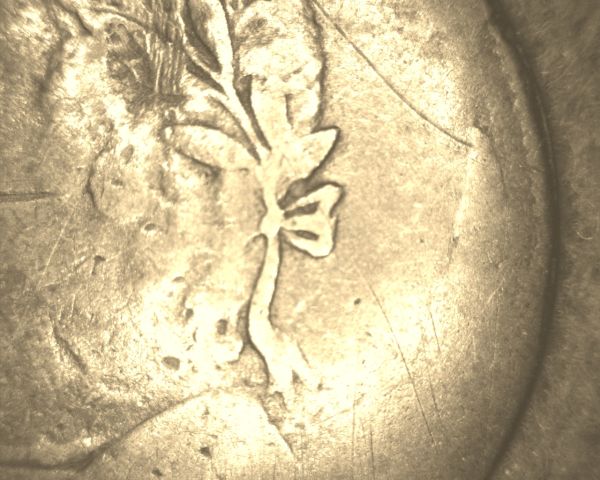 |
|
Pillar of the Community
United States
840 Posts |
Yes, it was well done; a very deceptive alteration. At present, its' most valuable asset is as an
educational piece deplicting this type of forgery. I have heard collectors far more knowledgeable
than I talk of numerous deceptive forgeries of this date. This photo is the first I have actually
seen. I think it would be interesting if one were to publish a study of the known host varieties
of the known counterfeits of this date. Most interesting. Thanks for sharing.
doug
|
| |
Replies: 38 / Views: 8,293 |










 Posted 03/27/2014 11:54 pm


