| Author |
 Replies: 10 / Views: 3,462 Replies: 10 / Views: 3,462 |
|
|
Valued Member
United States
207 Posts |
I am hoping you guys can help me out here on this. So recently I have been fascinated by the 1928-C $20 bills from San Francisco and Chicago. I always loved FRNs from the various 1928 series and the 28-C is really intriguing. The 1928-C $10s are beautiful as the later serials and seal have a bright almost yellowish-green color. I wanted to know why the 28-C $20s are usually found in relatively poor condition? I usually see them in raw or graded format in Fine to VF condition. Finding one in XF or AU seems to be pretty rare. Was it just because they had a low print run? Or because they were printed during the middle of the Depression and people almost always spent them? Below is an image of the note: (I don't own it, but I wish I did) 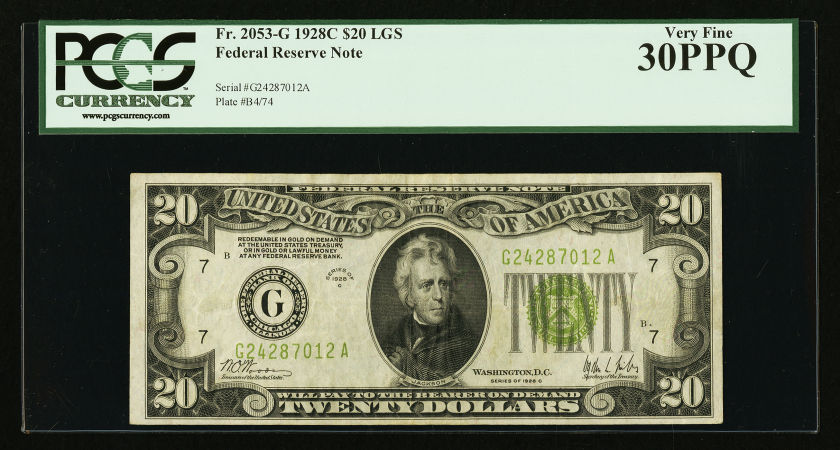 |
|
|
|
Pillar of the Community
Germany
645 Posts |
Hi Woodford,
I think some of the reasons for this are the short output time from 02.13.1932 - 03.03.1933 and the low print run which was only 3.363.300 for Chicago.
Well we would have to know how many bills have really left the vaults of the banks.
From when it was clear that Mr. Woods and Mr. Mills are to be replaced?
When it was soon clear that the mens are to be replaced, perhaps the bills were held back.
At that time of crisis was a real inflation by those responsible people.
On 01.01.1934 Mr. Julian and Mr. Morgenthau came into office.
The question is, have all produced bills ever seen a real circulation?
I do not think so.
Perhaps that is a reason because this bills are rare in better condition.
I'm not sure, It's only a idea.
I hope that you my thoughts well understand, my English is so bad.
|
|
Pillar of the Community
United States
1751 Posts |
$20 was a LOT of money during the Depression. There was a lower print run because of the reduced demand for new notes, I am fairly certain...especially of the higher denominations. If the FRB's don't need them, they don't order them from the BEP.
What few were produced probably all went into circulation in 1933 as we increased the money supply to stimulate economic growth and cover bank failures under the new FDIC scheme.
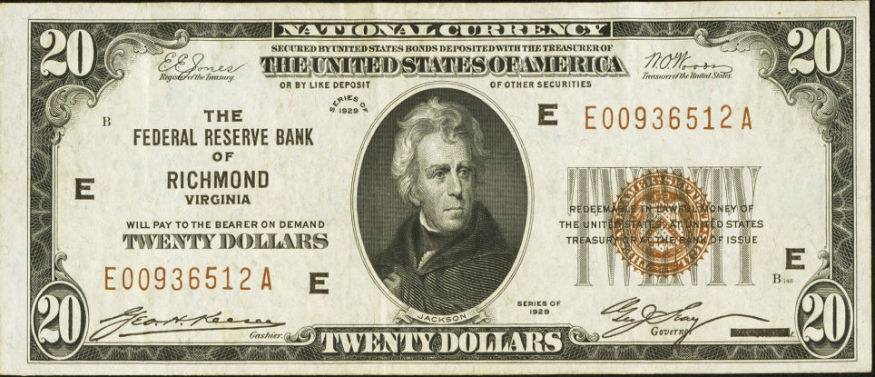
Remember that they even had to use pre-printed national currency note stock to cover the bank holiday in 1933. I like those Federal Reserve Bank notes on national note stock. They are a part of a very unique time in our country.
Similar situation at the US Mint where coinages were greatly reduced and/or years skipped on certain denominations during 1931, 1932 and 1933.
Nice picture of one, BTW. Looked it up and they are an expensive little beast, aren't they?
Edited by DoubleEagle20
05/20/2014 9:13 pm
|
|
Pillar of the Community
United States
7663 Posts |
There were not many collectors of 20's when these things came out in the 1930's.
Besides, $20 was a weeks salary for a lot of people and they could of cared less whether the the note was a 28-C, B, A or a yellow seal Gold Certificate. All they knew is they had 20$ to live on 'till payday rolled around again.
|
|
Pillar of the Community
United States
4409 Posts |
Don't forget that these notes had the gold clause and when President Roosevelt issued Executive Order 6102, these were called in along with gold coins and destroyed. They were made legal to hold again in 1964. http://en.wikipedia.org/wiki/Executive_Order_6102-MV |
|
Valued Member
 United States
207 Posts |
Learned so much from you guys! thanks! Doubleeagle, I had no clue they had to issue FRNs printed on national currency stock. Does that mean that '28C $20s are printed from national stock? westernsky & Meadow, that would explain the relative rarity of these notes and circulated condition they are often found in. Since then I have acquired one for my collection: 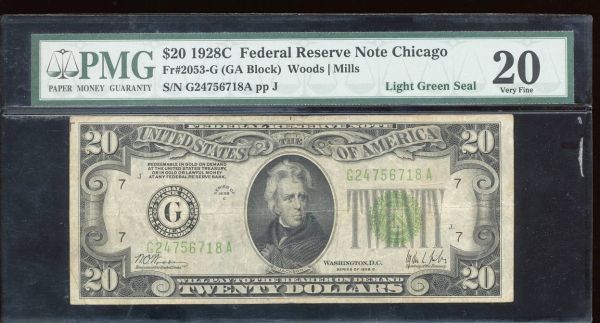 |
|
Pillar of the Community
United States
1751 Posts |
Nope. They are a special run in 1933 where instead of having the local bank of issuance printed on them, they have "The Federal Reserve Bank of Chicago" for example. Otherwise they look like a small national currency note. They were printed in an emergency for the Bank Holiday of 1933. They have a brown treasury seal. Neat notes and more affordable than the 1928-C. If you have the "Guide Book to US Paper Money" it will show them :)
Edited by DoubleEagle20
05/21/2014 08:56 am
|
|
Pillar of the Community
United States
4409 Posts |
|
|
Valued Member
United States
207 Posts |
Oh right, I have a few examples of notes like that. I didn't know they were printed in '33 for that reason though.
|
|
Pillar of the Community
United States
7663 Posts |
If you really wanna have some fun, not to mention a real challenge, try putting a set of 28-C $5's, $10's and $20's together. Many a currency collector has been frustrated by just this particular series. Just the opportunity to buy one of the rarer "28-C's" is a reward in itself. At least you can then say you were offered one!
|
|
Pillar of the Community
United States
1751 Posts |
I am working on a Chicago Fed set of the Bank Holiday of 1933 Emergency notes. So far I have a decent looking $10 and $20. Now I hafta find a $5, $50 and $100 I like.
|
| |
Replies: 10 / Views: 3,462 |
|










 Posted 05/20/2014 8:42 pm