| Author |
 Replies: 10 / Views: 1,925 Replies: 10 / Views: 1,925 |
|
|
Pillar of the Community
United States
1283 Posts |
First question, I'm assuming this was a mint error, and that they actually came from the Denver mint?
Second, I noticed some PCGS slabbed examples with the notation "weak reverse" and a few noted "strong reverse". Are these two varieties of the plain 1922s? I'm assuming the strong reverse is much more valuable?
|
|
|
|
Pillar of the Community
United States
7123 Posts |
Hi UAP
The 1922 no D although considered an error is really a coin made from over used over polished Dies ,,which obliterated the D on obverse die 30.basically a man made error but one that has a very high level of acceptance in the collecting community.
All of the 1922 Lincoln cents were minted at denver ,, none were made at any other mint for that year .
The weak and strong reverse are different Reverse dies one was heavily worn and displays weakness throughout the entire design details, the other has stronger but still fairly weak details ,,the difference is most apparent on the wheat heads , and the letters in the center of the one cent although the entire reverse of the strong reverse is better than that of the weak reverse .
I think by simple demand the strong reverse is a little more expensive based on collector appeal for the better looking coin .
Metalman
|
|
Pillar of the Community
United States
764 Posts |
strong reverse ones are worth approximately 15x the value of weak reverse ones.
|
|
Valued Member
United States
157 Posts |
The interesting thing is that the '22-D No D cent would be a minor variety if Philadelphia minted cents that year; 1922 was the only year other than 1815 when the Philadelphia Mint coined no cents.
That this variety happened to occur in 1922 is rather coincidental.
|
|
Bedrock of the Community
United States
20027 Posts |
I have a "weak reverse" example. The biggest problem I see is with grading these since the die wear looks like circulation wear. The only real way to grade them is to compare to others. Didn't answer your questions, but thought I'd chime in because this coin interests me.
Lincoln Cent Lover!VERDI-CARE™ INVENTOR https://verdi.care/
|
|
Bedrock of the Community
United States
17884 Posts |
There are three die pairs for this coin. Die pair 1 and 3 are the "weak reverse" varieties. They are listed that way because on those two obv dies the mintmark was not completely ground away and it comes and goes depending on how well it struck or if any dirt of grease clogged the mintmark of the die. So you will also see these called Weak D coins. The reverse for both of these were also worn out and in need of replacing.
On the die 2 coins the obverse die was ground down enough that the mintmark was completely removed. This worn out obv was also paired with a brand new die so coins from this die pair often look like the obv is VG while the reverse is a sharp XF-AU.
This error has happened on other coins but they never gained any following. I have seen examples of 1969 and 1970 "P" nickels. 1968's probably exist as well. (All nickels 1968 - 70 were struck at Denver and San Francisco.)
|
|
Valued Member
United States
133 Posts |
USArmyParatrooper: If I were to buy the 1922 No D it would be Die pair #2 like conder101 stated. With that said this is a very expensive coin that looks like a worn AG coin. I have a complete Wheaties set collected with my dad back in the 50's, with a Die pair 3 1922 No D. I also am completing a high grade Lincoln set 1909 to date, AU or better & need only the 1909-S VDB to complete. But I decided not to add the 1922 No D Die pair #2. Just do not like the coin & price. If I was to buy a variety it would be the 1955/55 DDO-001, but the price is ridculus. My Two Cents, have fun. Ron (ronald112) |
|
Bedrock of the Community
United States
20753 Posts |
Also note the vast amount of fake 1922 cents on the market. They were being made as far back as the first notice of the missing D. Many of the excessively worn 1922's are just that also, worn. Those may have the D very, very weak or apparently missing altogether due to wear only. Many D's were removed by simple erasing and then treating the spot with chemicals like gun bluing to make the coin appear as an original. Those are usually the ones with strong reverses so that they can command a greater monitary return from unsuspecting people. As to the fact that there may be 3 varieties, again note there are no records at the Mint of this error ever having been made. Great stories in coppercoins books on that subject.
Think I'll go back to erasing my D's on some of the other dated coins.
|
|
Bedrock of the Community
United States
62064 Posts |
I guess I believe in a different way of collecting. Rather than collecting the worn dies/abused cleaned ones like the 1922 No D and the buffalo three legged coins, I prefer EDS (early die state) coins that have full detail. It not that I don't have the VLDS (Very Late Die State) coins. It just that EDS coin take better images and look nice to me. Call me a coin snob, but that is just my preference. Some collect them, but me: Give me a great coin in EDS and a High grade. I used to like proof Cents in the 1936-1964 Cents. But the luster/cameo doesn't strike me as much as an earlier (pre 1964) proof Cent. I mean as far a coins from new dies, which do you think looks better. Of course I look closer to coins than most do. Here is an example of a die that is wearing severely that was featured in the book : "Looking Through Cents" by Charles Daughtrey  Note the wear around the letters and mintmark. Just a well aged die still used to create coins. But this happened on most years. So I like it better when I can find an earlier die state on a coin. 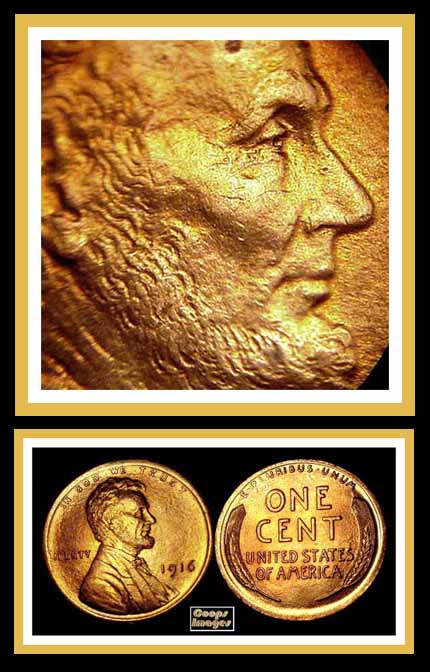 Note the details that are fresh on coins from this earlier die? True it is not an EDS coin, but the details are stronger and more eye appealing. Compare the details in the beard to a 1960's Cent? To me that is what I desire. But each has its own way for collecting what he/she prefers. Each has their own coin budget/likes/dislikes but that is what makes each one's collection different and special to them. |
|
Pillar of the Community
United States
1571 Posts |
Coop, I thought at first it was the 1913S-1MM-001, but it is not. Then I checked Chucks book, and find it is the severity of the die erosion, or wear, that gives the impression that the MM is an RPM, but that is NOT the case. Just plain old die were, and tear!. Nice photos, Coop!
Dick
|
|
Bedrock of the Community
United States
20753 Posts |
Good photos. I like the close up of Lincoln. This made me wonder about something. I think I read somewhere that one of the reasons Lincoln had so much hair on his face was due to a bad complexion. Now when you look at Lincoln Cent coins there is almost always some lines, bumbs, markings and they appear to move with different years. I wonder is the Mint has ever tried to copy Lincoln's complexion. An example is it appears that there is a little bump around the lip area on some cents. |
| |
Replies: 10 / Views: 1,925 |
|







 Posted 07/23/2007 12:32 pm





