| Author |
 Replies: 18 / Views: 3,393 Replies: 18 / Views: 3,393 |
|
Valued Member
United Kingdom
477 Posts |
At what age would consider a coin ancient, for me I feel around 1500 years old. What do you know or think it is? Also what are the oldest coins in the world known, that we as collectors can own? Here's a link to what the internet has told me the answer is:- http://www.fleur-de-coin.com/articles/oldest-coinAny additions to that would be appreciated. And what's the oldest age of a coin you own? Feel free to show visual examples or verbal. Mine is a Numidia Micipsa 148-118 BC or an Alexander tetradrachm fouree-I will upload that one for inspection on here in a different post. And the Numidian coin will be making an entry in guess the price sometime. Edited by awallin01
04/09/2014 7:50 pm
|
|
|
|
Pillar of the Community
United Kingdom
4208 Posts |
I consider ancient coinage to end when Anastasius reformed Roman currency into unquestionably Byzantine denominations. Byzantine coins are still kind of ancient, but thats where id draw the line.
My oldest coin is a bee from Ephesus, from roughly 400-288BC.
The oldest coins are from Lydia as shown, but older forms of money exist from thousands and thousands of years ago. We'll discount bartering systems (trading cattle or standard objects like bars of bronze) and go for things that are purely monetary in nature - they have no purpose except to facilitate commerce (though it should be noted that these wont be fiat money - the object traded will be of value and the value should be extractable, e.g. of good bronze - an exception is cowry shells). The Chinese had all sorts of ingots and knives which were used in place of money, but I havent researched it enough to tell you more than that.
|
|
Valued Member
 United Kingdom
477 Posts |
Thanks for the reply, yeah I've 'herd' about some of the other forms of monetary exchanges. Like the Mayans used 'things' like cacau beans :) amongst many other 'things'-I learnt about this on here, whilst searching for a coin :).
That coins sounds amazing, I've visited Ephesus. Turkey has some amazing historic sites, the catacombs there are unbelievable.
Thanks for the insight into 'what's considered' ancient aswell.
|
|
Valued Member
Netherlands
59 Posts |
From a western perspective, I'd say until about the end of the (western) Roman Empire for me personally. The line is somewhat artificial, but I'd say I'd say early Medieval coins such as Merovingian sceattas are already definitely medieval. So perhaps from the moment Odovacer deposed Romulus, coins are no longer 'ancient'. But definitely from the 6th century onward.
The problems with definitions start when you don't focus on the western Roman Empire, seeing as the Byzantine empire was of course directly continuous. The problem (if it is indeed a problem) becomes even more pronounced when you start talking about non-European coins. Perhaps the term ancient should be avoided altogether among collectors.
In the end; what's in a name? That which we call a rose by any other name would smell just as sweet, whether named late-Roman Valentinian or ancient (for example).
Edited by MichaelS
04/09/2014 4:40 pm
|
|
Pillar of the Community
Canada
5417 Posts |
I think the crumbling of the Roman Empire (Around 500 A.D.) that coins are no longer ancient, although the standard definition is 2000 or more years old.
|
|
Moderator
 Australia
17012 Posts |
Exactly where you draw the line between "ancient" and "mediaeval" is, as others have said, somewhat arbitrary since there is no universally accepted definition of the word. Western Historians often pick the date 476, being the end of the Western Empire. Many coin collectors prefer 498, being the coinage reform of Anastasius. Collectors of Islamic, Chinese and other non-Western coins generally avoid using such terms or redefine them for their own situation. Personally, I use 500 AD, being a nice round number and near enough to 498 to be identical for the purpose. As for the "oldest coins", it does in part depend on your definition of "coin". If your definition includes "precious metal", "stamped" and "roughly round in shape", then yes, the standard answer given on the above-linked webpage that the Lydian Greeks invented coinage sometime around 620 BC is correct. If, on the other hand, you're prepared to generalize your definition such that a coin is "a metallic object made specifically for use as money", then the Chinese win, with their knife-money (c. 685 BC) and spade-money (c. 1200 to 700 BC). They even made bronze replicas of the cowry shells that they also used for money (c. 900 BC), which are just as "coin-like" as the earliest Lydian coins. Finally, my oldest: it's not much to look at, a 1/12th stater from Miletus, circa 500 BC. 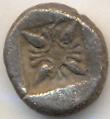 Don't say "infinitely" when you mean "very"; otherwise, you'll have no word left when you want to talk about something really infinite. - C. S. Lewis
|
|
Valued Member
United Kingdom
477 Posts |
Thank-you for the replies, I see the end of the Roman era seems to be a line in the sand-so to speak. And Michael that latter part was very philosophical, interesting perception :).
|
|
Valued Member
United Kingdom
477 Posts |
@Sap Yeah the Chinese were using currency alot earlier than any other records. Tangent-I read somewhere they used paper money hundreds of years earlier than the west but stopped using due to inflation. (Decided to find a link about it):- http://content.time.com/time/specia...4593,00.htmlVery nice coin, over 2 1/2 millenniums old amazing! Great condition also. |
|
Pillar of the Community
United States
5155 Posts |
Modern scholars say antiquity ends in 476 AD. I consider ancient anything older than 1453 AD. My oldest... China Western Zhou Dynasty (1046-771 BC) Deer Bone Primitive Cowrie Shell Imitation 19.0mm (1.69g) Ref: Hartill Type #1.2 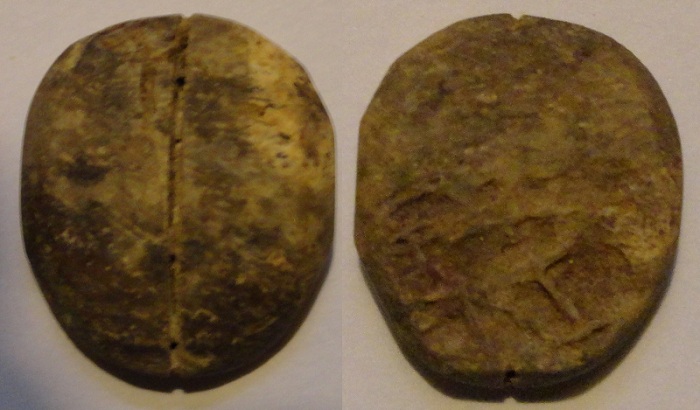 |
|
Valued Member
United Kingdom
477 Posts |
:O Ancientnoob, wow I can't get over how old that is. Just imagine the people who used it, and what they bought with it. Great share, and thank-you for the reply. I only have two man made items dating back around that time or later, but not currency.
|
|
Moderator
United States
23731 Posts |
I'm away this week so I don't have much time to check the posts. I've had a long discussion with Anoob about this topic. I have to agree with anoob about the cut off date. IMO the Byzantine empire started in late ancient times and it would stand to reason that we would have to include the whole empire from beginning to end.
|
|
Valued Member
United Kingdom
477 Posts |
Interesting, you see I never would of looked at it quite that way. But now I can see what you're saying, this was an interesting choice of topics. Thank-you for replying :).
Edited by awallin01
04/09/2014 8:22 pm
|
|
Pillar of the Community
United States
513 Posts |
As far as 'what is ancient,' I've normally seen it described that anything before the fall of the Western Roman Empire is ancient, anything after that (but pre-modern) is Medieval, with some places listing some Byzantine coins from a little after the fall of the Western Empire as ancient. The oldest coin I own is also my smallest is a little 6.6 mm, .3 g coin from Caria, minted between 460-440 BC. I actually didn't really read the size carefully when I bought it and was shocked when I opened the package, but it's really grown on me.   Edited by chuy1530
04/09/2014 10:19 pm
|
|
Valued Member
Netherlands
59 Posts |
"And Michael that latter part was very philosophical, interesting perception :)."
Thanks - but it was not really meant to be philosphical. I was just misquoting a bit of Shakespeare. That said; I used that sentence many times before during my studies when people would debate terminology rather than matter.
|
|
Pillar of the Community
United States
5010 Posts |
what everyone else said works for me...
i have a small modern coin collection, mainly in albums from after 1500. I have an ancient/medieval collection from before 1500 I keep separate. I don't separate the ancients and medieval...so I don't know what I consider the dive there.
if I ever get a coin from exactly 1500, i'll flip that coin..head modern, tails medieval/ancient.
|
|
Pillar of the Community
United Kingdom
3626 Posts |
My attica owl is circa 415 BC, I also have an olbian dolphin which is between 300-500 BC. 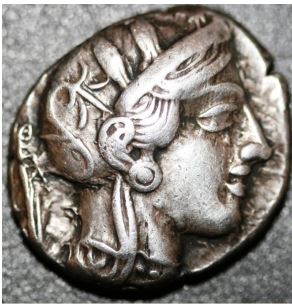 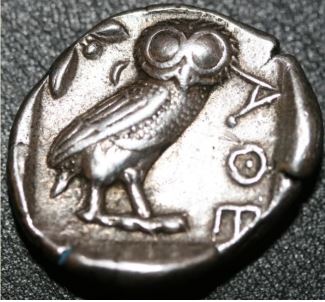 My favourite coin which I drag out at every opportunity! |
| |
Replies: 18 / Views: 3,393 |







 Posted 04/09/2014 4:30 pm


