











 Posted 07/27/2007 8:55 pm


G'day, just a few extra details to what Scottishmoney has written.
George III (d.1820) had a large family. He was succeeded by his son, who became George IV (d.1830). G4 had no legitimate children who survived him, so the throne passed to his brother, who became William IV (d.1837). Likewise, he had no legitimate children who survived him, so the throne would have passed to the next brother, but he had already died. However, the third brother had a surviving daughter, who became Queen Victoria. Because of the particular laws of Hanover, Victoria was disqualified, so the Hanover passed to the 4th brother: the Duke of Cumberland. His familiar name was "Jack". He was sometimes called "Cumberland Jack".
In English usage, another meaning of "Jack" is a gaming token.
When the Duke inheirited Hanover, he couldn't believe his luck: instead of having to live on the modest allowance granted to a dead King's 4th son, he became entitled to a much grander amount. He hastened to occupy his new throne, and to collect his revenues.
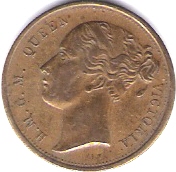
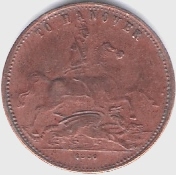
So, the token depicted is colloquially known as a "Cumberland Jack", made of brass, and the size of a sovereign. You will note that the reverse is a visual pun on the familiar image of St George slaying a dragon. In this case, the rider is jumping over the dragon, not attempting to engage it in battle.
There are variations:
one has "To Hanover ... and Good Riddance";
another is "Hasten To Hanover";
and there may be others.
These are readily available and not expensive. I think their greatest value is as a piece of tangible early-Victorian political satire.
Peter in Darwin
George III (d.1820) had a large family. He was succeeded by his son, who became George IV (d.1830). G4 had no legitimate children who survived him, so the throne passed to his brother, who became William IV (d.1837). Likewise, he had no legitimate children who survived him, so the throne would have passed to the next brother, but he had already died. However, the third brother had a surviving daughter, who became Queen Victoria. Because of the particular laws of Hanover, Victoria was disqualified, so the Hanover passed to the 4th brother: the Duke of Cumberland. His familiar name was "Jack". He was sometimes called "Cumberland Jack".
In English usage, another meaning of "Jack" is a gaming token.
When the Duke inheirited Hanover, he couldn't believe his luck: instead of having to live on the modest allowance granted to a dead King's 4th son, he became entitled to a much grander amount. He hastened to occupy his new throne, and to collect his revenues.
So, the token depicted is colloquially known as a "Cumberland Jack", made of brass, and the size of a sovereign. You will note that the reverse is a visual pun on the familiar image of St George slaying a dragon. In this case, the rider is jumping over the dragon, not attempting to engage it in battle.
There are variations:
one has "To Hanover ... and Good Riddance";
another is "Hasten To Hanover";
and there may be others.
These are readily available and not expensive. I think their greatest value is as a piece of tangible early-Victorian political satire.
Peter in Darwin


