| Author |
 Replies: 17 / Views: 8,409 Replies: 17 / Views: 8,409 |
|
Valued Member
United States
70 Posts |
A couple days ago I found an old book of Lincoln cents I put together when I was a kid, which is almost 30 years ago now (yes I'm old but still a newb). It came out of my parent's garage in Florida and I noticed something strange - the book is all filled up, but only 3 coins became seriously corroded in storage. The 82, 84 and 85 all show some strange white corrosive effect surrounding them. I did some research and learned a possible reason only those coins corroded and none of the others is because those 3 are primarily composed of zinc, and all the other coins in the book are pre-1982 and hence mostly copper. I didn't even realize there was something strange about the 1983 (and the 1982-D beneath it) - it didn't corrode. I just happened across a post on this forum tonight about a woman that found a bronze 1983, that seemed rather rare. So I looked at my book again tonight and noticed my 1983 seems to be made of a different composition than the 82, 84 & 85 - because it didn't corrode. And then I noticed the 1982-D didn't corrode either. After some more research I learned a 1982-D copper penny might not be that rare, but a 1983 would be. So my question is, what do you think and what should I do to test? I didn't touch any of them because I don't what's going on with all that corrosion. Any advice appreciated! Photo of all coins in book: 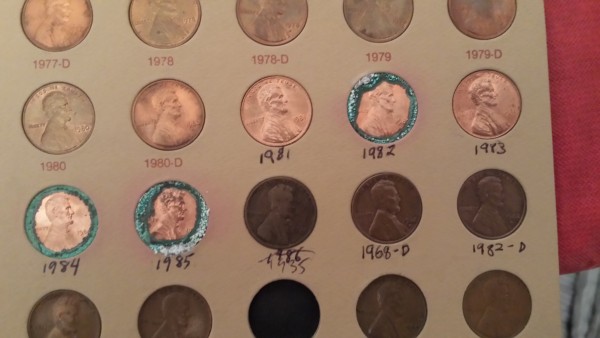 Photo of 1983 with flash: 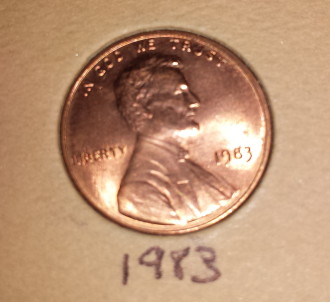 |
|
|
|
Pillar of the Community
United States
5230 Posts |
That's some serious "cheeze" on the 1982, 1984,and 1985.
As for the metallic composition of the 1983 you would need a scale.
|
|
Rest in Peace
United States
1943 Posts |
The test is easy. Copper cents weigh 3.1 grams and zinc cents weigh 2.5 grams. Check it out and let us know. Good luck.
Edited by pyrbob
05/14/2014 07:05 am
|
|
Valued Member
United States
355 Posts |
It's nice being able to see what sitting in a garage in Florida does to coins over the years. How long were they in the garage? pyrbob's got it right though, you can weigh them. Odds are that your 1983 is just a zinc cent that perhaps had a better copper layer around the zinc core.
|
|
Moderator
 United States
56855 Posts |
 to CCF. You need to weight it with a decent scale and maybe some better pics front and back would help.Good luck and enjoy our great site. John1  |
|
Pillar of the Community
United States
2651 Posts |
How close did you live in florida to saltwater?
|
|
Valued Member
 United States
70 Posts |
Thanks for all your help! You guys are great! But sadly, it's not bronze. I've used the see-saw simple scale method to determine the 1983 is no heavier than a zinc, so I am pretty sure it's not bronze and just must have had a better coating of copper on it as trent suggested because it didn't react like the others. However, the 1982 D is heavier than any other zinc cent so I am assuming it to be a (large date?) bronze. Also to answer your question trent, they were actually stored in several places but I'm assuming it's the time in Florida that did the most damage. They were in an attic in NJ for 10 years, then in a coastal condo in NC for 1 then near the shore again in Palm Coast FL for 10 years, then finally spent a few final years inland FL in Ocala. My parents kept them for me over the years and moved a couple times. They are both alive and well in Ocala now, fyi :) Here's a couple better pics to just close the chapter on this story. Correct me if I'm wrong, but is that corroded 1982 a large date zinc? I'm just learning to identify these date issues, so TIA if you can let me know: 1982 Large Date? 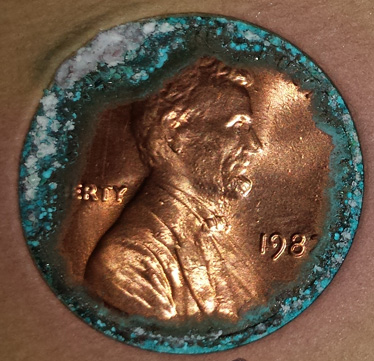 1983 NOT Bronze (darn!) 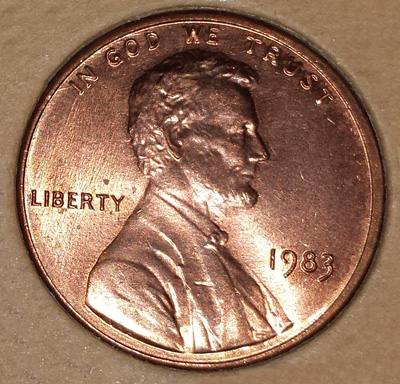 And just for S&G, the 1982 D Bronze, also Large Date? 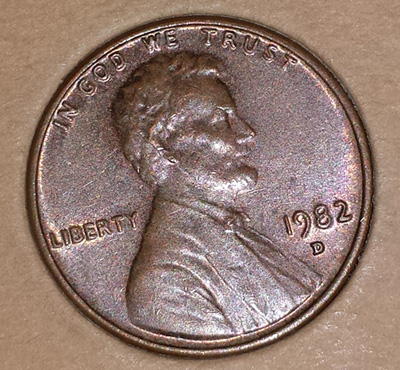 |
|
Moderator
United States
56855 Posts |
The 82-D is a LD. John1 |
|
Bedrock of the Community
United States
17884 Posts |
Both 82's are large dates.
|
|
Pillar of the Community
United States
8534 Posts |
Sell the grungy one on ebay as a monster toner lol. Oregon coin geek.....*** GO BEAVS ! ! ! ***
|
|
Valued Member
United States
70 Posts |
Thanks for the help Conder101! Too bad about the 82 LD Zinc - it seems to be worth a pretty penny in top condition, which that coin clearly is not.
|
|
Pillar of the Community
United States
1476 Posts |
You DO plan on getting a replacement page and transferring the coins over right?
|
|
Valued Member
United States
70 Posts |
Lol yes Dar I'm definitely moving them. My plan is to carefully remove them with gloves into mylar sleeves and album pages. Not going to keep them in that old book anymore! I'm still researching to see if there's any way to remove the corroded 82 without doing more damage and/or removing it. I never planned on ever cleaning or touching any coins but I would see these need something done. Any suggestions?
|
|
Pillar of the Community
United States
1476 Posts |
That '82 looks pretty far gone to me. You can try but I would just search out another. The '82 should be pretty easy to find in MS.
Edited by Dar
05/16/2014 4:02 pm
|
|
Pillar of the Community
United States
8534 Posts |
Stay away from folders. You may be surprised when you look at the reverses.
Oregon coin geek.....*** GO BEAVS ! ! ! ***
|
|
Pillar of the Community
United States
589 Posts |
Quote:
I'm still researching to see if there's any way to remove the corroded 82 without doing more damage and/or removing it. Bronze disease, if it is bronze disease, is very hard to remove, if not impossible. Verdigris, which it most likely is, is also hard, but not impossible. I've had good luck with a small amount of vinegar and salt with boiling water poured on the top, and then dipping the coin in that...sometimes they require a little soft bristle brush, although that isn't the best thing for them, I know. However, verdigris (especially the condition of your coins) would most likely result in pitting if you attempted to remove it. Honestly, those coins are much better suited for throwing back into circulation and either buying new ones or simply replacing them via roll hunting. |
| |
Replies: 17 / Views: 8,409 |







 Posted 05/14/2014 05:17 am





