











 Posted 06/08/2014 11:31 pm


It is a Korean charm but the inscriptions refer to ancient Chinese history and culture.
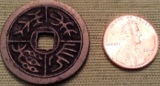
The inscription (first image) is 與天無極 (yu tian wu ji in Chinese). This translates as "like heaven, without limits".
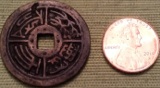
The inscription (second image) is e•·樂未央 (chang le wei yang in Chinese). Changle (e•·樂) and Weiyang (未央) were the names of two of Liu Bang's exquisite palaces.
Liu Bang became Emperor Gaozu of the Western Han Dynasty.
The Changle Palace and the Weiyang Palace have come to signify the height of Chinese culture and authority, i.e. "like heaven, without limits".
Gary
The inscription (first image) is 與天無極 (yu tian wu ji in Chinese). This translates as "like heaven, without limits".
The inscription (second image) is e•·樂未央 (chang le wei yang in Chinese). Changle (e•·樂) and Weiyang (未央) were the names of two of Liu Bang's exquisite palaces.
Liu Bang became Emperor Gaozu of the Western Han Dynasty.
The Changle Palace and the Weiyang Palace have come to signify the height of Chinese culture and authority, i.e. "like heaven, without limits".
Gary


