| Author |
 Replies: 14 / Views: 1,037 Replies: 14 / Views: 1,037 |
|
|
Pillar of the Community
United States
7123 Posts |
By this Lincoln Cent ! I believe the cent is broad struck it is considerably larger than a normal cent not round but more oval in shape,, and has a railroad rim both obverse and reverse . whats kicking my behind is the missing plating ,, the surface of the coin is bumpy and irregular, but the details look like they were struck on the zinc not real sharp but sharper than I would expect if the coin has been in acid or some other form of removing the plating . The weight is 2.5 grams which is also a stumper for me since it weighs correct for a plated zinc cent. I could use the help of the forum ! 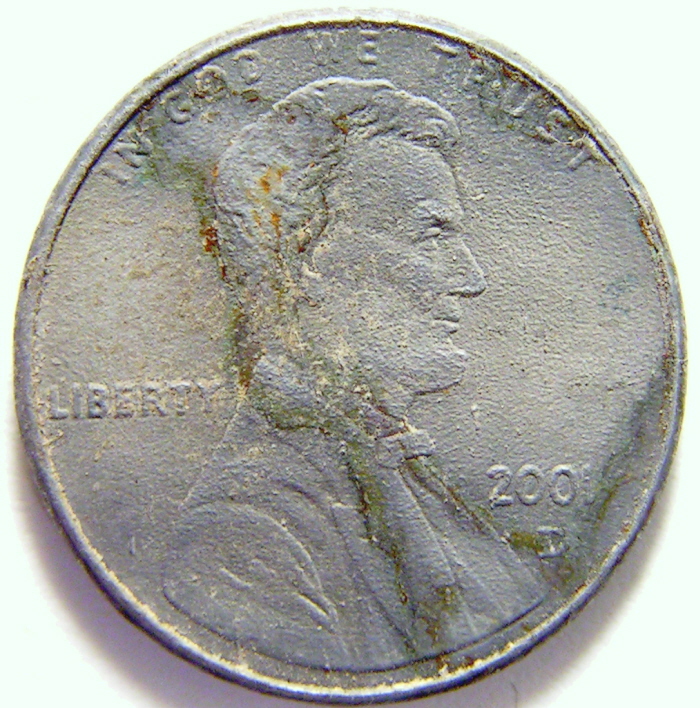 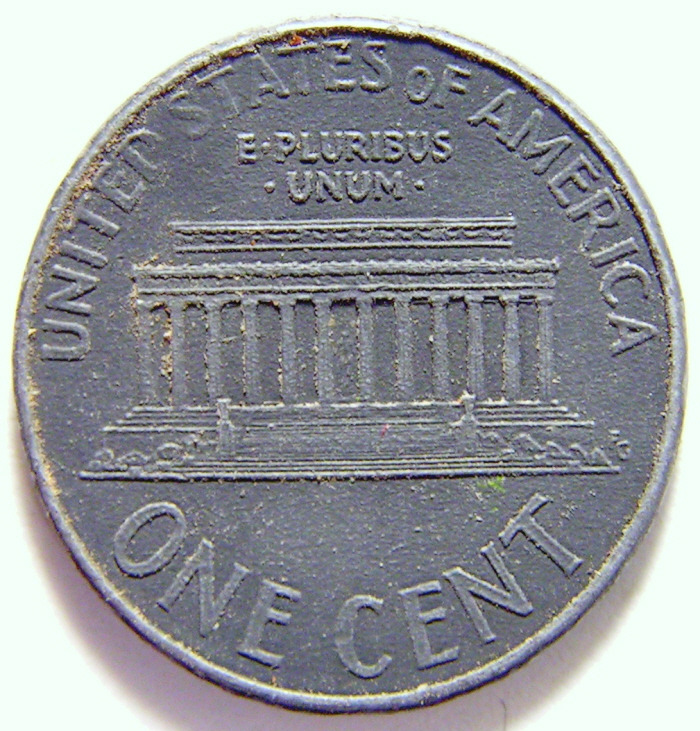 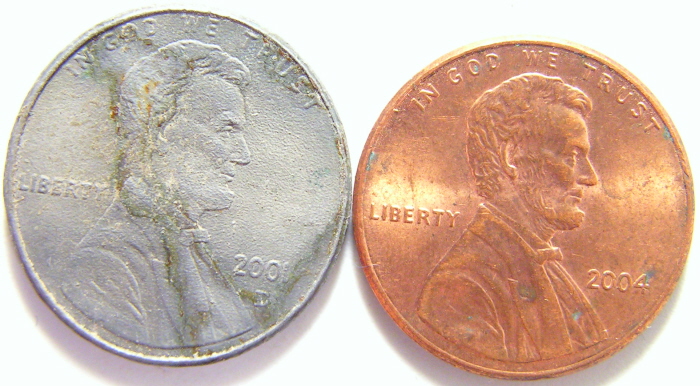 Thanks Metalman |
|
|
|
Moderator
 United States
23522 Posts |
I'm guessing it was heated and stretched somehow, more in the top half (looking at the obverse) than the bottom half. A broadstrike would still have the struck details in the correct places; the die size doesn't change. Zinc melts at less than half the similar temperature of copper - I'm guessing it went away during the heating process.
That doesn't explain the weight, though - how much of the 2.5g total should be zinc? Maybe the coin picked up flux or something from the heating?
|
|
Pillar of the Community
United States
2254 Posts |
Nothing about the head looks right. If it was "stretched", how would they do that without leaving marks? Maybe heated and put through a sheet metal roller? Hmmmm. To me it actually looks like a counterfeit coin. Like I said, strtching or whatever caused this, the facial features don't look right at all. The head looks really big, the nose and nostrils, chin, lips...  Regardless, I'm no expert, and I see Chuck is still online so maybe he will post... |
|
Pillar of the Community
United States
1952 Posts |
it could be a regular cent that was sitting in acidic dirt. I think if you put just a touch of copper cleaner n a very out of the way part of the coin you will see the copper return. maybe the edge or somewhere hat will not be seen right off. Chuck may have seen this before. I don't think it is an unplated zinc though but only because the zinc would have disappeared by now in the dirt. ( I say that because the coin looks like a detector find)
good luck on it
Gary
|
|
Pillar of the Community
United States
3507 Posts |
Hi,
A few things that it isn't.
It's not a broadstrike. It has none of the characteristics of being one.
It's not struck on a planchet that was missing the copper. The copper plating was removed. The bumpiness to the surface indicates that.
The coin was not treated in acid as even a weak acid like Hydrochloric acid would destroy the zinc and not the copper.
It is dangerous for the novice but there is a way that chemists and metalurgists can remove the copper plating using cyanide.
I can't tell you exactly how the coin was damaged but this is not an error but a coin that was damaged outside the Mint.
It has the look of being chemically damaged. The weight is not really an issue as the 2.5 grams wouldnt be too far out of tolerances for a zinc core. The copper plating does not add a lot to the overall weight of the coin.
I hope this helps,
Thanks,
Bill
|
|
Pillar of the Community
 United States
7123 Posts |
I bought 2,832 cents in a jar from a local ,, this was in the jar as far as metal Detecting I doubt it ,,the guy is like 89 years old ,,He is one of my coffee buddies at the truck stop .
Metalman
|
|
Pillar of the Community
United States
7123 Posts |
Ok not broad struck ,, how does the coin get the railroad rim if it is in the collar when struck ?
Metalman
|
|
Pillar of the Community
United States
3507 Posts |
You might be confusing the term railroad rim with something else. When a coin is struck with a collar partially in place, if you think about the width of the coin, some of the coin that is within the collar will be the normal size while the portion that is not within the collar will be a little bit larger. The effect is similar to the way a wheel on a railroad train looks. I dont see that on this coin. I'm at a disadvantage so here is a link to a pic on Coneca's website showing a partial collar strike , known as a railroad rim. http://hermes.csd.net/~coneca/image...enhanced.jpgYour coin was probably hammered between a few pieces of leather. It is a common practice, believe it or not to make a coin appear to be an error. Even though the person the coin came from was 89 , the coin may have been tampered with or dug up and then circulated into his collection from elsewhere. |
|
Pillar of the Community
United States
7123 Posts |
Ok ,,into the junk box with this one .
Metalman
|
|
Pillar of the Community
United States
7629 Posts |
Not sure what it is, but it doesn't look like an error of any kind. So many different things can be done to experiment with coins I doubt anyone has seen all the things people have done playing around with chemicals on coins. I figure that's the basic idea of what this is, and wouldn't attempt to venture a guess as to exactly what it is.
|
|
Pillar of the Community
United States
1571 Posts |
As Chuck would say....
Two things: First, the zinc coins will vary quite a bit in weight, more actually, than do the copper cents.
Two, Just because he is 89, doesn't make him "unable" I'm 82, and still am very able to operate a drywasher, all day! Those 5-gal. buckets, full of sand, weigh about 70-80 pounds each.
As far as the coin, I sure don't have a clue!
Dick
|
|
Pillar of the Community
United States
7123 Posts |
quote:
Just because he is 89, doesn't make him "unable" I'm 82, and still am very able to operate a drywasher, all day! Those 5-gal. buckets, full of sand, weigh about 70-80 pounds each.
Let me rephrase ,, I have had coffeee with Him just about every Sunday morning for the last 7 years ,, He does not metal detect. But He has been a great Help to me in my Metal detecting ! He has a knowledge of the history of this area that is hard to come by ! Metalman |
|
Bedrock of the Community
United States
62064 Posts |
The rim metal man mentioned is not part of the striking process. after the planchet is cut it is run through a setup mill and the rim is added then. If you look at a type 2 planchet you will see the rim added to them. This is before they are struck. Any clip or irregularity will also be noticed on the planchet after the setup. Thus the weakness of the rim 180 degrees from the clip. This is called the "Blakley effect." The larger the clip, the stronger the weakness. You can see this one double & triple clipped coins.
|
|
Pillar of the Community
United States
1571 Posts |
I didn't mean anything against the old gentleman, quite the contrary! I think we "old folks" should still be able to do things we used to do when younger. The knowledge he has of that area, can be a boon to you, and the metal detecting. I enjoyed it, too, out in the Prescott National Forest, in the Copper Basin area. I used to find "pickers' frequently, and got a lot of exercise that way. Much easier than "dry-washing"!
Dick
|
|
Pillar of the Community
United States
7629 Posts |
Regardless of who the prior owner of this coin was, anyone is prone to picking up other people's detector finds, tampered coins, etc. in pocket change when the originator of the problem spends or loses them. Because the 89 year old man had what's likely a tampered coin doesn't mean HE did the tampering.
|
| |
Replies: 14 / Views: 1,037 |
|







 Posted 08/05/2007 8:04 pm


