| Author |
 Replies: 18 / Views: 2,845 Replies: 18 / Views: 2,845 |
|
New Member
United States
6 Posts |
Hello CCF! I am a fairly new to collecting, and to this forum, so please excuse me if I am posting in the wrong place. I found a beautiful rainbow colored 1976 S Lincoln Penny while searching some old proof sets. I have been doing google searches to find out how this could have happened, and they keep bringing me to this forum. So I decided to join, and have learned so much reading all the posts. However, I still have not found an answer to my question. I'm hopeful someone will be able to educate me. Thanks in advance you all are more helpful than you know. -S.L. 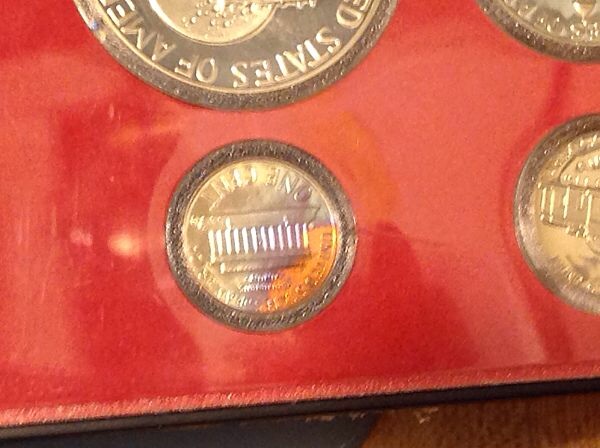 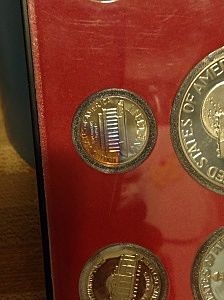
|
|
|
|
Pillar of the Community
United States
3755 Posts |
That IS a nice looking penny. Toning happens when the coin reacts to a chemical it is exposed to, or high temps or a combination thereof. Sometimes the older packaging itself reacts with the coin. There are so many possibilities, it is pretty much impossible to say exactly what it was. Is the obverse toning like that as well? Anything on the other coins? Oh, and  |
|
New Member
 United States
6 Posts |
No they are flawless. I was thinking it was maybe an uneven metal combo? I don't really know though. The obverse is completely normal, it's a nice red. I took a bunch of photos., but I'm having a bit of difficulty uploading.
|
|
Pillar of the Community
United States
1132 Posts |
During proof production, a chemical is applied to the die prior to the strike (to give it that mirror-like finish). It looks as though only a portion of the die had the proof chemical on it & the NW section did not. That portion appears to have the usual copper tone of a standard BU. I'm only speculating, but that's my $.02  Edited by CopperCastle
07/24/2014 02:03 am
|
|
Moderator
 United States
56855 Posts |
Quote:
During proof production, a chemical is applied to the die prior to the strike (to give it that mirror-like finish). Please post a link to that info,I would like to read up on it. John1  |
|
Rest in Peace
United States
4078 Posts |
Quote:
I would like to read up on it. Me to. |
|
New Member
United States
6 Posts |
Me three! I really appreciate the info. I have been searching, but when you don't know what terms to query it makes it hard.
|
|
Pillar of the Community
United States
1476 Posts |
|
|
Pillar of the Community
United States
1186 Posts |
Is that a crack or scratch in the plastic next to the memorial where "UNITED" starts. It's strange that the bright red starts from there.
|
|
New Member
United States
6 Posts |
No scratch or break in the plastic. I'm on my way to get this looked at by a well educated numismatist. Ill post the answer he gives me. :)
|
|
Pillar of the Community
United States
1132 Posts |
Edited by CopperCastle
07/24/2014 1:55 pm
|
|
Valued Member
United States
411 Posts |
OK, I figured it out , the guy running the die machine had a drop of sweat to fall from the tip of his nose and land on the coin just before it was struck. see this was being done in august of that year.
Really - I have no idea
|
|
Bedrock of the Community
United States
20069 Posts |
The toning is a natural part of aging. Most likely it's due to the storage environment and the packaging materials. Gaseous substances like hydrogen sulfide react readily with metals to create a thin-film effect responsible for the color.
Welcome to CC!
Lincoln Cent Lover!VERDI-CARE™ INVENTOR https://verdi.care/
|
|
Bedrock of the Community
United States
20069 Posts |
Quote:
During proof production, a chemical is applied to the die prior to the strike (to give it that mirror-like finish). The mirror finish comes from highly polished dies, not from any chemical. Also, in videos and such I've seen from the mint, they dry machine proof coins, there are no fluids involved in the stamping operation. |
|
Pillar of the Community
United States
1132 Posts |
I agree Thad, the mirrored section (the "field") is a result of the polished die. I misspoke when I referred to the mirror quality coming from the chemical, I meant the image itself. However I disagree about no chemical being used in the stamping process. The image portion of the die IS TREATED with acid to give the frosted appearance, as noted in the previous 2 articles.
Deep cameo's are a result of a newly used acid-treated coin die which gives more noticeable, frostier appearance. As the die is used over a longer period to strike a coin blank, the effect of the treated die fades which results to the less frosted look. Proof coins with images that do not have matte characteristics are not designated as cameo.
Edited by CopperCastle
07/25/2014 02:56 am
|
|
Pillar of the Community
United States
1132 Posts |
|
| |
Replies: 18 / Views: 2,845 |







 Posted 07/24/2014 12:55 am


