| Author |
 Replies: 14 / Views: 2,001 Replies: 14 / Views: 2,001 |
|
|
New Member
Finland
6 Posts |
I just bought this 1874-S Trade dollar from a well known european auction house. It looks good but its weight is only 416 grains instead of 420 (26.9 grams instead of 27.2)! Is this counterfeit or not? 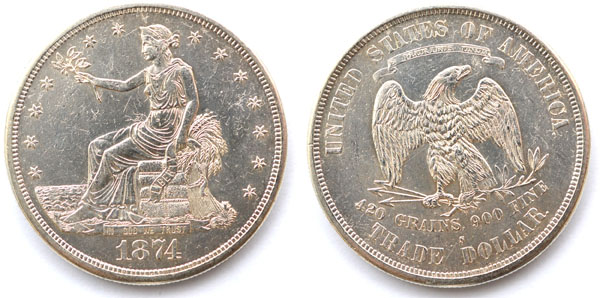 |
|
|
|
Pillar of the Community
United States
4703 Posts |
From the small pics, it looks pretty good to me.
|
|
Pillar of the Community
Canada
5417 Posts |
It looks fine, aside from the cleaning ofcourse. The coin is 98.9% of which it should be, I think you'll be fine.
|
|
Pillar of the Community
United States
506 Posts |
Check if any of the coin has been ground off. That is the original reason the mint started the reeded edges; so that people couldn't grind the silver off the sides and sell them as scrap.
|
|
New Member
 Finland
6 Posts |
|
|
Pillar of the Community
968 Posts |
If it's a fake it's a pretty good one.
|
|
New Member
Finland
6 Posts |
Edges are OK. It is good to hear that coin looks fine. I'm not an expert of American coins so I was worried. Is it normal that weight varies?
|
|
Pillar of the Community
861 Posts |
Nice looking coin, sharp stars and no major marks, I go with MS-63.
|
|
Pillar of the Community
United States
4883 Posts |
First off, since nobody has said it, welcome. Quote:
Is it normal that weight varies? There can be very slight weight variances, but 4 grains is a bit more than the mint tolerances in this regard. I think my first question would be, have you calibrated your scale recently, or weighed it on another scale as a control? Colligo ergo sum
|
|
New Member
Finland
6 Posts |
Thank you Lucky Luss.
I haven't calibrated my scale never. It is cheap chinese scale which accuracy is ca. 0.1 grams.
I can try to weight it to better scale tomorrow.
Is the San Francisco mint ever reuse older flans of foreign or american silver coins which weight would be 416 grains?
|
|
New Member
Finland
6 Posts |
I visited my friend's coin shop today. (He have a good official gold scale). Weight is 26.85 grams.
|
|
Pillar of the Community
United States
4883 Posts |
Quote:
Weight is 26.85 grams Well, that'd make it just over 414 grains, which is a smidgen light, although I'm not ready to condemn it solely on that basis. But I do wonder why, the U.S. Mint was pretty rigorous in this respect, especially with these as their potential acceptance in the Chinese trade was predicated upon their silver content being superior to that of the 8 reales coins then widely circulating. Quote:
Is the San Francisco mint ever reuse older flans of foreign or american silver coins which weight would be 416 grains? I've never heard of such a thing, and again to issue any under their marked weight would've simply undermined the whole project. I think I'd want to determine the specific gravity of this specimen next. Colligo ergo sum
Edited by Lucky Cuss
08/22/2014 08:31 am
|
|
Bedrock of the Community
Australia
21789 Posts |
Needs to be comparatively ring tone tested, against a known genuine coin.
|
|
New Member
Finland
6 Posts |
The specific gravity is 10.3. So it is OK.
How I can do ring tone test?
Edited by janio
08/23/2014 11:21 am
|
|
Bedrock of the Community
Australia
21789 Posts |
It is presumed that the suspect coin has been checked in detail for die characteristics, and is found to be OK. You need a known genuine Trade dollar to do a comparative ring tone test. 1. Put a thick blanket or similar below your hands. 2. Rest the Trade dollar on the tip of a gloved finger. 3. Tap the edge of the coin gently and listen for the ring tone. 4. Rest the known genuine coin on the tip of a gloved finger and tap the edge of this coin. 5. Listen and compare the ring pitch of the two coins. If the pitch is different, further testing is necessary, but the unknown coin comes under suspicion. The blanket is needed in case the coins should accidetally fall. The next good step is to use XRF testing, which is comparatively cheap and non destructive. |
| |
Replies: 14 / Views: 2,001 |
|





 Posted 08/21/2014 01:48 am





