| Author |
 Replies: 28 / Views: 4,713 Replies: 28 / Views: 4,713 |
|
|
|
Pillar of the Community
 United States
4778 Posts |
Thought I'd also post my 40-nummi follis version of the Wolf and twins type (its as wide [24 mm] but somewhat thicker than the half-follis):  And here's an example of one of the revalued early imperial bronzes:  |
|
Pillar of the Community
United States
5155 Posts |
I want to add one of these revalued Imperials to my collection. From what I have seen most are revalued as XXXXII 42 nummus. Impressive and historic piece.
|
|
Moderator
 United States
23731 Posts |
|
|
Pillar of the Community
United States
4778 Posts |
I think I read that people during that time may have found small hoards of these and they then decided to revalue them and reintroduce these into the money supply, but I do wonder if some early imperial bronzes were still in circulation at the time (perhaps in and out of circulation over the course of 4 to 5 centuries) and the Ostrogoths just simply gathered them up and revalued them to conform to the nummi system.
|
|
Pillar of the Community
United States
5155 Posts |
It would be interesting to know if these coins remained in circulation for that length of time. I read that the debased Legion denarii of Marc Antony remained in circulation well into the reign of Trajan, that something like 150 or so years. I posted a Hephthalite (Persian) drachm in another thread, we run into the same longevity of circulation discussion. On my drachm it is dated year 11 of Hormizd IV (581 AD) and the mint of Bhalk Afghanistan. It dates to the year Persian city fell and was probably the booty. The coin was counterstruck twice once with bust and once with (Caesar) in Bactrian Greek sometime in the mid to late 8th century for use in Central Asia. That's an expanse of nearly 200 years. I suppose it would be the equivalent of a taking a Spanish Milled Dollar (1780's) and revaluing it at 30 dollars today. It seems strange but with all the wonders of antiquity a coin that circulated 4-5 centuries later certainly doesn't surprise me, I think I would be more surprised if it didn't happen.
|
|
Pillar of the Community
Russian Federation
5186 Posts |
I've heard somewhere of a worn sestertius of Julia Domna (2nd century) counterstamped with a monogram of Leo I (5th century). However, my (feeble attempts at) googling did not result in any descriptions or pictures of such a coin, so I'm not even sure if it actually existed in the first place.
There are several modern examples of coins circulating for as much as 150 years before being demonetized; frequent reforms and upheavals in the modern world make any longer periods much less likely.
There is, coincidentally, an urban legend that some coin collector got a shilling of William I of England (11th century) in change at a hardware store in Birmingham. Anyone who actually knows anything about medieval coinage is probably laughing already.
EDIT: As for Antony's legionary denarii, one had been found in the Beau Street hoard, which dates from the late 3rd century.
Edited by january1may
09/03/2014 4:21 pm
|
|
Pillar of the Community
United States
3497 Posts |
According to the 'legends' I have read British travelers in the early 20th century frequently found well worn silver drachms of the "Great Iskandar" being exchanged in the market bazaars of Afghanistan.
Memories can be long in remote places and even the name of Kandahar Province is generally accepted as a historical echo of his times.
|
|
Pillar of the Community
United States
4778 Posts |
Quote:
I've heard somewhere of a worn sestertius of Julia Domna (2nd century) counterstamped with a monogram of Leo I (5th century). However, my (feeble attempts at) googling did not result in any descriptions or pictures of such a coin, so I'm not even sure if it actually existed in the first place. Hopefully it is true. That's something I would certainly like to see. Reminds me of the Anastasius folles that are counterstamped with Heraclius's forward-facing bust. Not as long of a time gap (Anastasius and Heraclius ruled a century apart) but pretty much the same thing was done: the official reuse of old money in later times. Another example I can think of is the Saxon practice of clipping down late-Roman era siliquae to the size of their silver sceattas. This was done around the 7th century AD, around three centuries after the siliquae used were struck. Quote:
According to the 'legends' I have read British travelers in the early 20th century frequently found well worn silver drachms of the "Great Iskandar" being exchanged in the market bazaars of Afghanistan. I think this would take the cake if the coins really was used continuously or at least on and off as money for 2000+ years! Edited by VisigothKing
09/06/2014 9:56 pm
|
|
Pillar of the Community
United States
4778 Posts |
Theodoric also attempted to raise the Ostrogothic (and former West Roman) capital Ravenna (in northeast Italy) to the same status and prestige as that of Rome and Constantinople, and this showed in the depiction of Ravenna on coins that were struck during his rule. Under Theodoric, Ravenna experienced its most productive era and the height of its influence and importance, with buildings, monuments, and other parts of the city being constructed and restored under the careful guidance of the king. Ravenna's classical heritage was also preserved by Theodoric's efforts. The city was made the main business and political hub of the kingdom. If you wanted to talk to the king, you had to go to Ravenna. If you wanted to receive your land grants, Ravenna was the place to go. Ravenna lost a lot of its importance when it came under the control of the Eastern Roman Empire, being reduced to a provincial capital answerable only to Constantinople. City of Ravenna, Ostrogothic Kingdom AE Decanummium (10 nummi) Obv: FELIX R-AVENNA ("Happy [city of] Ravenna"), turreted head of Ravenna facing right Rev: Monogram of Ravenna within wreath, X below Mint: Rome, struck 493-526 AD Ref: COI 78a 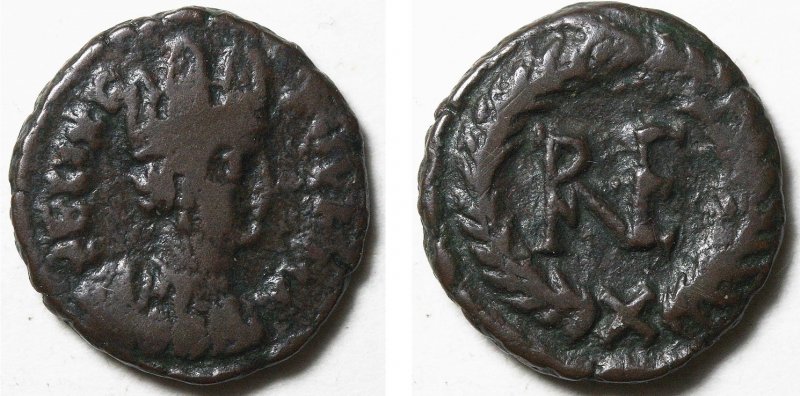 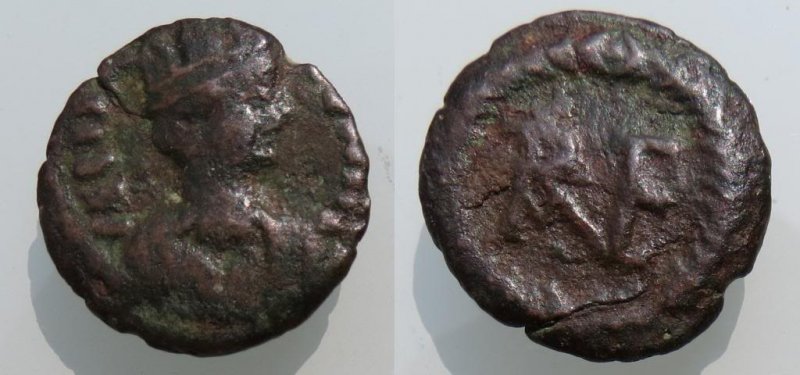 (one I used to own)  Rev Rev: Monogram of Ravenna within wreath, cross above, X below Ref: COI 78b  Edited by VisigothKing
09/09/2014 12:18 am
|
|
Pillar of the Community
United States
4778 Posts |
Well-known buildings in Ravenna constructed under Theodoric: Basilica of Sant'Apollinare Nuovo, world famous for its beautiful mosaics:     Mausoleum of Theodoric Mausoleum of Theodoric, completed in 520 AD:  (his sarcophagus)  Palace of Theodoric Palace of Theodoric (its remains):  Edited by VisigothKing
09/08/2014 6:24 pm
|
|
Pillar of the Community
United States
3497 Posts |
Interesting history !
I googled the 'mausoleum of Theodoric' out of curiousity and found this nugget .....
" Its roof is a single 300â€"ton Istrian stone, 10 meters in diameter "
Three hundred tons ! 600,000 pounds ! Ouch !
Probably explains why they never scavenged it for building materials.
|
|
Pillar of the Community
United States
4778 Posts |
Yeah, not a place I'd like to be in during an earthquake!
The mausoleum wasn't turned into spoila, but Theodoric's remains weren't as lucky, with his ashes thrown into the wind by the conquering Byzantines when they took the city.
These structures and their contents help show that the "Dark Ages" weren't as dark as people seem to think!
Edited by VisigothKing
09/09/2014 12:56 am
|
|
Pillar of the Community
United States
5010 Posts |
great write up VK!
and I like pics!
|
| |
Replies: 28 / Views: 4,713 |







 First Page


 Posted 09/03/2014 1:01 pm





