Those wacky Romans... they deified and worshipped everything. This one, however, deserves your devotion:
Venus Cloacina, Goddess of the Great Sewer.Yep. That's right. A
Sewer Goddess.Before you poo-poo Her importance, consider this: Rome's Cloaca Maxima (Great Sewer) was in large part responsible for the health and prosperity of Rome. Waste-related bacterial burdens were reduced as the sewage flowed away from the city instead of pooling in populated areas. The sewer also drained the marshlands, greatly diminishing the breeding grounds for disease vectors such as mosquitos.
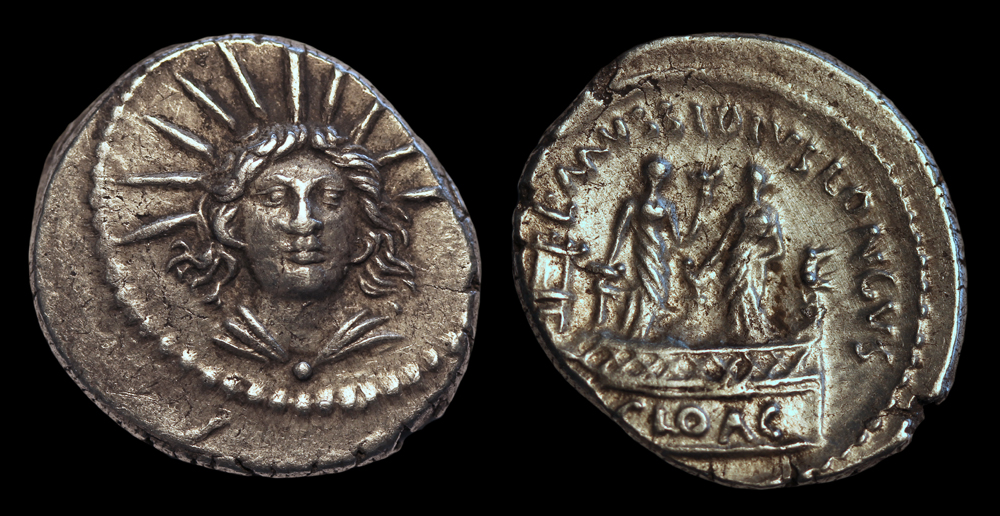 Moneyer issues of Imperatorial Rome. L. Mussidius Longus, 42 BC.
 AR denarius, Rome mint. Radiate and draped bust of Sol facing slightly right / Shrine of Venus Cloacina: Circular platform surmounted by two statues of the goddess, each resting right hand on cippus, the platform inscribed CLOAC and ornamented with trellis-pattern balustrade, flight of steps and portico on left; L • MVSSIDIVS • LONGVS around above. Crawford 494/43b; CRI 189a; Sydenham 1094a; Kestner 3758-9 var. (CLOACIN); BMCRR Rome 4252-4; Mussidia 7a.
Acquired from a dealer at the 2014 ANA World's Fair of Money, Chicago.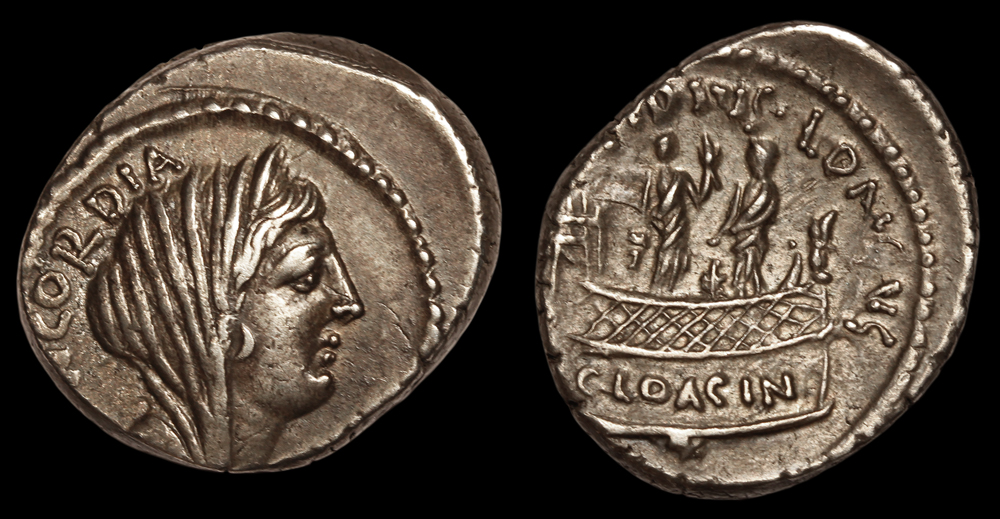 Moneyer issues of Imperatorial Rome. L. Mussidius Longus. 42 BC.
 AR denarius, Rome mint. Diademed and veiled head of Concordia right; CONCORDIA upwards behind / Shrine of Venus Cloacina: Circular platform surmounted by two statues of the goddess, each resting right hand on cippus, the platform inscribed CLOACIN and ornamented with trellis-pattern balustrade, flight of steps and portico on left; L • MVSSIDIVS • LONGVS around above. Crawford 494/42a; CRI 188; Sydenham 1093; Kestner 3753-4; BMCRR Rome 4242-3; Mussidia 6b.
Acquired from a dealer at the 2014 ANA World's Fair of Money, Chicago.History of Cloaca MaximaThe central lowlands and valleys in Rome were uninhabitable until the 7th-6th century BC when the Tarquin kings began constructing a large system for draining the marshes. Initially an uncovered canal, it followed the natural runoff channels and emptied into the Tiber river. Before Cloaca Maxima, the land on which the Forum was built was underwater much of the time.
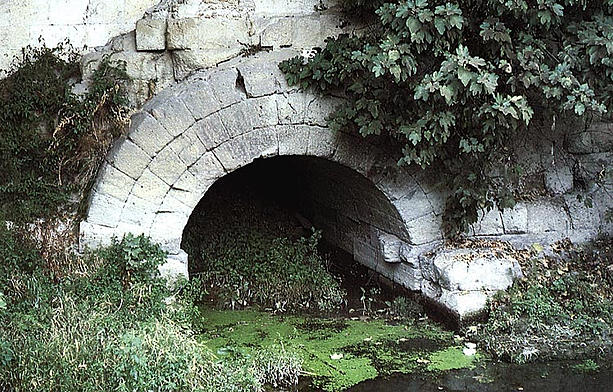 Outlet of Cloaca Maxima. Picture from ancientrome.ru
By the 2nd century BC the Great Sewer was fully covered; expansion of its reach was continual. At Rome's peak, it is estimated that the sewer conveyed 100,000 pounds of human excrement daily. While most homes were not directly connected to the sewer, waste thrown in the street was washed into the drain.
The public water systems were integrated. Waste water from the public baths flowed under the public latrines and into the sewer. Between that and rain, the latrines sewers were effectively and continuously flushed.
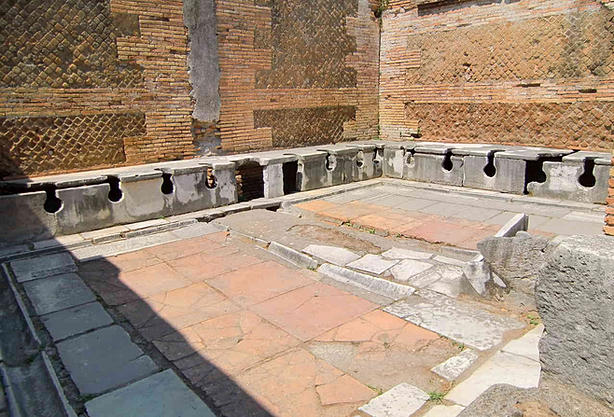 A Roman latrine in Ephesos. Water ran under the toilets, constantly flushing the waste. See the channel in the floor? That also had running water. The holes in front? That's where you insert your wiping stick. Lacking Charmin, a sponge stick (spongia) was used and re-used. After doing your business, while still seated you insert the damp sponge stick through the hole, wipe, and then rinse the stick in the water trough, leaving the spongia in the trough for the next person. Image from jackthreads.com
Cloaca Maxima exists to this day, incorporated into the modern sewer system. The Roman Empire didn't survive but its sewer did.
Side note: Throwing waste into the street was acceptable in ancient times. Live on an upper floor? Too much trouble to move your movements to the street? Too poor to pay a stercorarius to pick up your poop? No problem. Just toss it out the window. Be sure that it doesn't land on anyone though. Rome had a law against that,
Dejecti Effusive Actio. Oddly, it only applied to daylight hours. If your waste landed on someone, the personal injury attorneys were ready and waiting. The fine varied according to extent of damages. If the injury proved fatal, the fine was 50 aurei.
Sanitation, health, and epidemiology They may not have understood the link between sewage and standing water and disease, but Romans did know that marshlands were dangerous places. They attributed this to bad air. In fact,
malaria means "bad air". With the markedly improved drainage of Rome, malaria rates apparently decreased along with other diseases supported standing water and sewage.
Rome's superior public water works did not eradicate disease but the effect was mitigating. Consider Ostia Antica, a city once similar to Rome. The once-thriving port city did not have a sophisticated drainage system. The port silted over, standing water abounded, and it is theorized that rampant malaria played a significant role in the city's demise.
The Pontine region with its marshes suffered a fate similar to Ostia Antica. The population collapsed around the turn of the millennium, likely due to infectious diseases such as malaria.
By contrast, although residents of the city of Rome certainly contracted many diseases, the population as a whole survived and thrived.
Venus Cloacina In the six century BC, a statue of a woman was supposedly found in the Cloaca Maxima. She became known as the Goddess Cloacina; a deity that likely had its origin in the mythology of the Etruscans. Her name stems from either the Latin verb
cloare or
cluere, meaning "to wash, clean or purify" or from the Latin word
cloaca, meaning "sewer". How and when she became associated with Venus is unknown.
Recognizing the importance of their sewer system, even without understanding the infectious disease mitigation it provided, a shrine to the goddess was built in the Forum: the Sacrum Cloacina. I'm not sure when it was constructed. The details of the shrine are known only from these two denarii of Mussidius Longus.
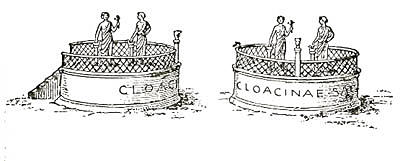 Sketch of Sacrum Cloacina, Christian Hülsen (1906). From wikipedia.
Today its foundation can be seen in front of Basilica Aemilia (marked on
this map)
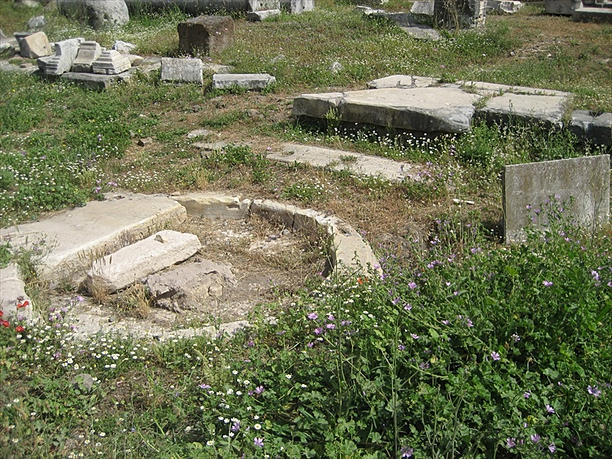 The foundation of Sacrum Cloacina today. Image from viaggidiunapecorainitalia.wordpress.com
Yes, I think this goddess is a keeper.

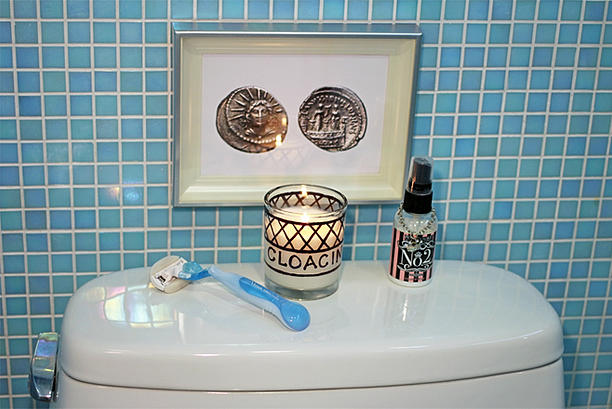
And now please excuse me. It's time for my daily devotional.
 Sources and additional reading: http://classicalstudies.duke.edu/up...caMaxima.pdfhttp://courses.umass.edu/latour/Ita...ystems_Rome/http://www.sewerhistory.org/article...pub_bath.htmhttp://www.wondersandmarvels.com/20...t-paper.htmlhttp://penelope.uchicago.edu/Thayer...e_Actio.htmlhttp://www.sewerhistory.org/article...cloacina.pdfhttp://penelope.uchicago.edu/Thayer...oacinae.html






 Posted 09/07/2014 2:27 pm





