| Author |
 Replies: 54 / Views: 16,325 Replies: 54 / Views: 16,325 |
|
New Member
Denmark
40 Posts |
For a while I've been thinking about starting a thread on the contemporary counterfeits. I think we have a few collectors on this forum - so perhaps this could be a place to share new acquisitions, information and questions of various sorts regarding the subject. Anyway - I'll start with my latest acquisition. A UK 1822 George IV sovereign. My guess is that its made of 'German silver' - I already have two similar sovereigns from the same die pair but these appears to both to be made of brass. Also the brass copy shown here is clearly produced from rusty dies - Which is common for contemporary counterfeits as the dies were often stored in less than perfect conditions (fx. buried in the ground, hidden in a stone wall or placed on a raft). The 'silver' example I think are made from the same however cleaned and slightly recut dies as the brass one. The existence of both brass and 'German silver' examples the test marks (at least on the brass example) and drill holes makes me believe that these counterfeits are indeed contemporary/close to the official issue. And not a later counterfeit, a jewellery product or an outright forgery made for collectors.  |
|
|
|
Pillar of the Community
United States
4809 Posts |
Interesting! I wonder if you are right?
|
|
Pillar of the Community
Australia
2830 Posts |
I pick up contemporary counterfeits when opportunity arises.
I've seen a lot of sovs and double-sovs bearing dates 1822 & 1823 - all brass.
Some have a loop cast on the rim - not soldered or added later: like a modern key-ring.
When looking at those without loops, I have found striations on the rim, suggesting that a loop used to be there, but has been filed off.
They must have been very underweight, compared to the genuine gold.
I don't think that they were made to be passed as forgeries, but I'm wondering what their original purpose was ?
|
|
Pillar of the Community
United States
937 Posts |
In Victorian times it was popular to make game counters and tokens from brass that mimicked sovereigns of George III. The coins were demonetarized and it could not be considered counterfeiting. Learned that on Antique Roadshow.
|
|
New Member
 Denmark
40 Posts |
The 1823 twopound where replicated for use as watch chain pendants and are quite common. Some where also produced for use as gaming counters or advertising tokens. I have not seen any of this particular denomination which one would consider being a contemporary counterfeit.  |
|
Pillar of the Community
United States
4883 Posts |
Spanish and Mexican crown sized silver coins comprised a genre that was widely counterfeited for the purpose of illicitly putting them into circulation. These have become collectible in their own right. This example came pretty late in the game, and is easily detected now for having worn down to the underlying base metal. It was likely originally silver plated, or maybe even just tinned. 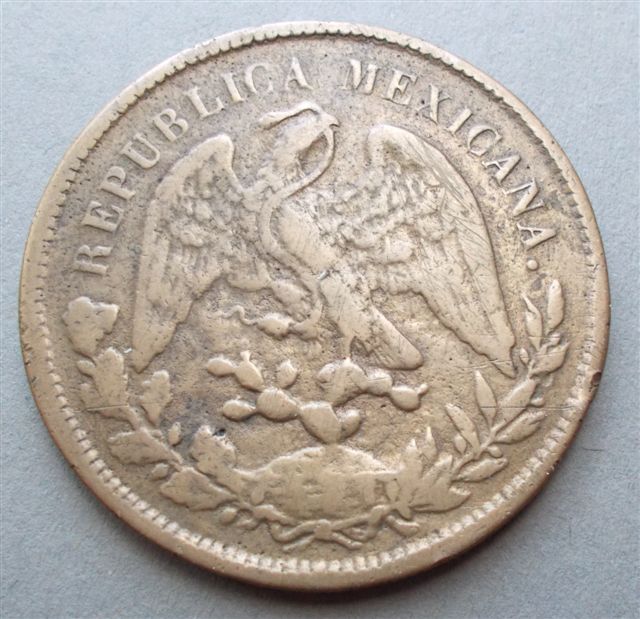 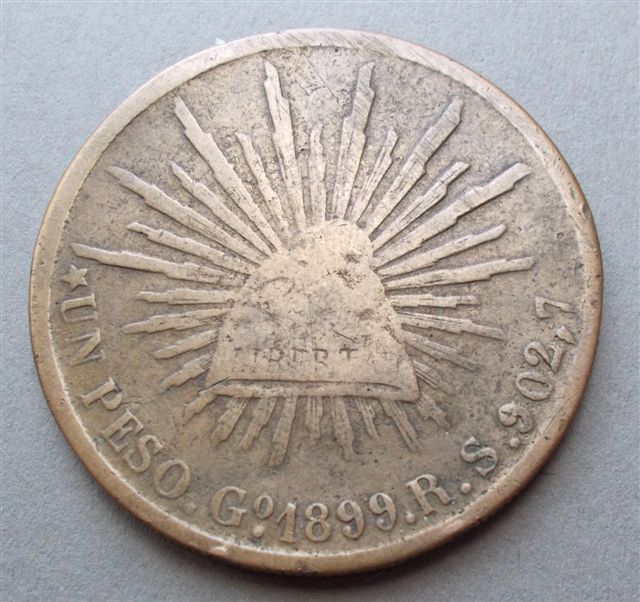 Colligo ergo sum
|
|
New Member
Denmark
40 Posts |
Nice one! Cast or milled?
My own area of interest is roughly UK & Ireland late 19 ct to the 1840s with a focus on the George III recoinage in 1816/18 - Most of these counterfeits were of the silver currency, milled in copper/brass and then silvered with which were probably some kind of tin(?) layer. Hence the 'silvering' easily wears off and most of the coins looks pretty much like yours. The later British counterfeits (Victoria and onwards) however are mainly cast in tin/lead/zinc while other metals are scarce.
|
|
New Member
Denmark
40 Posts |
More gold - Just got this 1826 sovereign. The first one I found of this type. Weight is only 4.15 gr which is only about half of a genuine coin.  |
|
Pillar of the Community
Australia
2830 Posts |
quote: "Most of these counterfeits were of the silver currency,
milled in copper/brass and then silvered with which were probably some kind of tin(?) layer.
Hence the 'silvering' easily wears off ..."
one technique was to rub mercury "quicksilver" over the base metal. The Hg would bond weakly to the host, enough to colour it.
Remember that the counterfeiter only wanted to pass it once, and doubtless took advantage of poor light, etc.
Some of my 1816~21 counterfeits still have traces of "silvering" in the recesses of the design elements.
quote: "In Victorian times it was popular to make game counters and tokens from brass that mimicked sovereigns of George III. The coins were demonetarized and it could not be considered counterfeiting ..."
I very much doubt that they were demonetized - they are still legal tender in Australia.
In the 1880s, all pre-Victorian sovs & halves were withdrawn from circulation, via the banks.
The token makers used gobbledegook legends, which bore only slight similarity to the genuine articles. Apparently, the courts accepted that artifice.
A risky enterprize,I would have thought - I researched the point a year or two ago, and put the results here on CCF:
as I recall, the last hangings for "coining" were in 1828.
There was an anomaly in the law, and lady-coiners were burned at the stake, rather than hanged.
|
|
New Member
Denmark
40 Posts |
I think some kind of tinning were widely used. At least for the period of my interest (ca. 1800-1840). However the earlier large silver counterfeits like the Bank Dollar (1804) plus the earlier countermarked (or not) Spanish 8 Reales together with the 1811/12 bank tokens are often silver-plated. For some reason this technique seems to have been omitted from around 1812. Perhaps it was to complicated for the large scale forgers? Quicksilver could explain why some high grade counterfeits don't show any sign of silvering. However it may have been more risky for the traffickers to pass them since the 'silvering' evaporates quickly and the few hoards which have come to light as far I remember all have more or less intact silvering.  A hoard of 1819 counterfeit shillings all silvered (and all from the same die pair). Regarding the George III counters which were produced in extremely large quantities - These are nearly all Guineas or half-guineas plus some scarce third-guineas. Not Sovereigns! The Cumberland Jacks and other medalet counters similar to the Sovereign gold coins were finally banned in the 'Counterfeit Medal Act' of 1883 and this banning led to an increased production of the Spade Guinea counters as these coins were obsolete hence safe to reproduce and sell. |
|
Pillar of the Community
United States
1211 Posts |
I will post up a bunch when I get home tonight. Contemporary counterfeits are my main collecting area of interest.
|
|
New Member
Denmark
40 Posts |
Looking forward seeing them! Here's an example of another silvering technique which is probably the so-called Sheffield Plate (but I'm not sure how to separate this technique from other kinds of silver plating). Also its my only 8 Reales with the octagonal countermark - I have the same die pair with oval countermark as well so the countermarking was done separately from the production of the coin.  |
|
Pillar of the Community
Australia
2830 Posts |
"Sheffield Plate" - see http://en.wikipedia.org/wiki/Sheffield_platethe counterfeits made by the British government, as part of their economic warfare against Napoleon and his allies, were "Double sandwich form", and the outer layers, on both sides, were a thin layer of genuine silver. Seuk's pic, above, possibly shows such a coin after some of the silver has flaked off. |
|
New Member
Denmark
40 Posts |
Here's a similar example of silver-plate. But I'm quite sure this is a cast coin as the design is exactly the same as the genuine Bank Dollar. Slightly blurred as one would expect from a cast - though this is a high quality one. Anyway, Sheffield-plate should be out of the question in this case.  |
|
New Member
Denmark
40 Posts |
In the mail today. A UK 1817 half crown (2nd bust) and a minor upgrade of one of the less common die varieties.  Edited by seuk
10/13/2014 4:36 pm
|
|
Pillar of the Community
United States
1211 Posts |
Seuk: I have the same 8R in my collection. Mine is ex-Lorenzo. It is GNL # 1792-O: Ab/R: Mo FM-001 and it is listed as one of the most common varieties with over 23 known.
|
| |
Replies: 54 / Views: 16,325 |










 Posted 10/03/2014 9:42 pm


