| Author |
 Replies: 54 / Views: 16,362 Replies: 54 / Views: 16,362 |
|
|
|
Rest in Peace
United States
10625 Posts |
I have one in my collection, a cast 1822 large Cent.   |
|
New Member
 Denmark
40 Posts |
Looks like a typical pewter counterfeit. Not much gained from casting One Cents one should think... Here's a similar low denomination cast counterfeit. A UK 1845 Penny which I keep even though I don't do much in cast counterfeits plus its really outside my period of interest.  |
|
New Member
Denmark
40 Posts |
@jerseyben - You say it's listed...Does it means the catalogue of the Eight Reales counterfeits are out now? I think Swamperbob mentioned there was a work in progress (years back). Anyway it probably is very common since I got two more examples (with the oval countermark).  Guess they were lucky when heating the dies. For some (smaller) coins I've seen average production figures round 20,000 to 50,000 pcs in the late 18 ct. But if a die where heated perfectly the turn out could be more than 200,000! |
|
Pillar of the Community
United States
1801 Posts |
Robert Gurney's book is out, 600 pages of great info and a huge number of counterfeits pictured. Available on Amazon |
|
New Member
Denmark
40 Posts |
Thanks! - Just ordered a copy. There's not much literature in this field so I'm looking forward reading it  Edited by seuk
10/14/2014 07:31 am
|
|
New Member
Denmark
40 Posts |
Speaking of books - I've just been rereading this one  Highly recommended for anyone interested in contemporary counterfeits. One thing in particular caught my attention - the use of wood molds for casting Elizabeth I 6d and shillings. Metal used were said to be a mix of tin and copper and I would have thought copper to have too high a melting point for use in a wooden mold. However the coins produced may have been mere blanks/washers without much design visible as this was done almost a hundred years after Elizabeth's reign. |
|
Bedrock of the Community
United States
17884 Posts |
Copper has a high melting point but tin has a much lower melting point. You melt the tin and then "dissolve" the copper into the molten tin. This will give you a molten alloy at a temperature much lower than the melting point of the copper. Next you soak the wooden molds so they will survive the molding process better. Their life will still be limited but it should be possible.
|
|
New Member
Denmark
40 Posts |
As I understand the mold should be as dry as possible since soaked or wet wood would cause disturbance in the metal surface? Anyway these coins are very thin so I guess the metal will cool fairly fast. And if only the melting point of tin is considered the heat is not very high to start with.
|
|
New Member
Denmark
40 Posts |
Another newbie - 1837 William IV halfcrown - Tin cast. The milled counterfeits being the norm for George III coins (except the crowns) seems to almost disappear during the 1830s. The new trend being tin/pewter cast coins like this one.  |
|
New Member
Denmark
40 Posts |
Another upgrade. UK Bank of England 1s 6d 1811. Besides the high grade its interesting by being engraved by the same engraver who did the 1s 6d dies for notorious forger; William Booth (hanged 1812). Booth made some 1 penny tokens (very rare) which should act as a cover up for his coining operation. The engraver of these tokens were Benjamin Patrick who is also the most likely candidate to have made Booths coining dies.  |
|
Pillar of the Community
United States
1211 Posts |
187x Seated half dollar, made of white (pot) metal, very lightweight, holed and scratched out on reverse as a crude cancellation, counterstamped on obverse 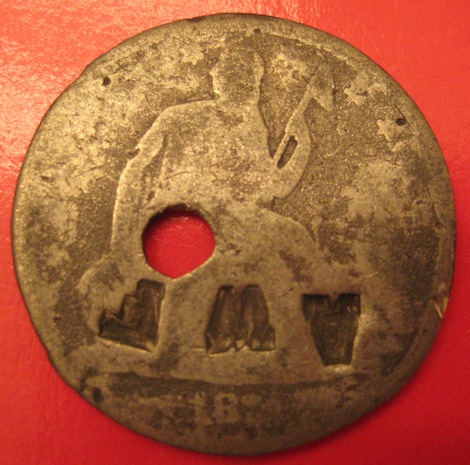 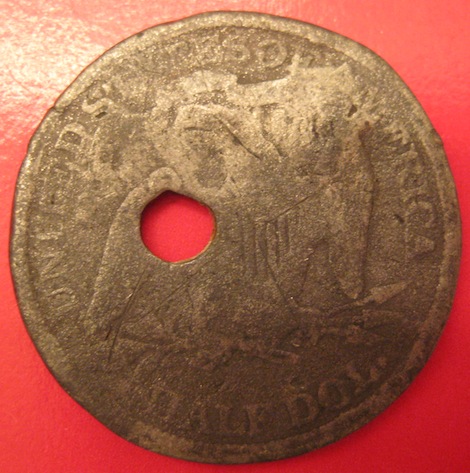 |
|
New Member
Denmark
40 Posts |
Well the hole cold be a cancellation however could it be possible that it was chanced into some kind of check or owners mark? The letters stamped may suggest some kind of use unless it was done purely for testing the stamps.
|
|
Pillar of the Community
Australia
2830 Posts |
thankyou for the reference to William Booth - it seems rare to me to be able to put an item 200+ years old into so much context. I did a little more research -
on 15/08/1812, William Booth was hanged at Stafford Gaol, Staffordshire, for "Forgery" - so my source has it.
I was a little surprised: I thought that "forgery" was paper-money, and "coining" was coins.
But I now appreciate that "forgery" was applied more broadly.
The same source tells me that -
during 1800-1827, executions in England & Wales -
2,338 people were hanged, comprising 2243 men and 95 women; including -
211 for Forgery;
144 for Uttering;
37 for H/T coining; and
14 for Uttering & forgery
Total - 406 in 28 years.
|
|
New Member
Denmark
40 Posts |
William Booth also forged bank notes besides the bank dollar and 1s 6d + 3 shillings bank tokens. Unfortunately some earlier finds of counterfeits related to him have been lost, but as far I know both the bank dollar and the 1s 6d counterfeits have been found close to Perry Barr where he produced his forgeries. So except for the 3 shilling we are fairly sure which variations are Booths. Another even better documented counterfeit is this one: http://www.predecimal.com/forum/top...-token-1811/ It is my hope that a detailed die study plus archive studies will produce some more connections between counterfeits and known coiners/engravers. But the production of counterfeits was a loose formed organisation so identification may prove extremely difficult. http://myweb.tiscali.co.uk/greatbarrhall/booth.htm http://www.capitalpunishmentuk.org/timeline.htmlEdited by seuk
10/17/2014 9:26 pm
|
|
New Member
Denmark
40 Posts |
Another newbie - George III 1815 3 shilling Bank of England Token. Both obverse and reverse are new to me - doesn't happens that often anymore.  |
| |
Replies: 54 / Views: 16,362 |








 First Page


 Posted 10/13/2014 7:57 pm


