| Author |
 Replies: 27 / Views: 10,289 Replies: 27 / Views: 10,289 |
|
Pillar of the Community
United States
603 Posts |
I did a quick search on the site but got nothing to help me. How do you tell the difference between a weak strike and wear on a coin, esp the morgan/peace series'? I know a weak strike will show up above the ear on the morgans but how to tell? Any help or links if I missed it in my search would be appreciated.
|
|
|
|
Bedrock of the Community
United States
20753 Posts |
Good question and seldom explained anywhere. Not sure myself but I usually go by the obverse and reverse comparisons. If one is or looks worn and the other side is much sharper, I assume it is a weak strike. If parts of a coin are strong and other parts are weak and the coin is in normally great shape, I assume that too is a weak strike. This is seen many times on the upper parts of the reverse on Lincoln Cents in the 90's or at least on mine.
Other than that I haven't seen any permanent explanations or subjects explaining that situation. I say permanent because if someone here comes up with a great explanation, it will be lost within a few weeks and the same question will pop up again and again, difficult to find that answer.
|
|
Pillar of the Community
United States
1173 Posts |
I am sure others will chime, but for me, weak strike is a possibility when the details on some parts of the coin are crisp and clear, but lacking on another part of the coin. With experience in a series, you develop an eye for "balanced wear" and when the wear seems uneven with some key details sharp, while others are not, you may have a weak strike.
|
|
Moderator
 United States
23522 Posts |
There's an easy answer to your question, but it's not the one you're likely to want to hear. Experience. Especially with Morgans, the difference between weak strikes and wear is a subtle one. You can't ever just look at the hair above the ear, and pronounce "weak strike." That has to be tempered by your knowledge of the other places you look for confirmation - indeed, I generally base my decisions about Morgans on the reverse rather than the obverse. The talons, the upper edges of the wings, the larger leaves at the bottom of the wreath - when you've seen enough of them, those are the places where wear stands out against strike. In a weak strike, the talons will flatten; under wear, they'll look the same but still show roundness. The upper edges of the wings are not "highest" points, and generally retain detail with a weak strike, but tend to wear early. The leaves tend to lose detail quickly with a weak strike, especially with 1921's, but wear towards the center of the coin more quickly than at their outside edges. There's no formula. There is only knowing what the difference is because you've seen it in the past. That's why it's such a slippery slope to try and grade from photographs - even the best pics cannot capture the subtle difference in color/luster on points of potential wear which might be the only reliable indicator of the actual state of the coin. All of the wear points I described above are extremely difficult to see on a photo - you have to be holding the coin to make an informed decision. With all that said, you'll note that I rarely participate in Peace dollar discussions. Nothing I know about Morgans is of any assistance with Peace dollars, and I haven't the experience to speak with any authority about them. |
|
Forum Mom
United States
5877 Posts |
I agree with Dave. Experience is the best teacher. I have noticed that when an area is worn, it is occasionally a slightly darker color than the rest of the coin, but this hardly a hard-and-fast rule. There are some series that I am comfortable with my judgement, but others that I am still learning. It also helps if you know that there are strike issues in certain areas with certain series. For this, specialized series reference books are invaluable.  |
|
Pillar of the Community
United States
2443 Posts |
I agree it's hard to tell, but there's some good tips here. BUMP.
|
|
Pillar of the Community
United States
1247 Posts |
Sometimes it's not a weak strike at all but worn dies. The field of the dies, and things closest to the field, such as stars and letters wear first on a die. Die wear is the exact opposite as the wear on coins--the low areas of coins are the high areas of the dies. Stretched or missing stars or letters often times are die wear. Rims that look strong on what appears to be a worn coin is usually worn dies, not a weak strike.
At the end of the day it doesn't matter whether it's wear, strike or worn dies. The coin will be worth less than the one that doesn't show it. Especially since it's nearly impossible to sort out how much is die wear and how much, if any, is coin wear. So it just comes down how it looks.
|
|
Valued Member
United States
411 Posts |
For most issues in mint state, it's not hard to tell. Look for star centers on coins with obverse stars. If some are sharp and others aren't, that's probably a weak strike. Same with any series: you find out where on the coin typical strike softness is found. If the softness is completely uneven, that's probably a strike weakness. If it's even, it may be worn. Etc.
But if you're collecting by date, you need to study the series in more depth. For example, I'm a baby with many issues, but I know Walking Lib. half dollars. I know that some dates never have full details on any coin due to soft strike. (Swiatek says that if there's a 1935-D with full details, only God knows about it.) This can be seen on virtually every Walker to some degree or another. It's the fault of the design. I've seen MS67 graded coins from PCGS and NGC that had significantly less than full details.
Also on Walkers, for instance, you learn that the relative depth of skirtlines goes a long way in determining the grade. But on every single Walking Liberty halve minted before 1923, one should less sharpness in the skirtlines because that's how they were originally designed. The design was tweaked in 1923 and after In coins minted after 1923, skirt lines are a typical place in those coins to find wear. But if you're looking for strong skirtlines on a 1917 Walker, you'll never find them.
It seems to me that the only way to know stuff like this is to study a series issue by issue. And bring your questions and pictures if you have them here. I have learned so so much from this community, and have always received excellent advise.
Edited by Stephen420
09/02/2007 7:50 pm
|
|
Bedrock of the Community
United States
14454 Posts |
there is a coin in a PCGS slab in the TPG section on this forum that I have to say I just can't agree with the assigned grade whether it be weak strike or worn dies or just plain wear, if you want to check it out it will just put more questions in your mind about weak strike verses wear |
|
Bedrock of the Community
United States
20753 Posts |
To further complicate this situation is the constant fun in Chem classes of acid or other caustic solution dipping of coins. Many are done very slightly and come out looking like a weak strike if done so as to expose the coins to the solution on one side only. Slight contacts with an eye dropper onto a portion of the coins can also weakin the notations. On very modern coinage it can not be hardly noticed at all. Just part of Chem101, by 201 more agressive things are being done.
|
|
Pillar of the Community
United States
3369 Posts |
Weak strike or worn die, I can't tell - I just consider it poor strike. For the Peace dollar obverse, I look for separation of individual hair strands, especially just below the coronet and on the forehead. On the reverse, the jucture between the eagle's right leg and the wing should be well-formed. Almost every 1921 has a poor strike - pancake flat hair and bad leg juncture. The best strikes I've seen are on 1924-25-26 P's - only 5-10% of these are satisfying to me, but they're all way better than the branch mints and the 1921's. As with the Morgans you have to look at a lot of coins, in hand rather than in photos. On the 1921's you can see the poor strike in almost any grade, but for the others it's hard to see without the fine details being present(XF-45 or better). "Two minutes ago I would have sold my chances for a tired dime." Fred Astaire
|
|
Bedrock of the Community
United States
62064 Posts |
Looks like several issues are being discussed here. One being coin wear. You notice coin wear on the deepest parts of the coin which are the highest part of the design. Normal wear will remove these higher feature of the profile. It wears at the rim, stars, hair and breast feather. I've go one with some wear to show how it is affected.  You can have a weak die from over cleaning and also coin wear. How do you tell each? Over cleaned die. The famous ones are the 1922 (no D) and 1937-D Three leg buffalo. Because of ever cleaning and wear on the die you would find the rim upset rim still in tack. One a worn coin the wear starts on the high parts of the design and the rim.  Note the rims are worn on this Cent and the reverse almost fades a way. So it is a common of two things. Over die cleaning/die wear and circulation. This year showed a lot of wear on the dies as they made more coins that the does should have. On a weak strike the details in the design don't get formed because of lack of strike power. Sometimes this is adjusted to get the right amount of pressure. But notice the lack of detail on this coin?  Not the rims how they are full and you can even see a partial collar rim on the edge of the coin. Another confusing error on a coin is called a strike through. It can be one part where the letter/s may be missing. This is not from a weak strike. If it were from a weak strike the details of the higher parts of the bust would not have been formed. But on this coin, just certain letters are affected. How? Grease or an obstruction fill that area of the die. The die could not strike through that area because the great prevents the coin from being shaped by the strike. 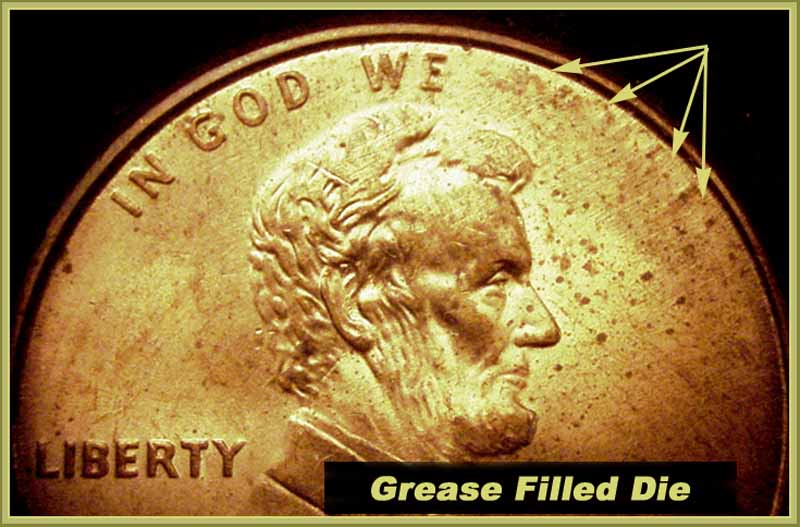 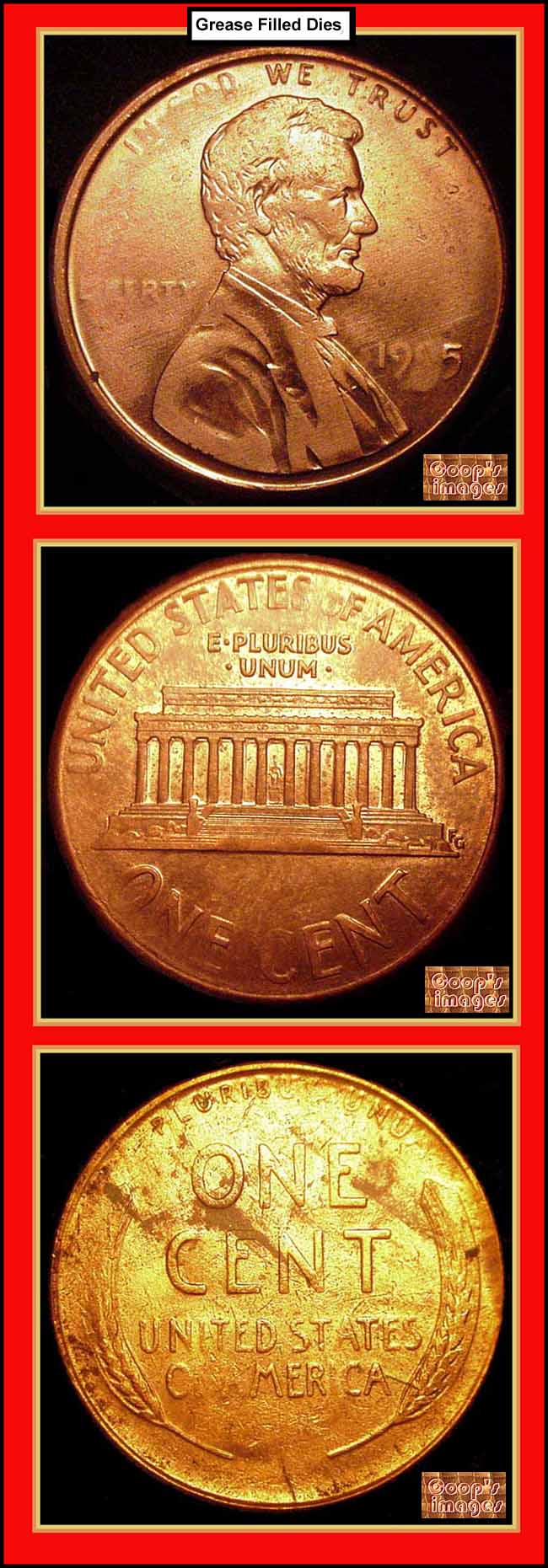 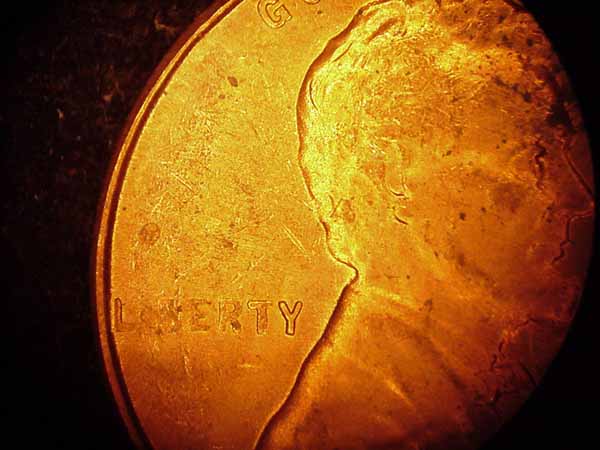 Worn dies. These are caused buy constant wear/ cleaning from clashed dies/ over cleaning and wear. What happens is that the fields meet to the letters/numbers have lost that difference in sharpness that the die had when it was in Early Die State. In the Very Late Die State the field and the letters/numbers look like show drifts that make the filed and devices that flow. This is caused by the dies continue to wear, coin after coin, taking more and more off the die so the crispness it had from the beginning is gone. 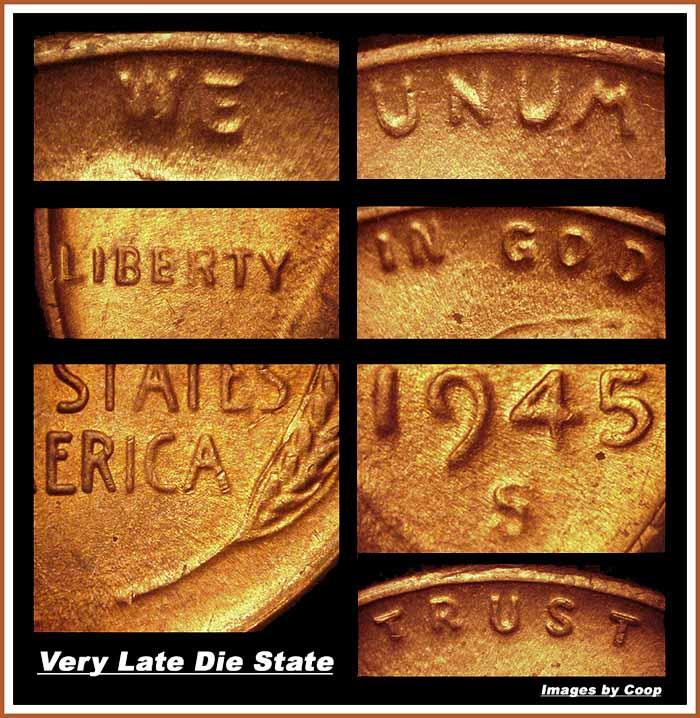 The die is seeing that last more coins before it is retired. The weakness happens in the 1940's/50's/60's as the dies life was extended to make more and more coin till the die fell apart. Edited by coop
09/03/2007 1:31 pm
|
|
Pillar of the Community
United States
7123 Posts |
Im feeling somewhat devilish today !  Here is one to test the info above with ,,weak strike or wear ? If the date Helps its a 1899-O 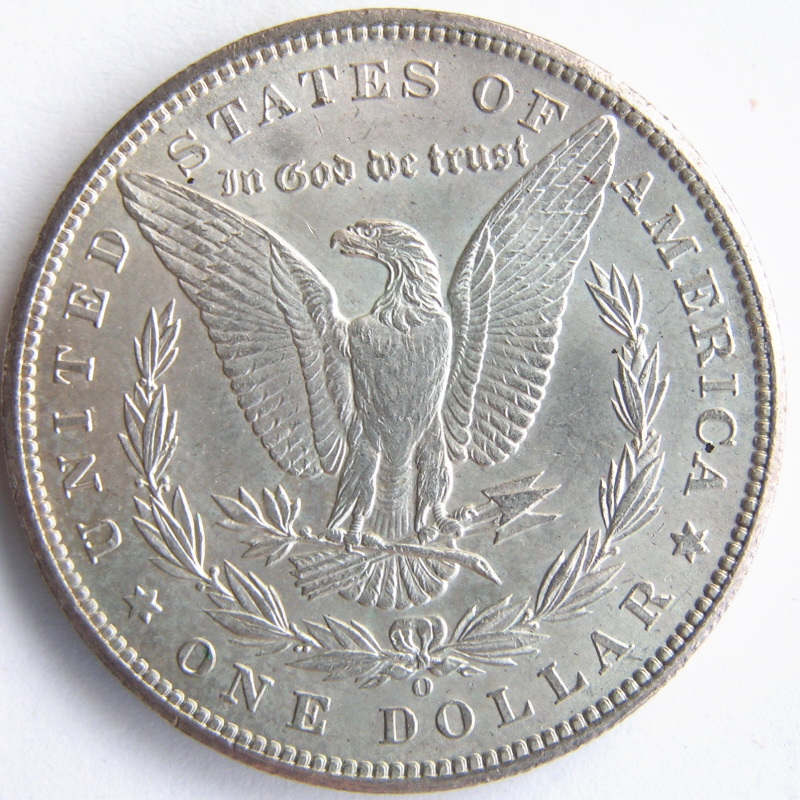 Metalman |
|
Moderator
United States
23522 Posts |
quote:
I'm feeling somewhat devilish today !
Here is one to test the info above with ,,weak strike or wear ?
If the date Helps its a 1899-O
I've got a pretty firm opinion, but I'll hold on to it for a bit. |
|
Pillar of the Community
United States
2254 Posts |
quote:
,,weak strike or wear
MS coin Metalman. With such clean fields and rim I find it hard to be anything else. But hey, what do I know..... At least you didn't say it was an 1888-o.  |
|
Valued Member
United States
411 Posts |
Metalman:  Looks like strike weakness to me because the dentils and legend seem untouched. But my main reason is that it's a New Orleans coin, which, if I understand correctly, are almost always weakly struck. Thanks coop for taking the trouble to post such an interesting and informative post. longnine also makes a similar and very important distinction between weak strike and worn dies  . This is something that has been sort of mulling around in my mind but I had not yet worked out that there's a distinction. Thanks to you guys for helping me understand this!  Edited by Stephen420
09/03/2007 6:00 pm
|
| |
Replies: 27 / Views: 10,289 |







 Posted 09/02/2007 08:50 am


