









 Posted 11/11/2014 01:27 am


I look at that coin and the first thing I see is a VERY STRANGE die crack.
A steel die will usually crack for one of two reasons.
First and most common is a crack due to failure of the steel due to stress fatigue. Cracks of this nature tend to occur in predictable positions where stress concentration occurs - they also take on rather predictable shapes. The press type will determine where stress concentration occurs. A press with a collar causes breaks in different locations than open sided screw presses.
The second most common cause of cracks happened mostly in older mints and was due to poor quality die steel. Internal voids or internal seams that were not detectable are typical. These too usually take on very standard shapes depending on the cause.
Here I see a crack that fits no normal classification for a steel fracture.
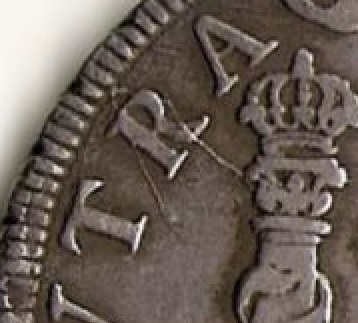
The crack starts at a point near the edge of the die and runs inward in two directions - away from a high stress area. After viewing hundreds of thousands of coins struck on collarless screw presses - I can not recall seeing an example like this.
A close look at the end of the lower of the two cracks shows a change of angle at the termination of the crack as if the die face twisted.
To me this looks like a typical tear in a plastic or hard rubber mold. Below I have circled the area that appears to show twisting.
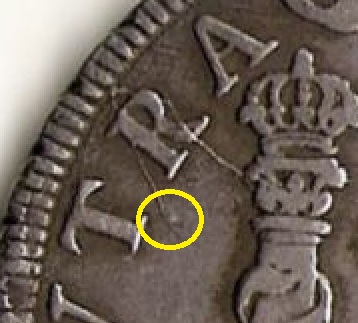
Can't be positive but I would want to look very close at this coin to see if the coin was an injection cast.
A steel die will usually crack for one of two reasons.
First and most common is a crack due to failure of the steel due to stress fatigue. Cracks of this nature tend to occur in predictable positions where stress concentration occurs - they also take on rather predictable shapes. The press type will determine where stress concentration occurs. A press with a collar causes breaks in different locations than open sided screw presses.
The second most common cause of cracks happened mostly in older mints and was due to poor quality die steel. Internal voids or internal seams that were not detectable are typical. These too usually take on very standard shapes depending on the cause.
Here I see a crack that fits no normal classification for a steel fracture.
The crack starts at a point near the edge of the die and runs inward in two directions - away from a high stress area. After viewing hundreds of thousands of coins struck on collarless screw presses - I can not recall seeing an example like this.
A close look at the end of the lower of the two cracks shows a change of angle at the termination of the crack as if the die face twisted.
To me this looks like a typical tear in a plastic or hard rubber mold. Below I have circled the area that appears to show twisting.
Can't be positive but I would want to look very close at this coin to see if the coin was an injection cast.


