| Author |
 Replies: 6 / Views: 2,680 Replies: 6 / Views: 2,680 |
|
|
Pillar of the Community
New Zealand
526 Posts |
These were found in a bulk lot I bought from an individual. I'm presuming they are replicas? There are eight in total - all have one side the same as the coin on left, but there are 6 variations on the other sides. Here are 2 - appreciate comments 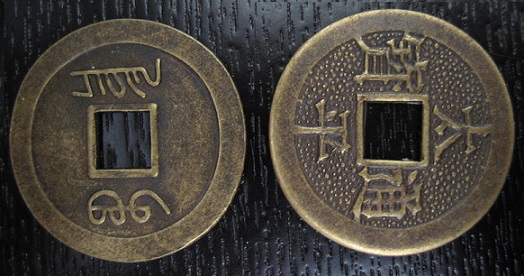 *** Moved by Staff to a more appropriate forum. *** *** Moved by Staff to a more appropriate forum. ***Edited by Bas S Warwick
11/26/2014 11:46 pm
|
|
|
|
Pillar of the Community
Canada
2805 Posts |
Yes, these are replicas. Unlike modern coins, Chinese square-holed cash coins were cast in molten metal, not struck: the casting would leave a rough look to the surfaces behind the characters. The pattern of dots you see around the characters on your "coin" is an attempt to replicate this "rough look" and its presence is the quickest way to pick out shoddy modern fakes.
|
|
Pillar of the Community
3772 Posts |
'Tourist' copies, minted en masse.
|
|
Moderator
 Australia
16969 Posts |
They are very frequently sold in sets of 10 different obverses, one for each of the Qing Dynasty emperors. Such mass-produced pieces are also sold for Feng Shui purposes in the West, tied up into various "lucky" configurations. Apparently, the evil spirits can't tell (or don't care) whether the coins being used to repel them are genuine or not.
Don't say "infinitely" when you mean "very"; otherwise, you'll have no word left when you want to talk about something really infinite. - C. S. Lewis
|
|
Pillar of the Community
 New Zealand
526 Posts |
Thanks for the prompt replies everyone. I thought they were copies, but wanted to make sure. I will just move them on as replicas. Someone somewhere will enjoy a lucky token (thanks Sap  ) Edited by Bas S Warwick
11/27/2014 12:38 am
|
|
Pillar of the Community
Belgium
2895 Posts |
Here a lot to read about the 'Lucky charm' (I found it somewhere on internet) A Chinese Coin with the Powers of a Charm
This is an example of an official Qing (Ch'ing) Dynasty minted coin, meant for general circulation, but which was immediately considered to have the powers of a charm. In the year 1713 AD, to celebrate the 60th birthday of Emperor Sheng Zu (Kang Xi), this special issue kang xi tong bao (康熙e€šå®�) coin was cast with a bronze of a golden color. A 60th birthday is considered a major event in China. In honor of this milestone, the Chinese character xi (熙), which is located below the square hole, was written slightly differently. The character would normally have a vertical line at its left. Also, the part of the character normally written as (臣) has the center written as a (å�£) instead. Finally, the upper left part of the tong (e€š) character, located to the right of the square hole, has only one dot instead of the usual two.
There are several stories connected with this coin that have been passed down for the last 300 years which have given this coin the power of a charm. The stories have turned out to be historically false but continue to be believed. The different versions of the story basically state that the bronze used in the casting of this coin came from the melting down of gold statues of the eighteen disciples of the Buddha. These disciples were called lohan (luohan 罗汉) in Chinese. Because the metal used to cast the coins was believed to be directly associated with these disciples of Buddha, the coin is believed to have special powers and is usually referred to as the lohan coin or arhat money.
Because of its special charm qualities, these coins were given to children in olden times as lunar New Year money (yasuiqian 压å²�e'±).
These coins were also considered to represent good luck because they commemorated a reign lasting for sixty years which is a complete cycle of the traditional Chinese calendar and thus symbolic of a long life.
Traditionally, these coins also acted as a keepsake or pledge of love between a man and a woman. Some women would even wear one of these coins tied to their hand in lieu of a "gold" engagement ring.
Up until about the 1940's, there was a tradition in the rural villages of Shanxi Province where stylish young men liked to carry a lohan coin between their teeth. This was an attempt to mimic the tradition of stylish young men in the cities who liked to show off a gold tooth.
These coins can even be placed in a wall of your house, under the driveway to your house, or (I think) in the west corner of your garden.I found this tekst here: (scroll down) http://primaltrek.com/charmfeatures...s_of_a_Charm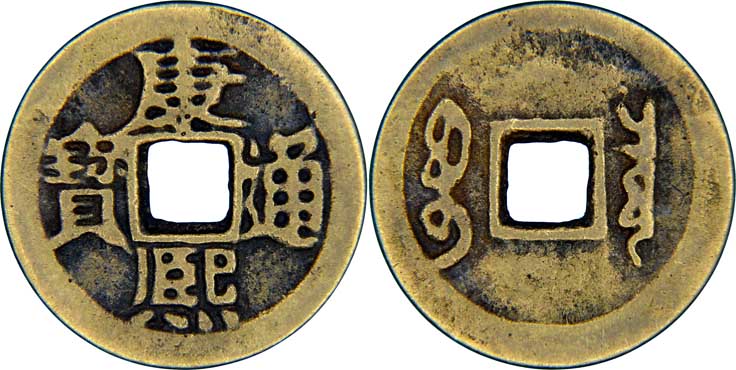 and a modern replica: 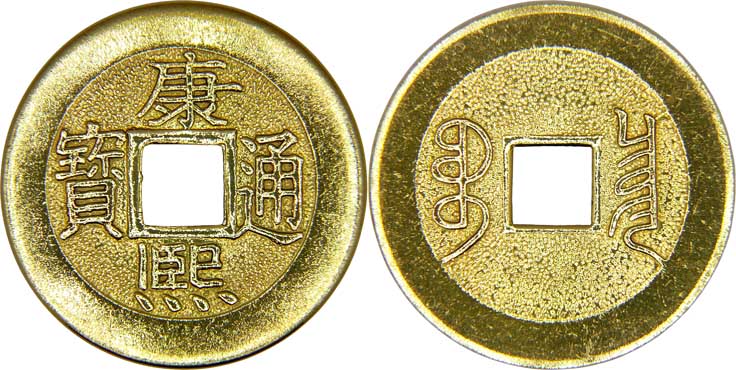 |
|
Pillar of the Community
New Zealand
526 Posts |
Thanks Petrus
I also found these uses for the replicas
1. They are placed together with wealth symbols such as Money Frog, Chi Lin, Dragon Tortoise, Pi Yao and Wealth Deities.
2. You may also place 6 loose Chien Lung coins in your rice urn with real money in a "red packet" (angpow) to multiply your income. Similarly, you may also put 6 loose Chien Lung coins into red packet to be sitted by wealth symbols for activation purposes. This is a secret reinforcement method to empower the Feng Shui wealth symbols.
3. Loose coins are also essential to fill up wealth ships and wealth vases. They should be in multiplication of a hundred.
4. For the tycoons and those who wants to be extensively rich, you may purchase them in bulk and plaster them into your walls and under your floor tiles or carpets to create abundance. Living in a bed of prosperity coins are deemed extremely auspicious and you will be blessed with a life filled with riches.
5. Create a treasure chest filled with loose Chien Lung coins and bury it in the northwest corner of your garden or home to create abundance or mentor luck.
6. You may also implant nine of these coins with Yang side on top and Yin side on the bottom in the paving stones leading to your doorstep to signify lots of money paving their way to your home. You may also tape them under a thick floor mat.
|
| |
Replies: 6 / Views: 2,680 |
|







 Posted 11/27/2014 12:06 am





