| Author |
 Replies: 21 / Views: 5,425 Replies: 21 / Views: 5,425 |
|
Forum Dad
 United States
24244 Posts |
 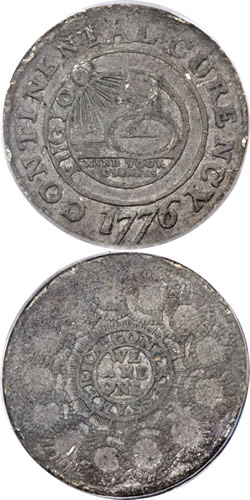 The following is a press release from Heritage The following is a press release from HeritageGroundbreaking colonial coin seen for the first time, to be offered in Heritage's Jan. 2015 FUN auction DALLAS â€" A unique and unlisted 1776 Continental Dollar in pewter, has been uncovered at Heritage Auctions. The Newman 1-A Dotted Rings Continental Dollar is known in brass, with a population of just three pieces. Heritage cataloger Brian Koller identified the present example in pewter, with Very Fine details, an entirely new discovery in a composition that was previously unknown to exist for the die variety. "I was absolutely shocked when I saw it," said Mark Borckardt, Senior Cataloger and Numismatist at Heritage. "The coin is clearly the Newman 1-A Dotted Rings variety, but it is undoubtedly pewter. Until now, the three known examples were Brass." The coin will be offered on Jan. 7, 2015, as part of Heritage's Platinum Night FUN auction."This piece represents an extremely important discovery in the field of colonial coinage," said Jim Halperin, Co-Chair of Heritage Auctions. "For the first time ever, a collector can acquire a complete die variety set of Continental dollars in the pewter composition at one time, given that the selections from The Partrick Collection selling that same night includes every other variety of Continental Dollar in all known compositions." Continental dollars were the first coins struck on behalf of the United States government in the year of Independence. The designs follow the influence of Benjamin Franklin, feature the phrase "Mind Your Business," and are similar to those devices and inscriptions found on Continental paper money printed early in 1776. The obverse of the coin is inscribed with the word "FUGIO" and depicts a sundial. The reverse has 13 interconnected rings, representing the 13 United States. While the origin of the Continental Dollars is unknown, they were produced in New York City. Notice of an official coinage appeared in the June 27, 1776 issue of the New York Journal, and the first illustration of a Continental Dollar appeared in a German book published in 1783. Although a few rare Continental dollars are known in silver, and a few others in brass, the majority of those encountered are made of pewter. Silver was scarce in colonial America, while pewter was plentiful. Different varieties have the word Currency spelled three different ways: CURENCY, CURRENCY, and CURRENCEY. Approximately 1,000 Continental Dollars of all varieties are known to exist today.
|
|
|
|
Moderator
United States
23522 Posts |
|
|
Rest in Peace
United States
10625 Posts |
|
|
Moderator
United States
23522 Posts |
The last brass example of 1-A hammered for $282,000. This should beat that rather handily.
|
|
Moderator
United States
16712 Posts |
Quote:
"For the first time ever, a collector can acquire a complete die variety set of Continental dollars in the pewter composition at one time"  swcoin.ecrater.com
|
|
Bedrock of the Community
United States
10045 Posts |
Awesome find--but this collector will never get his hands on one.  |
|
Pillar of the Community
United States
3453 Posts |
|
|
Valued Member
United States
168 Posts |
Wasn't there copies of that coin that were given out or sold for like tokens? I'm asking because I have one and I have no doubt that it has to be a copy and its made of pewter I think.
|
|
Pillar of the Community
United States
3253 Posts |
None were officially issued for circulation. But, tantalizingly, some seem to have gotten out there, at the time
|
|
Moderator
United States
16712 Posts |
Or carried as curiosity pieces..given to certain elected officials.
swcoin.ecrater.com
|
|
Pillar of the Community
United States
1903 Posts |
Based on my very limited knowledge of pewter....you can melt this stuff in your kitchen oven (350-450 degrees) it seems an inappropriate metal for coining. This is a casting metal. To me anything made of pewter screams of contemporary counterfeit...but I am no expert. My amateur gut tells me that any pewter coins of this era were smartly made copies in hopes of fooling the holder that they were silver coins. Again...just my nonfactual amateurish perspective. I was lucky enough growing up to live near a pewter shop and I never saw anything made of the stuff ever be made other than by casting and then later engraving. Cast, bend, engrave, polish was the standard procedure for everything they made.
Edited by unholyroller
12/10/2014 11:04 pm
|
|
Moderator
United States
16712 Posts |
I will tell you this. I have handled pewter and it is very soft.. You could easily bend this coin in half.
Having said that, this coin was attributed to die characteristics of the Newman 1-A Dotted rings die.
I believe it's the real deal.
BTW, VF Details could be a soft strike contributing to the soft metal giving it more of the appearance of more than actual circulation.
swcoin.ecrater.com
|
|
Valued Member
United States
168 Posts |
Like I said before, there is no doubt in my mind that mine is a copy, just not sure when it was made or copied let alone when or who passed them out. Here is mine with the paper that is with it. 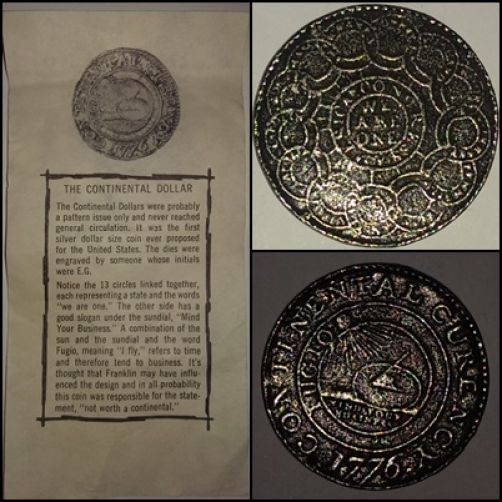 |
|
Moderator
United States
16712 Posts |
Yup, the bumpy, uneven appearance of your coin and the color..puts it no doubt a cast copy.
swcoin.ecrater.com
|
|
Pillar of the Community
United States
1903 Posts |
I am eager for a brief education here. When they attribute a coin to a certain die, am I wrong in thinking that of someone made a copy of an actual coin that it would have the same die attributes as the original?
|
|
Pillar of the Community
United States
4897 Posts |
Wonder if this means there is a 1-B in pewter.....somewhere....  |
| |
Replies: 21 / Views: 5,425 |




 Posted 12/10/2014 8:35 pm





