| Author |
 Replies: 14 / Views: 1,652 Replies: 14 / Views: 1,652 |
|
|
Valued Member
Canada
329 Posts |
Edited by wazzappenning
01/08/2015 3:38 pm
|
|
|
|
Moderator
 United States
56855 Posts |
Looks like an acid dip to me. John1  |
|
Pillar of the Community
Canada
2531 Posts |
Acid shrunk coin. When you see thinned letters, it's an instant identifier.
It was struck as a normal coin. After being put into circulation, someone put this coin in acid. The acid are away the metal and you end up with a smaller, thinner coin.
|
|
Valued Member
 Canada
329 Posts |
that much detail remains with a coin thinned to 1/4 of a standard one? actually, if a planchet 1/4 thick of what its supposed to be was fed into the dies, would they strike both sides? obviously it wouldnt be on top of another planchet as we'd have a completely different situation.
Edited by wazzappenning
01/08/2015 3:51 pm
|
|
Pillar of the Community
 Canada
5649 Posts |
|
|
Valued Member
Canada
329 Posts |
dont get me wrong, I'm not arguing, just curious if a planchet this thick is even possible let alone a coin? (from the mint)
|
|
Bedrock of the Community
Canada
10743 Posts |
You know.. we always say 'acid' coin but could it be possible that the mint could have actually made something like this... just wondering.  |
|
Pillar of the Community
Canada
2531 Posts |
Acid eats from all surfaces with the same rate. That's why you still see the design. I can explain this better with a diagram: 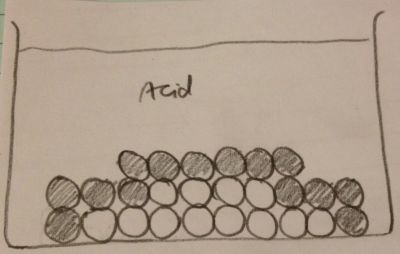 The shaded atoms that make up the surface reacts first. I think it's possible to have a really thin planchet if it got split before striking. But you'll see striations where it split and it wouldn't strike up well either. |
|
Valued Member
Canada
329 Posts |
well I think this one IS an acid coin. I was hoping I had found something here, but if I'm right, the collar was responsible for the 12 sides of this coin. they are all still there, but it is slightly smaller in diameter; so no way it hit a smaller collar.
slur, I'm guessing by not strike well, you mean probably weak strike?
|
|
Pillar of the Community
Canada
2531 Posts |
There isn't enough metal to flow up and fill in the "negative relief" of the die.
|
|
Forum Kid
Canada
1074 Posts |
nice diagram... I agree the exposed surface area allows for the acid to reach the outer edges. acid job
|
|
Pillar of the Community
United States
2775 Posts |
I think this coin was subject to a class room experiment or similar too. Maybe a garage experiment, let see what happens when I do this.
I also think SlurExe97 shows one of the best examples I've seen of how acid can react to metal alloys. Be it intentional acid dip or buried in the right conditions.
Acid dip coins like this have detail present, but reduced. Over all size and thickness is reduced consistently in the process.
A split or extremely thin rolled planchet before strike would weight less than norm, but has a weak appearance with missing detail(s) as the volume of metal is no longer equal to fill the voids needed to make a quality strike like a full planchet would.
Striations from a split planchet may or may not be present, pending strike tolerance or clearance between dies. I think die clashes are a good example of how close the strike clearance can get. Thanks, Doug.
PS: A rookies opinion.
|
|
Pillar of the Community
Canada
2531 Posts |
If you want a great resource on errors I suggest reading about them in www.error-ref.com. Most of my knowledge on error coins come from reading that site. They also have a few examples of acid jobs under the "Non-Errors" section. My diagram is just a copy of a classic Chemistry textbook diagram, but simplified a lot. I'm not drawing tens and tens of circles because I'm probably gonna make it messy. |
|
Pillar of the Community
United States
2254 Posts |
I agree with all of the above regarding acid. I have done my own experiment with a US Lincoln Cent which I am guessing is about the same thickness as what this coin was originally. My coin is almost razor sharp on the edges yet the design is still in tact, albeit very "out of focus" for lack of a better phrase. |
|
Valued Member
Canada
329 Posts |
good thought about the die clashes; but still wouldnt be enough metal to fill the die. I'm not sure if ive come across that page before slur, but I bookmarked it, thanks.
|
| |
Replies: 14 / Views: 1,652 |
|










 Posted 01/08/2015 3:40 pm


