| Author |
 Replies: 11 / Views: 1,915 Replies: 11 / Views: 1,915 |
|
|
New Member
United States
14 Posts |
Hello all, First post here. I found this coin during a recent roll party. Please help identify type of error. My first inclination is that the error is FS-01-1951D-521 (021.51), but I am a second year rookie. Thanks for all your help! 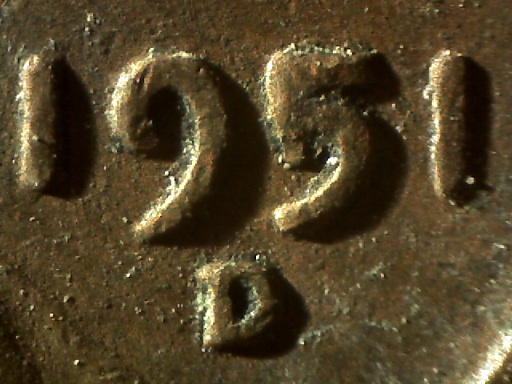 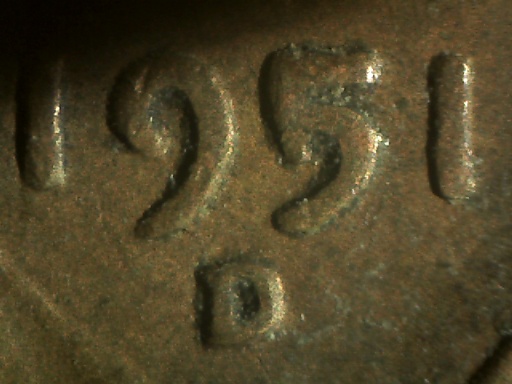 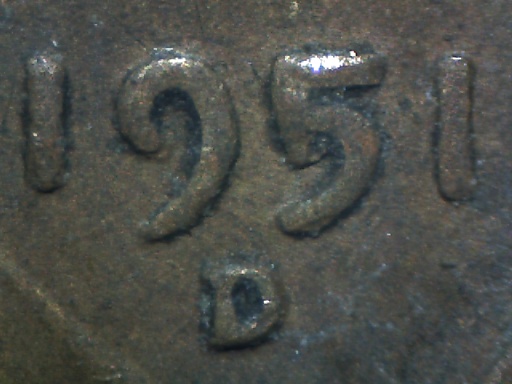 *** Moved by Staff to a more appropriate forum. *** *** Moved by Staff to a more appropriate forum. *** |
|
|
|
Moderator
 United States
56855 Posts |
 to CCF. It is not 021.51May be a die chip on the 5. John1  |
|
Bedrock of the Community
United States
62064 Posts |
I'm not familiar with the FS numbers so I'm not sure what you are seeing? What I can see is a coin from the 50's wheat era where they over used the dies during that time. We find a lot of die chipping, die wear, die abrasion and other things that happened during that time. I see a lot of grime around the devices that may be hiding a possible RPM (Re Punched Mint mark). But I can't tell from the image provided. The devices look normal in size on the date. So if you were matching something to the die chips on the 5, that happened a lot during those years and is not always a good marker to identify a variety. So I'm thinking you are thinking this is a RPM? |
|
New Member
 United States
14 Posts |
What I am seeing is a possible RPM where the "D" was re-punched on the "5". After your reply and one other though, I agree with the both of you. Its listed in the Cherrypickers book with a picture that is similar to mine. In the book it states that the coin found is unique and none others had been documented.
Can you tell me a good way to clean the grime off of coins that will not ruin the value? Thanks for all input.
|
|
Moderator
United States
56855 Posts |
At your own discretion,use a well worn soft tooth brush under running water. John1 |
|
Pillar of the Community
United States
3362 Posts |
There is a lot of debate about cleaning. Here is one quote which I found:
""A simple but effective way to remove this crud employs an artists brush and a solvent. I use Xylol (Xylene), which is an organic solvent available at most paint supply stores. Using a small artist's brush with a wood handle and relatively stiff bristles (equivalent to a a baby's toothbrush), follow these steps:
• Keep work area well-ventilated and follow solvent safeguards.
• Paint one side of the coin with solvent.
• Work crud out using tiny circular brush strokes. Don't drag brush across coin's surface.
• Concentrate on cruddy areas; then quickly do rest of coin.
• Blot off solvent while surface is still wet (rewet if necessary).
• Repeat process for other side of coin and any areas where some crude remains.
• Add a thin coat of Care, Blue Ribbon, or some similar protectant.
• Brush away excess coating using standard "copper brush." These are jeweler's brushes with natural, cream colored bristles and a wooden handle. An old brush (well-used with a greenish tint on the bristles) is preferred."
from â€" The Die Varieties of United States Large Cents 1840 â€" 1857 by John R. Grellman, Jr. page v M & G Publications, 2001
|
|
Moderator
United States
56855 Posts |
You need to start out using the least destructive method,distilled water and work your way up to acetone or Xylene. Read up before you use chemicals. John1 |
|
Bedrock of the Community
United States
62064 Posts |
It is just a die chip in the 5 that you are seeing. Not a "D" in that area.
|
|
Pillar of the Community
United States
3362 Posts |
Quote:
You need to start out using the least destructive method,distilled water and work your way up to acetone or Xylene. Read up before you use chemicals. I think that this is an excellent suggestion! |
|
Bedrock of the Community
United States
62064 Posts |
Make sure the coin is dry fully before putting it back into a 2X2/air tight/flip. any moisture will turn the coin green if it is not totally dry. Hair dryers can help make sure. I use a different method. But I won't go into it now. But it is on the DVD if you have a copy. I do have an image on the my image host: 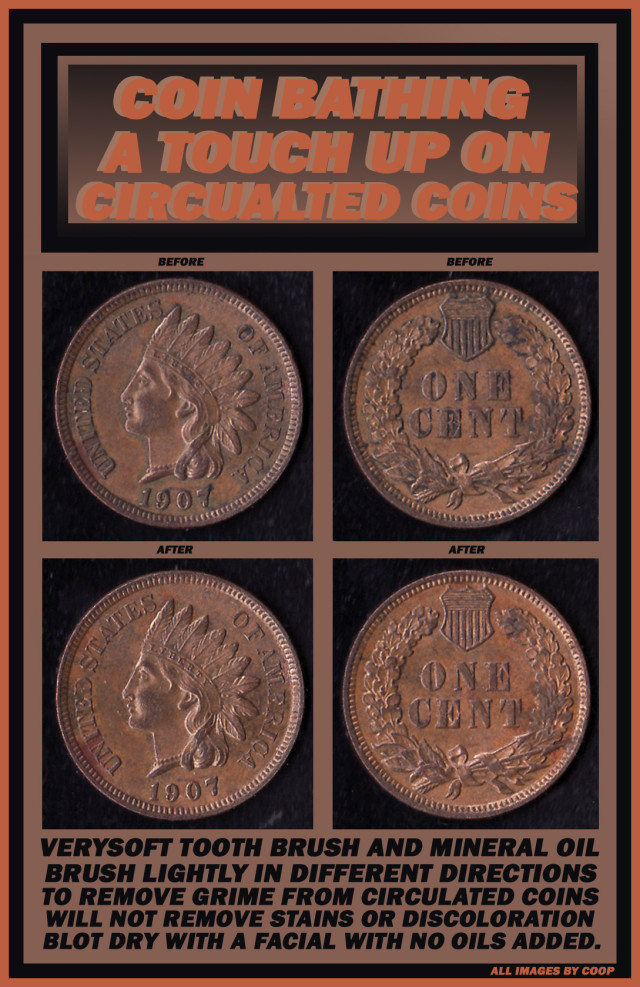 It involves mineral oil and a very soft worn tooth brush. But only removed grime. Will not remove spots or toning if you use it only one time. Not to be used on BU or Proof coins, just circulated coins. Experiment on several dirty coins from circulation until you get the process down.  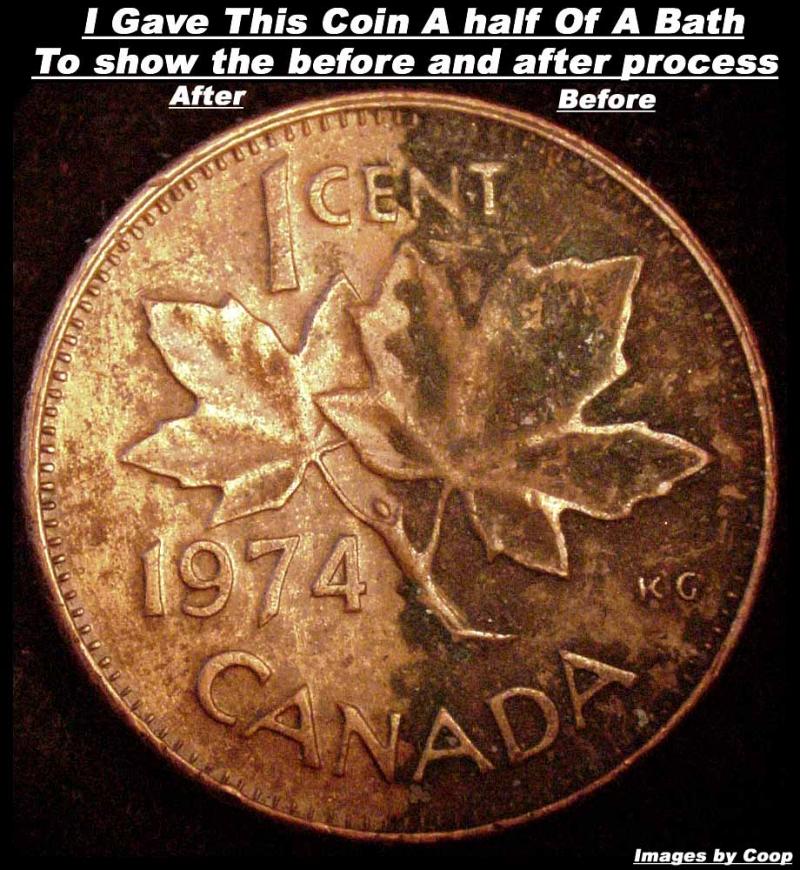 When removing the excess oil, blot (Not rub) coin with a plain tissue (No oils or perfume added). If the coin needs a second bath, then repeat and you might want to use a green thorn to remove grit from the devices. Keep in mind the grit may have sand in it and it might scratch the coin if wiped across the fields. So go carefully an use different directions when you are using your brush. I use the brush at times pressing down to work on the devices and at different angles/directions concentrating on removing the gunk. but it a piece come off, keeping mint it may contain sand, light brushing it off the coin and not grinding it into the fields. Again this is for circulated coins. It will not remove spots, rust, finger prints, carbon spots and distractions. Just the grime from around the devices. It will not remove green verdigris.Edited by coop
01/13/2015 10:17 am
|
|
Pillar of the Community
 United States
1034 Posts |
Coconut oil with a very worn out tooth brush, also works well.
|
|
Bedrock of the Community
United States
62064 Posts |
I prefer mineral oil. Coconut and olive oil are organic and can spoil or discolor. Mineral oil is similar to the composition of grease/oil which the coins are already exposed to. It is also in-expensive. Look for it in the laxatives section in a food/drug store. Doesn't spoil, but remember to keep the cap tight. It can be messy if it is tipped over.
|
| |
Replies: 11 / Views: 1,915 |
|









 Posted 01/12/2015 12:49 pm


