| Author |
 Replies: 11 / Views: 1,607 Replies: 11 / Views: 1,607 |
|
|
New Member
United States
4 Posts |
Hi, my brother found this coin years ago. After reading a bit I believe it to be a Tesserae, maybe of Roman origin. Can anyone confirm, or correct me? 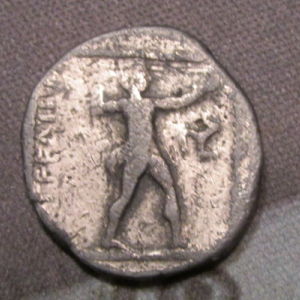 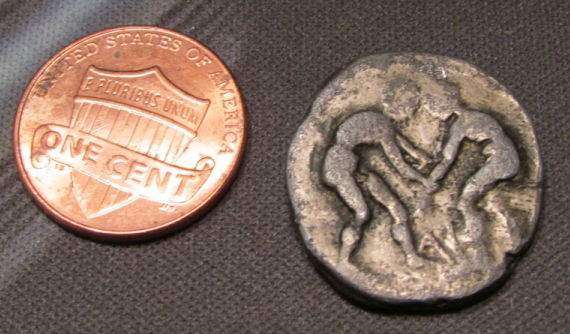 P.s. I have no idea if it is authentic. The only thing I'm really sure of, is that it is made of lead. *** Moved by Staff to a more appropriate forum. *** |
|
|
|
Moderator
 United States
14463 Posts |
I moved your thread to the Ancient coin section to get noticed by the experts here.  |
|
Pillar of the Community
3772 Posts |
Seems the legend on the right side of the upper picture should be legible. Can you make a better picture of that? If it is really lead, then it is most likely a copy (or maybe at best a contemporary forgery). But wait for further comments and let's work out what type it is. |
|
Moderator
United States
23731 Posts |
to the community The piece is supposed to be a siver stater from Pamphylia, Aspendus. It should weigh right around 11 grams and be around 18 mm. From the appearance of this piece I have doubts that it genuine, it looks to have a silver wash over some type of base metal most likely lead. |
|
New Member
 United States
4 Posts |
Thank You Fuzzy317!
Medieval: I tried. It's almost completely worn off. I took the highest resolution pics I could, but my photo skills aren't great. I'm almost positive it's lead. I haven't tried scratching it. But it left very clear marks when I dropped it over paper. And then maybe rubbed it against paper, just a bit, to test that theory. :D
echizento: I'm unsure of its weight. I tried weighing it on my scales, but it didn't show any reading. (Seems odd to me, as I can clearly feel the weight of this thing in my hand. So maybe my scales are broken. I did measure it, it 20mm by 21.5mm.
|
|
Pillar of the Community
3772 Posts |
Not necessary anymore since 'echizento' recognised the type.
The text is part of "ESTFEDIIUS" (you can read the middle part ...tFEDIIV.., the trangular shape is a delta [aka D]) consistent with the type. Since the type was only produced in silver, yours is clearly a copy/forgery of some sort.
|
|
New Member
United States
4 Posts |
Okay, definitely a fake. My question, is this a more modern counterfeit, or an old one?
|
|
Pillar of the Community
3772 Posts |
Cannot determine that from the picture. That would require an expert to see the coin in hand or an analysis of the silver mixture. There are also means to determine the composition of the silver layer, modern silver (usually) has a higher degree of purity - can't remember at the moment what's it called. Question is if the effort is worth it.
Wait for others to comment.
|
|
New Member
United States
4 Posts |
|
|
Pillar of the Community
United Kingdom
4208 Posts |
I cant recall a single contemporary example of the greeks silvering lead. By the colour of the lead, I suggest its modern - lead quickly gets a white powdery patina a if this were a contemporary piece we'd expect it have quite seriously deteriorated - when the oxide is cleaned off and the metal revealed, the detail is usually significantly mushier.
|
|
Pillar of the Community
United States
5155 Posts |
Here is my silver stater of Aspendos, I believe your coin to be a modern base metal copy. 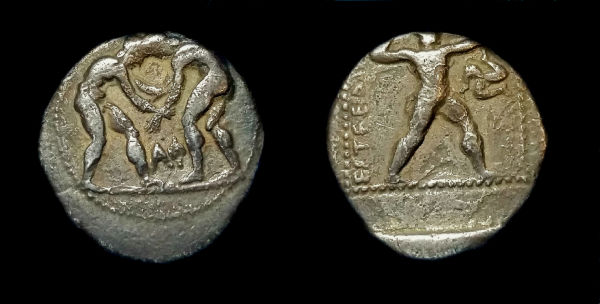 |
|
Pillar of the Community
United States
5155 Posts |
"modern silver (usually) has a higher degree of purity - can't remember at the moment what's it called."
0.925 % Silver = Sterling.
|
| |
Replies: 11 / Views: 1,607 |
|










 Posted 01/21/2015 01:31 am


