| Author |
 Replies: 15 / Views: 1,725 Replies: 15 / Views: 1,725 |
|
|
Valued Member
United States
462 Posts |
Attached are images of an error coin I have had for awhile now but can't completely figure it out. Here is what I do know: 1. It's an Israel 10 Sheqalim struck on a 2.5 gram Canadian cent planchet from the years 1982-1985. 2. It's closely double struck 3. The dies are rotated about 45% degrees from its normal medallic alignment 4. The coin has proof like surfaces 5. The brockaged side's design is slightly expanded, more in the center of the coin. 6. The brockaged side's design is raised. The PCGS label doesn't mention the double strike nor that its struck on a Canadian cent planchet. I just can't figure this coin out and its sequence of events. I am not sure which is the hammer die on this series. Maybe the coin was 1st struck as an off metal on rotated dies. Hopefully someone can help me out here including Mike Diamond? Here is the PCGS label that missed a few things. 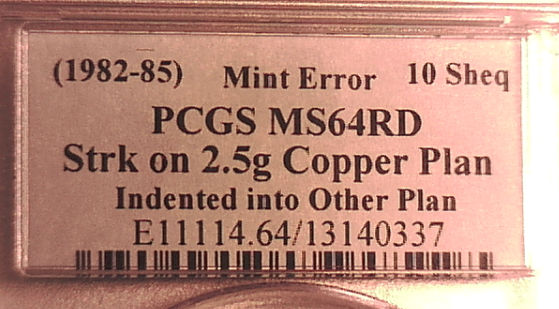 Here is the 10 Sheqalim side that has proof like surfaces. It also shows the degree of rotation (about 45 degrees) 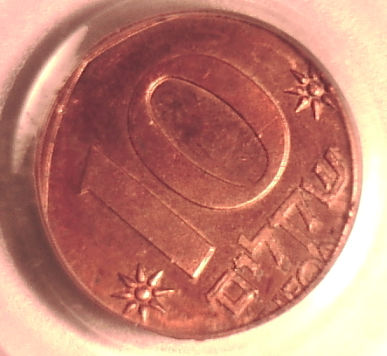 This image shows the closely overlapping double strike along with the metal flow line tears at the bottom of the letters. 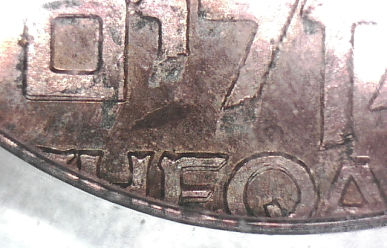 Here's the brockaged side, keeping in mind that its rotated 45 degrees from the other die design. The images show some expansion but not a lot. The design is raised. The design showing should also confirm that the coin was double struck. 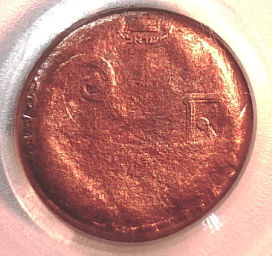 Below is what a normal 10 Sheqalim looks like 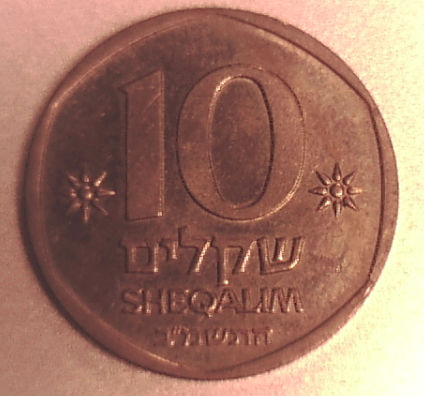 Here is the other side of the normal coin 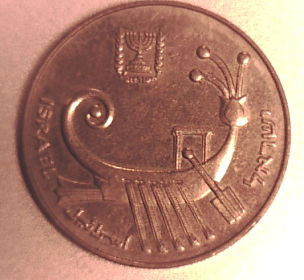 |
|
|
|
Pillar of the Community
Canada
4912 Posts |
Seeing as the brockage side is raised that would make this coin a die cap, this would also explain the proof like surface and the slight multiple strikes.
Feel free to call me Will.
|
|
Valued Member
 United States
462 Posts |
I think the raised design is the normal 1st strike which was slightly expanded, when as a struck coin, was indented into another normal 10 Sheqalim planchet. Maybe it failed to eject from the collar and a new planchet was fed over top of it. Keeping my original hunch that it was struck with 45 degree rotated dies. I am not sure I agree with the capped die angle but if it is, it would have to be a counterbrockage type since the design is raised.
|
|
Moderator
 Canada
10477 Posts |
Looks like a later stage counterbrockage to me... since it is not in mirror image and stretched out.
"Discovery follows discovery, each both raising and answering questions, each ending a long search, and each providing the new instruments for a new search." -- J. Robert OppenheimerContent of this post is licensed under a Creative Commons Attribution-NonCommercial 3.0 Unported License. See: http://creativecommons.org/licenses...0/deed.en_USMy eBay store
|
|
Pillar of the Community
Canada
2430 Posts |
Later stage counterbrockage.
|
|
Valued Member
United States
462 Posts |
If its a counterbrockage, it would have to be an earlier state from a rotated capped die. All of the design is still showing from the original strike, keeping in mind that there wasn't that much to begin with since it was struck on a cent planchet. I really don't think its a counterbrockage though. I think it was struck coin struck into a 10 Sheqalim planchet. Rounded edges is another clue combined with it being double struck with the second strike causing the expansion as it was indented into the host planchet.
|
|
Pillar of the Community
United States
2752 Posts |
I agree with Zimmy that this off-metal coin is double-struck. The first strike was die-struck on both faces and the second strike was uniface.
Error coin writer and researcher.
Edited by mikediamond
02/08/2015 11:34 pm
|
|
Valued Member
United States
462 Posts |
Mike.....any ideas on why the obverse and reverse are rotated 45 degrees? Is it because that is how the dies were lined up when struck?
|
|
Moderator
Canada
10477 Posts |
How do you explain such a drastic stretch of the design?
"Discovery follows discovery, each both raising and answering questions, each ending a long search, and each providing the new instruments for a new search." -- J. Robert OppenheimerContent of this post is licensed under a Creative Commons Attribution-NonCommercial 3.0 Unported License. See: http://creativecommons.org/licenses...0/deed.en_USMy eBay store
|
|
Pillar of the Community
Canada
2632 Posts |
Quote:
Maybe the coin was 1st struck as an off metal on rotated dies Probably right there, this link shows the same rotation as Canadian coins. 191102585560The side with the 10 denomination and date (in Hebrew) is the reverse. Which side was the hammer? I would think it was the obverse but I suppose that could go either way. |
|
Pillar of the Community
United States
2752 Posts |
It's possible there was a rotated die error. But it's also possible that dies were in their proper orientation. What may have happened is that, after the first strike, the coin rotated 45 degrees. The first-strike details on the face bearing the denomination were completely erased by the second strike. That wouldn't be too unexpected given the increased effective striking pressure involved. If this second scenario is correct, then the close doubling you observe may well be Machine Doubling or (less likely) a third strike. The expansion of the design on the opposite face is pretty much what I'd expect of a uniface second strike into a larger planchet. The design runs off the edge because we're dealing with an undersized planchet. Error coin writer and researcher.
|
|
Valued Member
United States
462 Posts |
Mike, I understand both scenarios and thanks......I personally am leaning towards the coin being struck on rotated dies for the following reasons. 1) It's not that uncommon to see rotated strikes on Israel coins. 2) The flow marks on the one image may be too drastic for Machine Doubling, I think. |
|
Moderator
Canada
10477 Posts |
As much as I would like to buy into Occam's razor, I think it is more complicated than that. The only time I imagine a uniface strike stretching a design like that, is when it is a capped die...  "Discovery follows discovery, each both raising and answering questions, each ending a long search, and each providing the new instruments for a new search." -- J. Robert OppenheimerContent of this post is licensed under a Creative Commons Attribution-NonCommercial 3.0 Unported License. See: http://creativecommons.org/licenses...0/deed.en_USMy eBay store
|
|
Pillar of the Community
United States
2752 Posts |
I have seen a number of double-struck, off-metal and wrong planchet errors with just this appearance. In contrast, I have never seen a full counterbrockage associated with an off-metal error.
Error coin writer and researcher.
Edited by mikediamond
02/09/2015 4:43 pm
|
|
Pillar of the Community
Canada
2430 Posts |
With all do respect Mike but could it be possible for this to be the first one?
|
|
Pillar of the Community
United States
2752 Posts |
Anything is possible, but I see no physical evidence that would elevate this hypothesis above the much more likely one I offered. In this case Occam's Razor is the way to go.
Error coin writer and researcher.
|
| |
Replies: 15 / Views: 1,725 |
|










 Posted 02/08/2015 5:21 pm


