








 Posted 02/24/2015 02:03 am


I will start by saying I am unfamiliar with the coin or how the dies were made - however, it seems to me that it should be called a rotational punching error (provided the digits of the date were punched into the die). If you rotate the final digit 90 degrees counterclockwise it becomes a correctly shaped number 4. It is not really retro-grade as that would imply an incorrect punch existed or a very poor engraving.
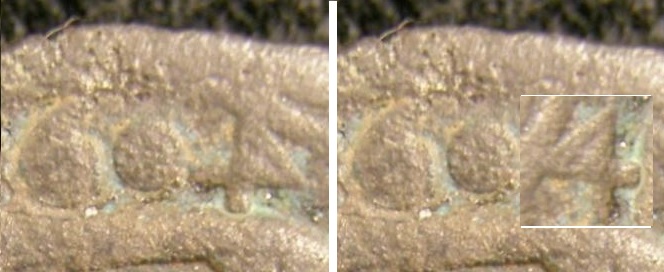
The clue for me as to the cause is the shape of the 4. A normal 4 has a downward leg that is longer than the length of the crossbar. Rotation as I depict above would correct that issue. It is also much easier to envision a die setter rotating a punch accidentally than to believe a punch was cut wrong or an engraver made such an error.
When I first saw the picture I actually read the number as 400 - like the Portuguese coins depict denomination - vertically (I presumed the photo of the coin was rotated 90 degrees.) Then I noticed that the second zero was actually a 6.
It is a very interesting variety nice to see it documented. It also makes me wonder if the die may have been corrected by repunching the digit correctly - creating a 4/4 variation? Something to hunt for anyway.
The clue for me as to the cause is the shape of the 4. A normal 4 has a downward leg that is longer than the length of the crossbar. Rotation as I depict above would correct that issue. It is also much easier to envision a die setter rotating a punch accidentally than to believe a punch was cut wrong or an engraver made such an error.
When I first saw the picture I actually read the number as 400 - like the Portuguese coins depict denomination - vertically (I presumed the photo of the coin was rotated 90 degrees.) Then I noticed that the second zero was actually a 6.
It is a very interesting variety nice to see it documented. It also makes me wonder if the die may have been corrected by repunching the digit correctly - creating a 4/4 variation? Something to hunt for anyway.


