| Author |
 Replies: 17 / Views: 2,979 Replies: 17 / Views: 2,979 |
|
New Member
United States
5 Posts |
My first post, thanks in advance. I found this nickel in circulation. It appears that there was no die in the press to strike the "head" side. The coin runs about .041" around the edge, and about .071" in the center of the coin, giving the blank side a slight "domed" appearance. Also on the "tails" side, you can see two rings that transferred through when it was struck. Any thoughts on how this came about, and how often this happens? Sorry if I posted the pix wrong... Thanks again, Ike. 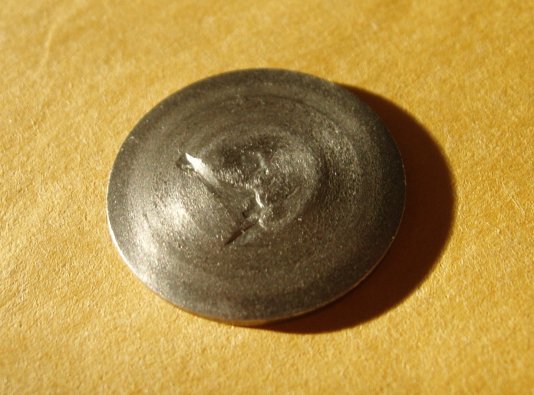 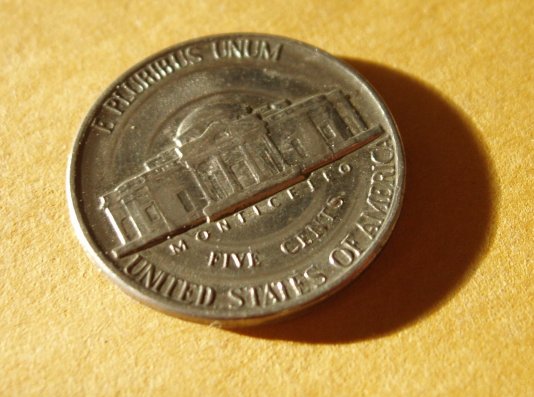 |
|
|
|
Member
United States
703 Posts |
Hi and welcome, this is not an error and has no value.
Someone with too much time on their hands no doubt.
errrrrror
|
|
Member
United States
3242 Posts |
welcome!
But that coin has been stuck in a dryer it looks like
|
|
Valued Member
Australia
161 Posts |
Even a uniface (1 sided coin) is struck with 2 dies just that 1 is blank. You will normally have a rim on both sides of the coin too even if there is no design. These are usually done to test a new metal composition of planchets or to see how a new design will look on a coin.
|
|
New Member
 United States
5 Posts |
I guess coming from a steel stamping background is what got me interested in this coin. I'm not certain how a individual coin die is mounted to the die frame in the press, but if the blank die is missing, what ends up backing the coin on the stroke? This coin appears as if the outside shows the lettering around the rim to be deeply embossed, with the flat of the coin dished from the outer edge in. The center of the coin, thicker than the edge, show much less detail. I wondered if, without a bottom die in place, the blank is supported mainly on the outer third of the coin, reflecting a deep emboss, with the excess material flowing towards the unsupported center, which results in thicker material and less detail.
|
|
Bedrock of the Community
United States
14454 Posts |
Welcome to the forum, I think the assessment that this coin was probably stuck in a commercial dryer may be correct. I am not a error expert but have seen other coins that show the same characteristics your coin shows on here and this is what some of the experts told them about their coin they asked about here on the forum
|
|
Pillar of the Community
United States
7629 Posts |
It's a Dryer Coin. The obverse was struck, but was mostly ground off wheeling around in the dryer rubbing against the drum. The back of the collar and neck show in the image. |
|
Pillar of the Community
United States
2177 Posts |
Welcome to the forum Ike!
|
|
Pillar of the Community
United States
3507 Posts |
Hi and welcome:-) Sorry guys, not a Dryer Coin. The details on the reverse are still too good and do not show the usual damage that a dryer would cause. Tons of nicks and dings begin to flatten the details on a ' Dryer Coin' and the reverse shows none of that. The two concentric rings could have been cause by a counting machine or whatever device the coin was locked into to machine the obverse. This on definitely looks like a coin that a machinist outside the mint fooled with just to see what kind of damage could be caused. So,post Mint damage, probably machined in some way, and definitely not a Dryer Coin. Thanks, Bill Edited by foundinrolls
10/11/2007 02:41 am
|
|
New Member
United States
5 Posts |
My digital postal scale at work has this coin and a regular Jefferson nickle each weigh .2 oz., so it would seem that material wasn't removed, no? |
|
New Member
United States
5 Posts |
Standard nickel on the left... 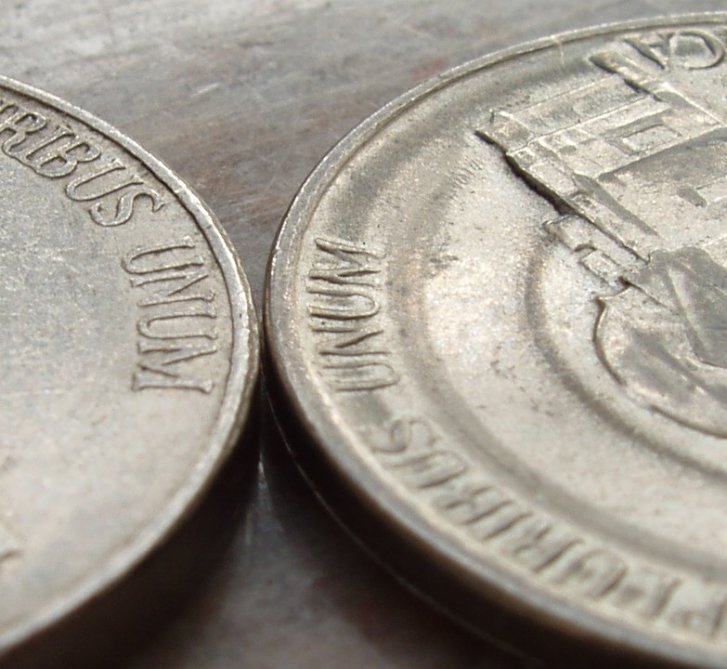 |
|
Bedrock of the Community
United States
12437 Posts |
Quote:My digital postal scale at work has this coin and a regular Jefferson nickle each weigh .2 oz., so it would seem that material wasn't removed, no? Postal scales are not the best way to weigh coins as a nickel should weigh 5 grams so weighing in ounces will not be precise. Most US coins have odd weights(i.e. a quarter weighs 5.7g), not a nice round number so accuracy is important. Generally, it is best to weigh a coin on a scale that is accurate to 0.1g or even 0.01g and for silver and gold, a powder scale that weighs in grains is the best. It is hard to say exactly what happened to that coin other than something abraded the obverse in a circular pattern wearing down the surface. |
|
New Member
United States
5 Posts |
Quote:
It is hard to say exactly what happened to that coin other than something abraded the obverse in a circular pattern wearing down the surface. The deformation (dish) on the stamped side has me puzzled. If I found that this coin weighed the same as a standard nickle, what would be your next best guess? |
|
Valued Member
United States
199 Posts |
Perhaps, a washer was fell on top of this coin when the coin was struck creating a washer imprinted brockage.
|
|
Valued Member
United States
199 Posts |
Perhaps, a washer fell on top of this coin when the coin was struck creating a washer imprinted brockage.
|
|
Pillar of the Community
United States
3507 Posts |
Why is it so hard to accept what the coin is. It's damaged. Unknown form of destruction.
If it were a brockage through a washer, or a brockage of any kind, the reverse would have the details obliterated by the washer or the obverse would have the exact shape of a centered washer easily detectable.
There is no known way for this to have happened at the Mint.
|
| |
Replies: 17 / Views: 2,979 |





 Posted 10/09/2007 11:05 am





