| Author |
 Replies: 20 / Views: 6,253 Replies: 20 / Views: 6,253 |
|
Pillar of the Community
Hong Kong
1270 Posts |
Hi members, I know little about this beautiful coin and don't find any useful information from the internet so I post it here to ask for any information about. The theme of this coin is for Confederation Armament Fund. The observe design shows it clearly. A female liberty personifies the country, one of her hand holds the sword and the other hand has a pigeon above which imply "fight for peace". But I can't find any information about "Confederation Armament Fund". What is it actually? Also, can anyone tell the full translation of the motto at the back of the coin? I am stumbled by the word "TUENDA". About the country name, Helvetia, is it a formal name for Switzerland now? Any other input is always welcome. Thank you. 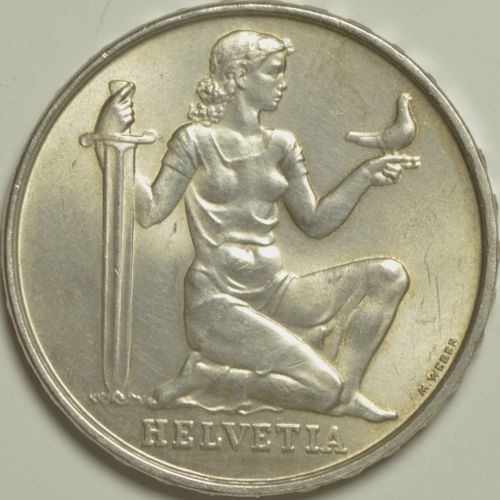 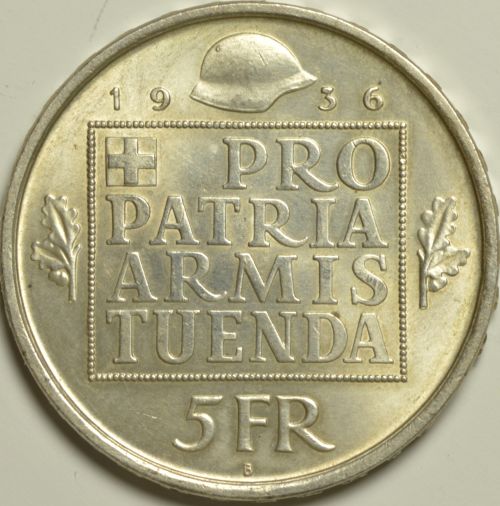 The edge motto is "DOMINUS PROVIDEBIT" which is translated to "Lord will provide".   There are 13 stars at the edge. Do they stand for anything meaningful?  |
|
|
|
Bedrock of the Community
United States
11951 Posts |
I can't help with any information, but I think that is a very
nice looking coin.
I hope some expert jumps in, I would like to know more information too
|
|
Bedrock of the Community
Australia
21792 Posts |
Wikipedia:
The name 'Helvetia' derives from the name of a Gaulish tribe known to the Romans as the 'Helvetii'.
She is the female personification of the Country of Switzerland.
|
|
Valued Member
109 Posts |
Google Translate renders "pro patria armis tuenda" as "for homeland defense weapons".
|
|
Pillar of the Community
United States
3486 Posts |
|
|
Pillar of the Community
United States
3486 Posts |
Just from reading a few links I offer a possible explanation:
Switzerland was unprepared for World War I.
By the 1930s the country was updating its defenses and equipment in anticipation of a second war.
The coin is called a commemorative but it seems to me that it was sold as a "Savings Bond."
Money taken out of circulation was diverted to these war preparations.
It would be the patriotic thing to do.
Just an educated guess.
|
|
Pillar of the Community
Canada
2805 Posts |
Switzerland has four official languages; German, French, Italian, and Romansch (a minor language spoken only in remote parts of Switzerland). All of these languages render "Switzerland" differently; "Schweiz", "Suisse", "Svizzera" and "Svizra". You can't fit all this onto one coin, and how will you make it equal when one language has to come first? So the Latin word "Helvetia" is used; that way, all languages are equally excluded.
|
|
Pillar of the Community
 Hong Kong
1270 Posts |
All of you , thank you your input. I am glad this coin have sparked some valuable opinions from our members. Quote:
The coin is called a commemorative but it seems to me that it was sold as a "Savings Bond." This saying is funny but really true. I agree. The issue of this coin had at least shown the government's stance on the War though the lump sum of money got (200,000 x 5 F) was not a big value. Quote:
Switzerland has four official languages; German, French, Italian, and Romansch (a minor language spoken only in remote parts of Switzerland). All of these languages render "Switzerland" differently; "Schweiz", "Suisse", "Svizzera" and "Svizra". You can't fit all this onto one coin, and how will you make it equal when one language has to come first? So the Latin word "Helvetia" is used; that way, all languages are equally excluded. Nalaberong, it makes sense. Agreed and thank you. |
|
Valued Member
Belgium
83 Posts |
This is the very first real commemorative coin (excluding the shooting thalers) that Switzerland has produced. 20000 pieces were minted. The coin should weigh 15 grams, should have a diameter of 31 mm and consist for 835/1000 out of silver. Values (acoording to th swiss coin and currency catalog edition 2013 are 20 CHF (=19.84 USD) in XF and 30 CHF (29,76 USD) in Uncirculate dcondition.
The 13 stars represent the former 13 cantons that formed the confederate swiss republic in 1848.
|
|
Valued Member
Belgium
83 Posts |
This first commemorative coin was issued to commemorate the "wehranleihe" which is translated as "military loan": in 1936 (in the interbellum it was already noticed that a second world war was coming) the Swiss government decided to issue an official government bond in order to be able to arm the military forces. In total they collected 335 millions swiss francs this way.
The lady on the obverse represents Switzerland. She is holding a sword (in defense) and a peace pigeon (Switzerland remained neutral during world war II) . The text "PRO PATRIA ARMIS TUENDA" is LAtin for "For weapons to protect the country (fatherland)". The edge text "dominus providebit" is translated as "Our lord will provide". This text originates from teh coins of the cantron of Bern, in which capital (Bern itself) the coins were minted (up to today).
|
|
Pillar of the Community
Hong Kong
1270 Posts |
Perfect! Jupke, thank you your thorough explanation of the coin.
|
|
Pillar of the Community
Hong Kong
1270 Posts |
Quote:
This text originates from teh coins of the cantron of Bern, in which capital (Bern itself) the coins were minted (up to today). Hello Jupke, what is meant by "teh coins"? Just want to know more about the motto. Very thankful if you can elaborate. |
|
Pillar of the Community
Canada
2805 Posts |
"Teh" is just a misspelling of "the", I assume. Switzerland is a confederation of 26 cantons (basically states), which used to each issue their own coins. The borders were decided centuries ago, so they look strange on a map   Bern is the capital of Switzerland, so I guess the coins of Bern used to say "DOMINUS PROVIDEBIT", and when the currency was standardized (one set of coins for the whole country, instead of one set of coins for each canton) it was the motto from the capital's coins that was ultimately used on the edges of all coins. |
|
Pillar of the Community
Hong Kong
1270 Posts |
Nalaberong, it is so kind of you to share your knowledge. Thank you. Henry
|
|
Pillar of the Community
United States
5362 Posts |
Does anyone know if the Swiss mint used unpolished collar dies on commemorative 5 franc coins?
I checked Heritage auction results and did not find a single example of a 1936 Armament Fund 5 Franc with a collar die that shows multiple lathing lines.
I suspect the coin could be a well executed Numismatic forgery. If so I would suspect it is struck on a polished silver planchet. Dies are close to perfect but I see another issue that in my opinion would be unwise to publish.
Regarding the fund - from what I have read the fund came as a result of the threat of war by Germany (Nazi) - hence an armament fund.
|
|
Pillar of the Community
Hong Kong
1270 Posts |
Bob, are you joking? This coin is a "well executed numismatic forgery"?
|
| |
Replies: 20 / Views: 6,253 |










 Posted 03/09/2015 08:47 am


