| Author |
 Replies: 22 / Views: 7,670 Replies: 22 / Views: 7,670 |
|
Pillar of the Community
United States
616 Posts |
I've been working on my OFEC Album for three (3) years now and just recently attained and surpassed the 300 country mark! I know that the topic of OFEC and what defines a country have been heated topics on this forum in the past, so I'll make the criteria simple so that everyone can be included. I started my OFEC collection using the collection managing software and country list from Numista.com. I continued to use it until the powers that be on the site couldn't make up their minds over the country status of a few controversial micro-nations and obscure countries, to which were constantly being removed then added back to the list within a few days.  Along with numerous other constant changes that seemed to be made on a daily basis! Granted, Numista.com is an excellent peer driven website that in my opinion just seems to need more modorators to control it's ever growing member base. So this is the last country list from Numista that I chose to use. I have tried to stick to a simple, more "purest" type of country list.  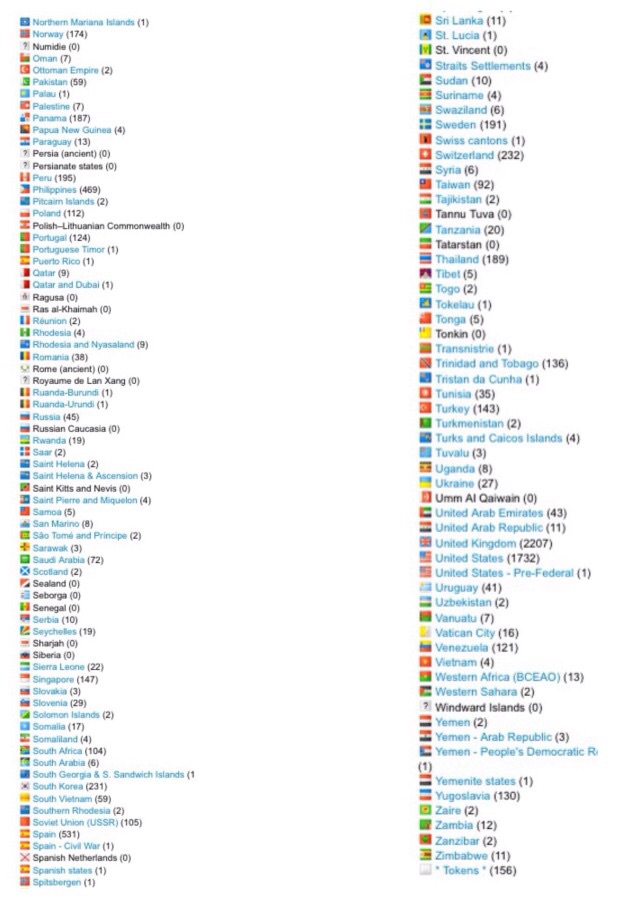 I have aquired 301 of the 390 on this list. 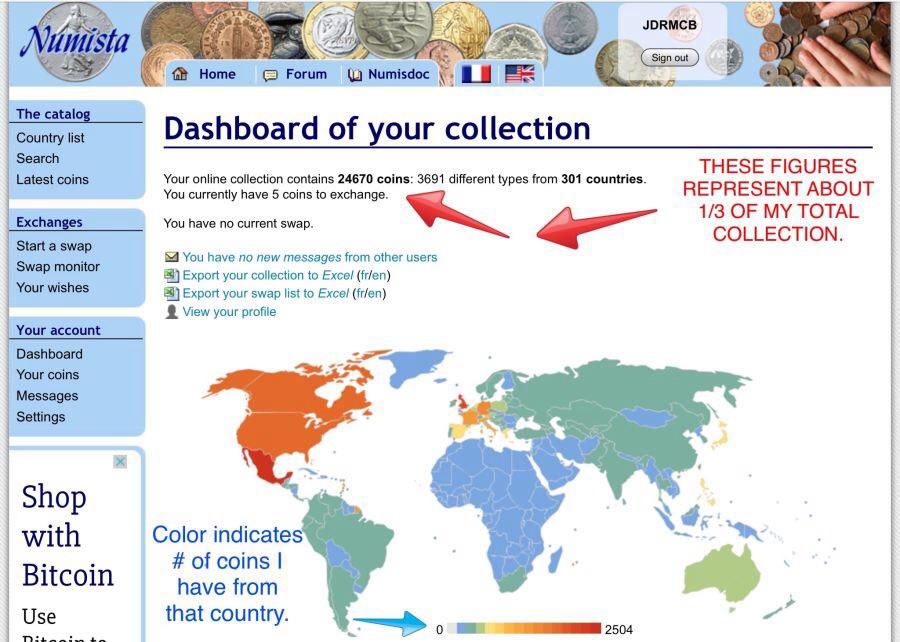 So whether you count all the German and Italian states as individual countries or any other countries that are not on this list, is irrelevant, in my opinion, all OFEC lists should at the least contain these countries. So how many OFEC Collectors have at least one coin from at least 300 countries on this particular list? |
|
|
|
Bedrock of the Community
Australia
21789 Posts |
THAT is quite some accomplisment!
How 'bout other forms of OFEC* when the acquisition rate lessens?:
One From Every Century. Only need 26 coins to make your own individual set, which becomes a statement on the development of World coinage, right from the beginning
or,
One From Every Culture? - You will be suckered into learning a lot more about World history, economics and geography.
That will dig you deeper into the World of numismatics as well, into which you have already come.
There are a few quite knowledgeable collectors here in the CCF, that already have a similar approach to collecting.
|
|
Moderator
 Australia
16967 Posts |
Quote:
So how many OFEC Collectors have at least one coin from at least 300 countries on this particular list? I'm reasonably sure I would - just skimming over your list, I've got most of the blue countries, and over half of the black countries. Though, as is usual with working off someone else's list, it's sometimes difficult to match countries I own with countries on the list. And some of the ones on the list are still either "nonsense" countries, or at least badly translated from some other language. I'm pretty sure "Persianate states" isn't really a thing, and I'm not entirely sure which coin series might be applied to it. Don't say "infinitely" when you mean "very"; otherwise, you'll have no word left when you want to talk about something really infinite. - C. S. Lewis
|
|
Pillar of the Community
Canada
2805 Posts |
"Persianate states" are a subject of some drama on Numista, they were recently called "Caucasian khanates". Revisions are ongoing.
|
|
Pillar of the Community
Canada
2785 Posts |
using numista as my initial guide I hit 300 several months ago.
in my collection there are a couple of "nonsense" countries that I intend to replace with "real" ones in the near future, but for now taking a break (it was a long crawl to 300) and working on Canadian colonial tokens.
like others, I have made additions based solely on my own criteria, ie chose to count Japan as 2 (imperial and modern/post WWII), several Germanies (empire, notgeld, 3rd reich etc, but not each individual state) and several revolutionary issues (spain, mexico etc)
the whole collection can be seen in the link in my signature. there are several coins in there that would be easily upgradeable but were either coins I found or bought very early on in my collecting and mean more to me than having a bright and shiny version.
last (and most important), congratulations !
|
|
Moderator
Australia
16967 Posts |
OK, I finally had some time to sit down with my database and compare lists.
Here are the countries that the OP has, that I don't:
Alderney
British Antarctic Territory
Lorraine
Northern Marianas
Palau
Here are the countries that I have that the OP does not:
Aksum
Antigua (& Barbuda) (the 19th century token listed in Krause)
Argentine Provinces
Ascension Island
Austrian Netherlands
Austrian States
Belarus
Benin
Byzantine Empire
Carthage
Central African Republic
Chad
Cilician Armenia
Cocos-Keeling Is.
Congo Rep.
Congo Free State
Dominica
Dutch Republic
Equatorial African States
France - Feudal
French Guiana
Gabon
Gaul
German New Guinea
Greece (ancient)
Guadeloupe
Hawaii
Hejaz & Nejd
Hungarian States (Slavonia)
Hunnic Empire (? I have Hephthalite coins)
Isles de France et (Bourbon)
India - ancient
India - Danish
India - Dutch
India - French
India - Mughal
Indian kingdoms
Islamic caliphates
Italian Somaliland
Ivory Coast
Judaea
Kiau Chau
Korea
Leichtenstein
Leige
Lundy
Madeira Islands
Martinique
Moldavia & Wallachia
Montserrat
Nabataean Kingdom
Nauru
Numidia
Persia (ancient)
Persianate States (I'm claiming them)
Polish-Lithuanian Commonwealth (both halves)
Ragusa
Ras Al-Khaima
Roman Empire
Saint Kitts & Nevis
Saint Vincent & Grenadines
Sharjah
Siberia
Spanish Netherlands
Tatarstan
Tonkin
Windward Islands
That's 301 - 5 + 67 = 363.
Going through, I found some "errors" in the listing, which I at least can see need improving.
British West Indies - yes, I know that's what Krause calls them, but even the introductory paragraph in Krause admits this is only partially correct. "British Colonies" would be better.
Byzantium Empire should be "Byzantine Empire".
Central Africa and Western Africa - in order to be consistent with both Krause and the listing for "Equatorial African States", these should be changed to "Central African States" and "West African States".
Comoro Islands should be "Comoros Islands"
French cities - umm, what? I assume this refers to the 20th century notgeld-like pieces listed in Krause, and not mediaeval pieces which would go under "feudal"?
Greece (ancient) - "Greece" is very specific geographically, and politically sensitive too. "Greek" is less so.
Hunnic Empire - the Huns never had an "empire". The Hephthalites (so-called "White Huns") issued coinage in their homeland in Central Asia.
Numidie and Transnistrie - these are their French names; replace the final "e" with an "a".
Polish-Lithuanian Commonwealth and United Arab Republic - as with the Austro-Hungarian Empire, these countries never issued a single unified empire-wide coinage; their member-state coinages are filed under Poland and Lithuania, and Egypt and Syria.
Royaume de Lan Xang - delete the first two French words and file this one under "L".
Ruanda-Urundi - these Belgian Colonial coins are actually issued under the name of "Belgian Congo - Ruanda - Urundi". File it under "B".
St Lucia and St Vincent - for pity's sake, either file all the Saints under "St" or under "Saint". Don't split them. I'd file them all under "Saint" to keep the alphabetical order proper and correct.
Finally, some "omissions". No matter how hard I try, I can't find anywhere logical to put these countries I own:
Coins of the pre-Roman Celtic-Iberian cities and tribes in what we now call Spain. They are Celtic, not Greek (their language is even less like Greek than English is), but cannot be filed under the other three possible "Celtic" options (Danube, Gaul or England). As with Greece, I have each city-state listed as a separate "country" in my own database, but as a generic entry, "Celtiberian city-states" couldn't go wrong.
Coins of the hundreds of petty Islamic dynasties that existed throughout the Islamic world, from Spain to Indonesia, in between the fall of the Caliphate and the rise of the European colonial powers. Only some of them (like Crimea) are given their own entries.
Seleucid and Bactrian coins are acceptably "ancient Greek"; the Gupta Empire is definitely "ancient India". But there's a continuum of Indo-Greek and Indo-Scythian states in between those two periods, and it can be difficult to judge which of those two categories a certain coin ought to be filed under. Then there's the Kushan Empire, which doesn't really belong in either.
While we're on the subject of ancient Greeks, it would certainly be helpful to split "Roman Provincial" out from "Roman Empire", as they do constitute two separate coinage systems.
The Venetian colonies of Cattaro and Dalmatia & Albania. "Italian states" doesn't really fit, since the territories in question are currently owned by Croatia.
The fantasy "coins" of Easter Island, Galapagos Islands, Kurdistan, Northern Cyprus and others. If the fantasy "BES Islands" and "Nagorno-Karabakh" coins are on the list, then so should mine be.
There is the issue of whether countries with the same name at two different time periods with radically different borders should be separated. Examples: Armenia (ancient Kingdom / modern state), Bulgaria (mediaeval empire / modern state), Colombia (pre-1831 / post-1831), Italy (Napoleonic Kingdom / modern state), Palestine (British Mandate / modern fantasies), Serbia (mediaeval empire / pre WWI state / Nazi puppet / modern state), South Africa (Boer Republic / modern state). The point is, if the different incarnations of the countries had happened to have been given different names, there would be no question - they would all have been given separate entries. Of course, the whole issue of whether a mere change in name alone qualifies as the creation of a "new country" is dealt with inconsistently by this list.
Krakow - a nominally autonomous "free city" in what is now central Poland, but at the time (1815-1846) was on the border between Austria, Russia and Prussia. Filing it under "Poland" seems mundane, and it certainly doesn't belong under "German states".
The Majapahit Empire was a pre-Islamic state in what is now Indonesia. There are a few other early coin-issuing empires in Southeast Asia that could also be added, though I don't own examples from them; Lan Xang is the only one of these listed there.
Mauretania, like Numidia, was an ancient puppet state supported by the Romans in northern Africa. Note this isn't quite another "new country with old name" thing, as Mauretania (ancient) and Mauritania (modern state) have slightly different spellings, in both English and French.
The Sabaeans were an ancient state in what is now Yemen. Filing them with the modern Yemeni states seems a bit... broad.
The Empire of Trebizond was a piece of the Byzantine empire in what is now northern Turkey, that broke away after the Crusaders occupied Constantinople; they stayed independent until a decade after the Ottomans conquered Constantinople, a period of over 250 years. Their coins are not listed in the mainstream Byzantine catalogues.
Don't say "infinitely" when you mean "very"; otherwise, you'll have no word left when you want to talk about something really infinite. - C. S. Lewis
|
|
Pillar of the Community
Canada
9647 Posts |
|
|
Pillar of the Community
United States
1391 Posts |
Congratulations! 300 is quite an accomplishment.
I have 290 countries in my collection according to numista standards. I have a few more according to my reckoning. But I am slowly making my way up the list and hope to have 300 countries soon.
There are several things numista does that irritates me to no end. The French people are very difficult to deal with. Very difficult.
Some categories that don't make much sense:
Judea is a little strange. Some of the coins are listed under Roman, like the coins of the First Revolt.
Not sure how useful these are:
Argentine provinces
Canadian provinces
Newfoundland gets stuck in Canadian provinces but based off how other things are in the catalog it could almost be independent.
Stupid little miconations:
Hutt River
Micronesia
Northern Mariana Islands
Sealand
Seborga
Lundy
Italian states, this category covers several independent nations over the course of centuries.
Malay peninsula. What is this? Not a country, just an area. There are many countries listed in here that make no sense, some going back millennia.
Persia (ancient), Persianate states. There are many different countries here that have been condensed.
United States - Pre-Federal, not sure how this is useful.
Yemen is all messed up.
India is broken out into categories that don't make much sense. Why Ancient, kingdoms and states?
France is a similar mess (Feudal, kingdom, cities, etc.).
|
|
Pillar of the Community
 United States
616 Posts |
SAP, your the man!!  I must say I'm quite impressed with your knowledge AND ideology on collecting world coins! I really appreciate you for putting a method to Numista's madness! I guess you've already figured out that this peer-driven site was originally started and mostly moderated by Frenchies, hence all of the loose French interpretations of the names of some countries on their list! I have been wanting to transfer my coins to a much nicer "Deluxe" coin friendly album for some time now, but just the thought of attemping to arrange them in a more logical order was truly daunting! But thanks to your A-Z revision of the list (that must have taken you numerous man hours of research  ), I can't wait to get started!  I realize that it will always be a work in progress, as I strive to include other various subsets, but at least it will be more fluent read, but most importanly....I will finally be happy with it, thus achieving that sense of accomplishment that I require after every personal project I complete or goal I set and then surpass. You are all correct in your statements concerning Numista's current state of disarray. Maybe we can convince SAP to sign up and moderate the moderators! And Wade, your OFEC collection is Awesome and quite similar to mine! I too chose to use well circulated coins for certain countries to give the album more character and validity. As well as lots of silver and a single gold coin. Once again, thanks to everyone for all your responses! |
|
Pillar of the Community
Canada
2805 Posts |
My OFEC collection is at 248 by Numista's count. However, Numista has certain inconsistencies, as previously discussed. My biggest objection is that "German States", "Indian Princely States", "Canadian Provinces", etc. only count as one country - so, doesn't matter if you have 20 coins from 20 different German states or 5 coins from 5 different Canadian provinces, you're only getting +1 to your Numista country count. If all of these instances were separated out, I think I would have about 15 more countries added to my list.
Then there's colonialism. "India - Republic" and "India - British" are kept separate. But! What about "South Africa - British", "South Africa - Republic"? There is no distinction to be seen! Same story with Mozambique, Angola, Cabo Verde, Seychelles, Mauritius, and many, many more. If you also separate out colonies and independent republics, the count jumps ever higher.
And, if you choose to make a distinction between Kingdoms, Republics, and People's Republics (as seen on the Numista listings for France, but no other country), that's even more.
So, if I were to make my own count of what I consider to be radically different countries, my count goes above 300. Or, that's what I tell myself, anyway...
I'm a fairly regular Numista contributor, lots of scans on that website are mine. Recently, the flags next to the icons were all updated, and now the Tokens section is being slowly fixed up as well. Maybe the country list will be next.
By the way, the U.A.R. is also a recent change and a subject of some controversy. To me, it depends what those coins say on them. If they say "United Arab Republic" instead of Egypt, I think they belong under the United Arab Republic - but - few collectors can read Arabic (myself included), so the lack of familiarity leads to bitter arguments.
|
|
Moderator
Australia
16967 Posts |
Quote:
Newfoundland gets stuck in Canadian provinces but based off how other things are in the catalog it could almost be independent. Newfoundland was "independent", as far as being separate from Canada or anywhere else except Britain was concerned. Under the Statute of Westminster (and Act of the British parliament in 1931), six "Dominions" were recognized: Australia, Canada, Ireland, New Zealand, Newfoundland and South Africa. Personally, I count all of the Canadian Provinces of the 19th century as "separate countries" too. Quote:
Stupid little miconations: Micronesia Micronesia, despite its name, is not a micronation; it's a fully fledged member of the United Nations. However, all of the "coins" issued in its name are unoffical. Until MIcronesia actually issues legal tender coins, the country "belongs" with Galapagos Islands, etc and Numista should be consistent: either include them all, or exclude them all. Personally, I'd prefer Numista include them, but perhaps in a separate "unrecognized countries" list, or colour them a different colour or something. Quote:
Malay peninsula. What is this? Not a country, just an area. But a useful agglomeration of mini-states - just like "German states" and "Italian states". Again, they have to choose - either list each state as a separate country, or slap down a bunch of these vague geographic block labels. More such "blocks" are to be preferred if this is the way to go, to cover other "gaps"; as I mentioned above, "Indonesian states" is one such that remains missing. Quote:
United States - Pre-Federal, not sure how this is useful. It's where I put my Virginia 1773 halfpenny. Of course, in my own list it's a separate country, under "V". Quote:
India is broken out into categories that don't make much sense. Why Ancient, kingdoms and states? Presumably because that's how the Krause catalogues do it: there is a curious division of the Indian states into "Princely states" and "Independent kingdoms", which I can't really tell the difference between; presumably it's got something to do with their diplomatic staus with Britain/EIC at the time, but I think they'd be better off simply merging those two categories. I don't know where Numista users file pre-Mughal Indian states coins, such as the sultanates of Dehli and Bengal; "ancient", "states" and "kingdoms" are their options, I suppose. Quote:
Then there's colonialism. "India - Republic" and "India - British" are kept separate. But! What about "South Africa - British", "South Africa - Republic"? Well, one could argue that "British India" and the "Republic of India" are separate, on the grounds that there is a border change as well as a regime change; "British India" also included what we now call Pakistan, Bangladesh and (for a time) Burma, but did not include the ten small Portuguese and French exclaves that still existed in 1947. Quote:
To me, it depends what those coins say on them. This also is a general principle I try to apply; if it "says" a different name on the coin, it gets filed under whatever name is there on the coin. I'll also freely admit I also apply this rule rather arbitrarily, especially for non-Latin-alphabet-using countries; I split "Ceylon" and "Sri Lanka" at the 1972 name change, but ignore completely the fact that "Thailand" was called "Siam" prior to 1939. Quote:
If they say "United Arab Republic" instead of Egypt, I think they belong under the United Arab Republic - but - few collectors can read Arabic (myself included), so the lack of familiarity leads to bitter arguments. Syria and Egypt federating into the UAR was a "difference that made no difference" as far as the coinage was concerned, because the two halves of the country kept completely separate currencies. So if you're going to separate the UAR from the Egypts and Syrias that came before and after, you'll really need two of them: "UAR - Egypt" and "UAR - Syria". Don't say "infinitely" when you mean "very"; otherwise, you'll have no word left when you want to talk about something really infinite. - C. S. Lewis
|
|
Pillar of the Community
Canada
2785 Posts |
I'm going argue for Lundy, simply for the fact that Harman had the cohonies to buy the island, name himself king & illegally issued his own currency. the fact he chose his currency to be named "Puffins" seals the deal.  Quote:
Stupid little miconations: Micronesia micronesia counts as "tokens", not as a country (or at least it did last time I was on numista) Edited by Wade
03/10/2015 9:20 pm
|
|
New Member
United States
17 Posts |
I think as I've counted it I am at 287 according to Numistma but it's a little confusing, like where is British Guinea? I also don't understand how Newfoundland, Prussia or the Papal States are not listed seperatly. And how is Russia not listed as Czarist, USSR and modern?
|
|
Moderator
Australia
16967 Posts |
Quote:
...where is British Guinea? There is not, and never has been, a place called "British Guinea". There was a place called "British Guiana", in South America next to French Guiana and Dutch Guiana; British Guiana is now called "Guyana". "Guinea" is a region in Africa; it is also the name of two separate though neighboring countries in that region, neither of which were ever owned by Britain (one was French, the other Portuguese). Don't say "infinitely" when you mean "very"; otherwise, you'll have no word left when you want to talk about something really infinite. - C. S. Lewis
|
|
Pillar of the Community
Canada
2805 Posts |
Or maybe you want New Guinea?
|
|
New Member
United States
17 Posts |
Yes, I meant British Guiana.
|
| |
Replies: 22 / Views: 7,670 |
To participate in the forum you must log in or register.
Disclaimer: While a tremendous amount of effort goes into ensuring the accuracy of the information contained in this site, Coin Community assumes no liability for errors. Copyright 2005 - 2026 Coin Community Family- all rights reserved worldwide. Use of any images or content on this website without prior written permission of Coin Community or the original lender is strictly prohibited.
Contact Us | Advertise Here | Privacy Policy / Terms of Use
|
| Coin Community Forum |
© 2005 - 2026 Coin Community Forums |
| It took 0.59 seconds to rattle this change. |
 |
|










 Posted 03/09/2015 10:46 pm


