| Author |
 Replies: 15 / Views: 1,911 Replies: 15 / Views: 1,911 |
|
|
New Member
United States
2 Posts |
I have come across 2 bank notes dated 1929. One is a $20 and one is a $5. They are embedded in some sort of acrylic. Any information on these bills would be appreciated. Also, the good or (more likely) the bad news about the previous curator's decision to display them in this fashion. Thanks. 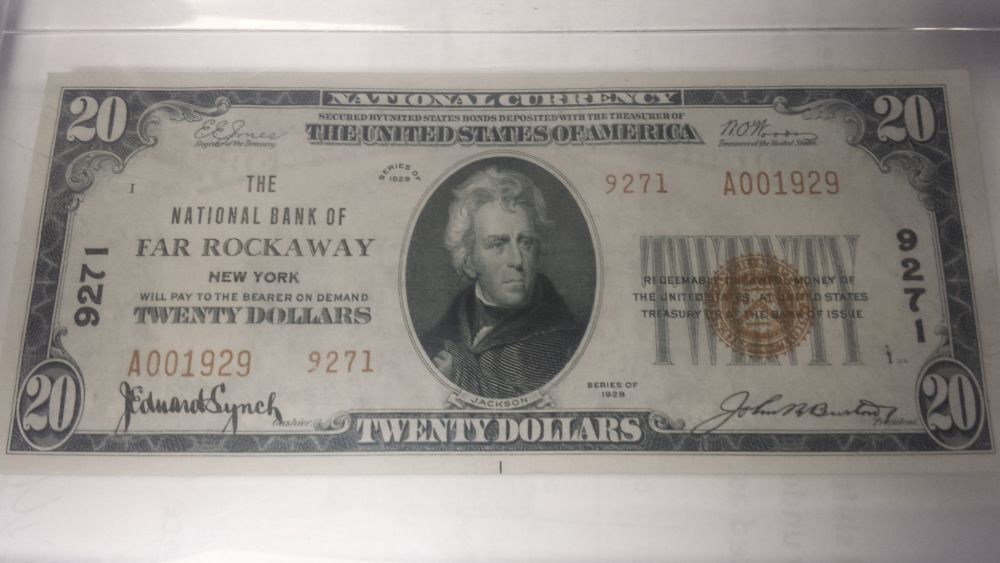 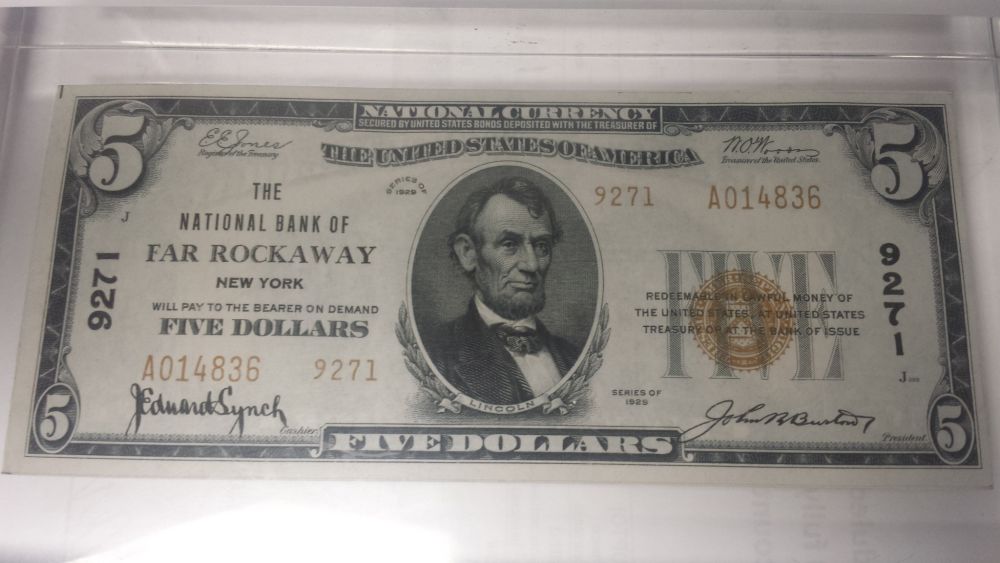 |
|
|
|
Pillar of the Community
United States
8137 Posts |
 Your bills are national bank notes and there are thousands of different banks that issued them. I don't know the value of them because there are so many, but they look to be in a higher grade. Also the holders look like currency holders. That is actually a good way to store them because it will protect the bills. |
|
Bedrock of the Community
 United States
12921 Posts |
By "embedded", what do you mean? Hopefully as CoinCollector2012 guessed, they're currency holders. Your notes look to be in pretty good shape, perhaps even CU. |
|
New Member
 United States
2 Posts |
No seems. Looks like a paper weight. Perhaps lucite but an acrylic of some sort. My only experience is with baseball cards and am familiar with holders. There is no way into this one. Is it lost cause? They certainly look authentic.
|
|
Pillar of the Community
United States
4409 Posts |
What you have are Series 1929 Type 2 national bank notes from Far Rockaway, New York.
The 6th edition census that came with my Kelly National Bank Note book shows there are 47 small size reported; neither of your serial numbers is recorded.
On the $5 it might interest you to know that the note below it (serial number 14837) exists.
|
|
Pillar of the Community
United States
4409 Posts |
The last auction record, that I can find, of a note from this bank is a Series 1929 Type 1 $10 that sold for $350 in June of 2014
Personally, I would leave them in the holders if they were mine as I'd be afraid of damaging the bills in the process of removing the lucite/ acrylic.
-MV
|
|
Valued Member
United States
108 Posts |
I would leave them in there
|
|
Bedrock of the Community
United States
12921 Posts |
|
|
Pillar of the Community
United States
4707 Posts |
They appear to be in high grade. If it were me, I would take to a jeweler and get an opinion if he may be able to get them out of there without damage.
|
|
Valued Member
Canada
488 Posts |
I personally find it somewhat interesting that the serial on the $20 note is the same as the year issued.
|
|
Pillar of the Community
United States
1116 Posts |
If these notes were laminated would it have any effect on their value?
|
|
Pillar of the Community
United States
4409 Posts |
Since no one answered ghostrider's question.
Generally speaking the value of laminated notes and damaged notes is less than one without problems.
Of course, with nationals collectors have realized that you take what you can get for certain banks or risk potentially searching for years for another example.
Other national collectors may have different opinions and thoughts. Hopefully, they'll chime in.
-MV
|
|
Pillar of the Community
1153 Posts |
The signature in the lower left on both notes looks odd to me. Notice how the J and the Y are cut off, while in the same regard the signature on the lower right loops into the bottom border?
Also the signature in the lower right is not in the same spot on the two examples. All the other signatures are in the same spot, except for the lower right. Could be because of different denomination, but odd the other signatures are the same.
|
|
Pillar of the Community
United States
4409 Posts |
I'm going to guess that is the variation in the signatures is due to the printing process. Here's a type 2 $20 on ebay that shows a different placement of the bank President's signature 170939327578 |
|
Pillar of the Community
United States
4707 Posts |
csotus, this is common on 1929 nationals.
|
|
Pillar of the Community
United States
1116 Posts |
Thanks Meadowview for your response.
|
| |
Replies: 15 / Views: 1,911 |
|






 Posted 03/24/2015 11:10 am





