| Author |
 Replies: 19 / Views: 2,039 Replies: 19 / Views: 2,039 |
|
Pillar of the Community
United States
3363 Posts |
I found a definition of Die Subsidence here (sunken die): http://www.error-ref.com/?s=sunkenQuote:"Die subsidence is a form of plastic deformation that results in a portion of the die face sinking in. The term "subsidence" is derived from geology. It means a sinking land surface. A synonym for die subsidence error is "sunken die error". The coin itself will show a bulge on one face. The opposite face may or may not show weakness in the design. It rather depends on how deeply the die face recedes. The appearance of die subsidence errors is highly variable. It can be local or global (affecting the entire die face). Localized forms can be compact, elongated, circular, or oblong. Die subsidence errors are often associated with cracking. The die cracks (conventional or bi-level) can skirt or penetrate the zone of subsidence. Other errors sometimes found in association with die subsidence errors include split dies, shattered dies, interior die breaks, retained interior die breaks, and Retained Cuds. The causes of die subsidence errors are conjectural. They may reflect an abnormally soft interior that results from improper heat treatment (e.g., cooling, heating, tempering, quenching). They may reflect an intrinsic flaw in the die steel or the use of the wrong type of steel. Subsurface cavities, or pockets of low-density contaminants such as slag might also contribute to the formation of a zone of subsidence." I think this may be what is going on here with the cornice of columns 9 and 10. What do you think? 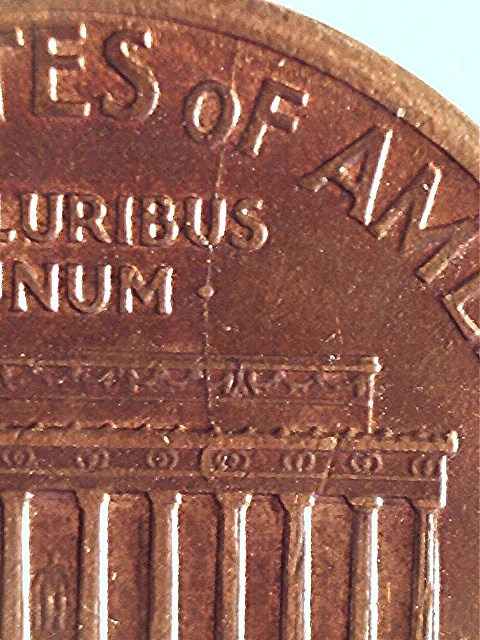 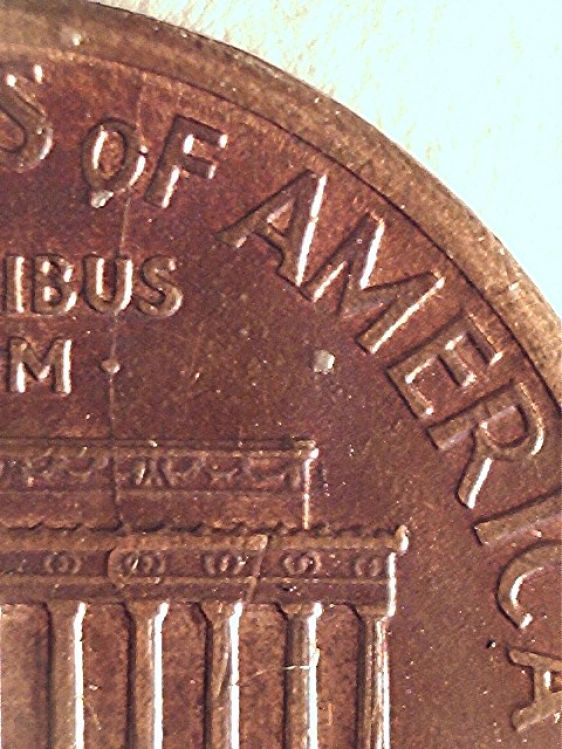 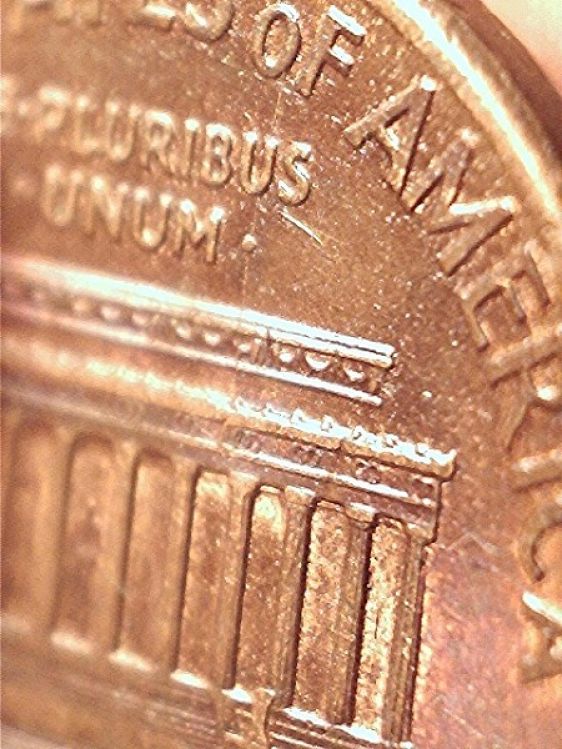 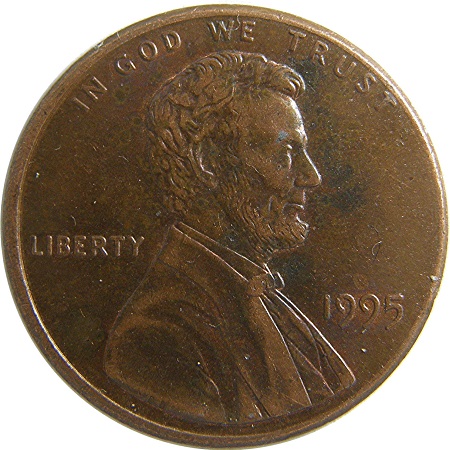 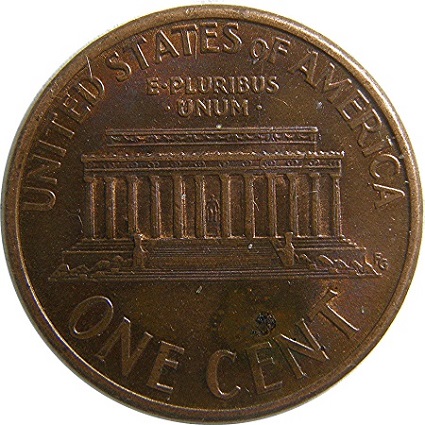 |
|
|
|
Bedrock of the Community
United States
62064 Posts |
|
|
Pillar of the Community
 United States
3363 Posts |
The quote I gave IS from Mike Diamond's site. The die crack leads into the area where the die has sunken as he describes. I have indicated that area with arrows. It is easy to miss when you just glance at the photo. I missed it when I first examined the coin because I focused on just the crack. 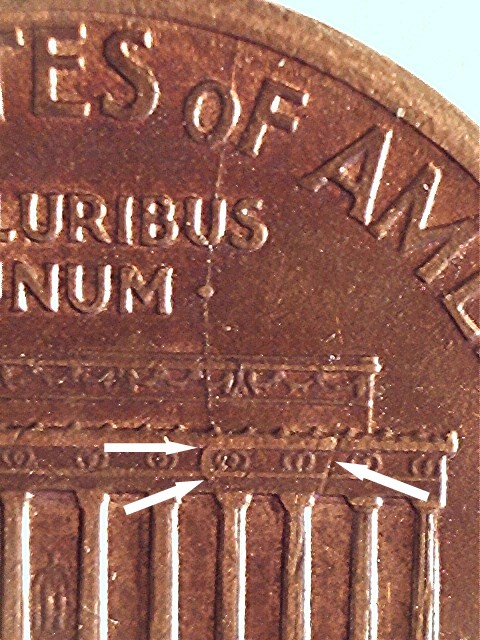 |
|
Pillar of the Community
United States
3363 Posts |
Here is the view of the sunken area at an angle. As I indicated in the original post, the sunken area is the cornice at the top of the 2 columns. 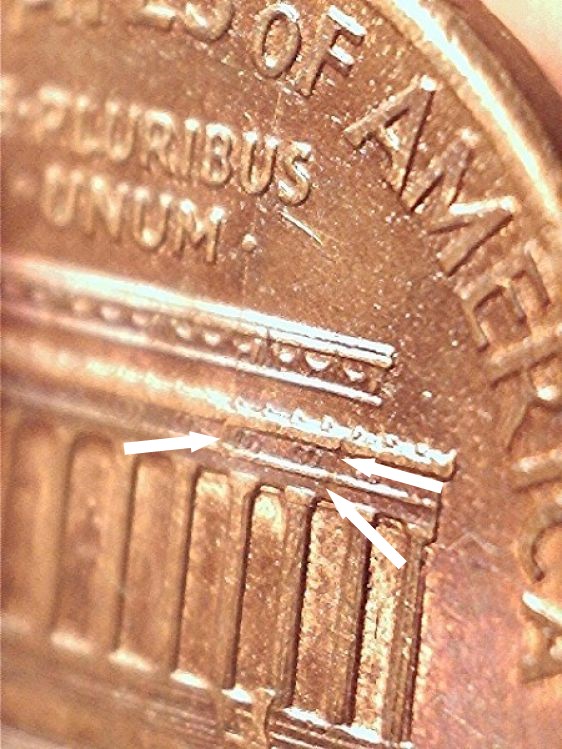 |
|
Moderator
 United States
23522 Posts |
Your light is coming from the right, and at your left-hand arrows a shadow is being cast to the left. That's only possible if what the arrows are pointing at is higher than the surrounding area. But a displacement like that would be difficult on the anvil die, so let's call me confused for the moment.  |
|
Pillar of the Community
United States
3363 Posts |
SsuperDdave - you are exactly correct. That area is raised because the die has sunken in at that point. Please re-read the definition I gave from Mike's site.
|
|
Pillar of the Community
United States
3363 Posts |
Quote:
But a displacement like that would be difficult on the anvil die I don't really understand why it would be difficult? Also I don't understand if "difficult" means impossible? If it is impossible then what other explanations are possible for this raised area on the coin (sunken on the die)?  Maybe it is not Die Subsidence? |
|
Moderator
United States
23522 Posts |
My bad; I was mis-visualizing your visualization. My only worrry is the completeness of detail, which ought to go away with subsidence. |
|
Pillar of the Community
United States
3363 Posts |
Thanks, SsuperDdave. I did not know that the detail was supposed to disappear! This was the only explanation I could find to make sense of what I am seeing - including the crack leading to the raised area. Perhaps someone could supply some other alternatives? I will be signing off now, but will check back on this thread tomorrow morning. I appreciate your help.   |
|
Pillar of the Community
United States
5964 Posts |
Maybe the completeness of the detail was saved because of the crack. It's not supposed to disappear to begin with.
Edited by CoinMasters
03/30/2015 03:14 am
|
|
Pillar of the Community
United States
5964 Posts |
I just googled die subsidence and right below your definition, Mr. Diamond has an article on it. I glanced through it and he said the deformation worsens. Maybe you have an early one. Now you have two alternatives, either of which allow you to retain your original diagnosis (without having to choose between Mr. Diamond and CoinMasters). lol
Edited by CoinMasters
03/30/2015 03:46 am
|
|
Moderator
United States
56855 Posts |
All I see is a die crack and to the right of that a hit mark. John1  |
|
Pillar of the Community
United States
3363 Posts |
Thanks, SsuperDdave and CoinMasters for taking the time to examine my photos and see the feature in question. Also, thank you for reading my comments in the post. I am thinking that I am going to stay with the description of what is happening as "Die Subsidence" unless I can find something better. CoinMasters, your reference: Quote:
Mr. Diamond has an article on it. I glanced through it and he said the deformation worsens. Maybe you have an early one. ...leads me to identify it as "Early Stage". Thanks for noticing that! I have never seen or found one of these, so I think that it is most interesting! |
|
Pillar of the Community
United States
5964 Posts |
It was my pleasure, reading your post Pete2226. It is a spectacular coin, and now I know a lot about Die Subsidence. This forum is the jank.
|
|
Pillar of the Community
United States
2752 Posts |
It looks like the area on the Memorial is flanked by two bi-level die cracks. Any bi-level die crack is defined by a sinking-in on one side of the crack; that's why it has a stepped appearance. This rather common form of brittle failure is not the same as a die subsidence error. With the latter, there is plastic deformation of the die face that results in the production of a shallow depression. Its counterpart on the coin is a swelling, which may or may not show peripheral cracking. Basically, the cracks are a side-effect of a die subsidence error, not the cause. In the case of a bi-level die crack, the cracking (and the subsurface deformation associated with it) is the sole cause of the uneven surface. Here's a well-developed die subsidence error in conjunction with a split die and a small Cud: http://www.ebay.com/itm/321705355241Note the swelling on the side of Roosevelt's face that coincides with a loss of design details. And here's a very nice die subsidence error in a Colombia 10 centavos: http://www.ebay.com/itm/201308670386Error coin writer and researcher.
Edited by mikediamond
03/30/2015 11:56 am
|
|
Pillar of the Community
United States
3363 Posts |
Thank you so much, mikediamond! What a perfectly clear explanation! I had never heard of a bi-level die crack! Thanks, also for the comparative illustrations - very helpful. It looks like I should have done some additional searching on your error-ref...I would have found it! I will try to be more thorough the next time I find something puzzling to me. Here is the reference if anyone would care to check it out: http://www.error-ref.com/?s=bi-level+die+crack |
| |
Replies: 19 / Views: 2,039 |







 Posted 03/29/2015 9:47 pm


