| Author |
 Replies: 12 / Views: 1,905 Replies: 12 / Views: 1,905 |
|
|
Pillar of the Community
United States
4883 Posts |
Colligo ergo sum
|
|
|
|
Pillar of the Community
United States
5362 Posts |
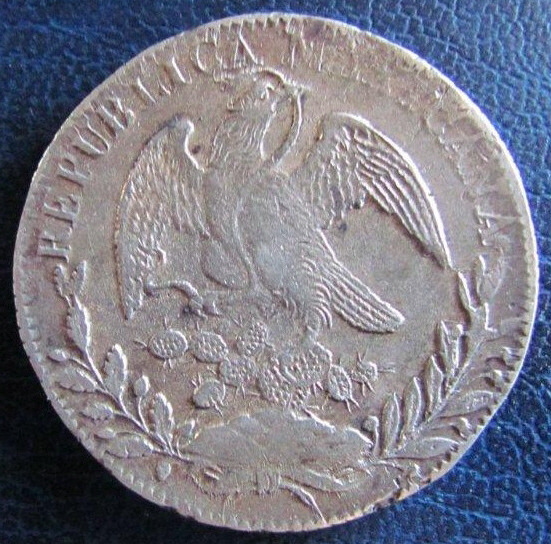
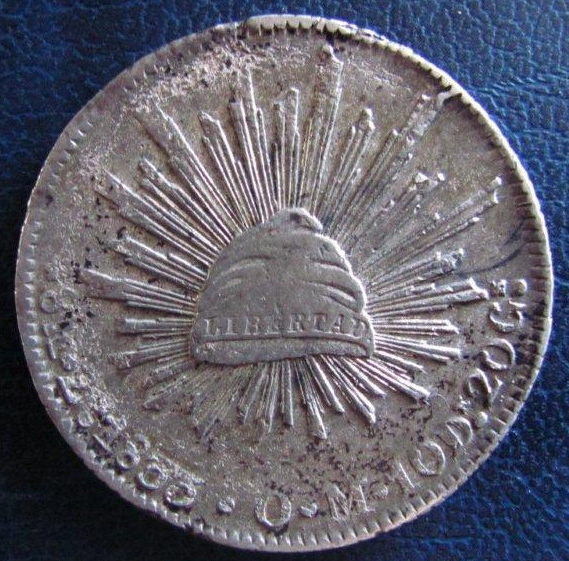
I can only presume that you mean the Riddell # 232. I will not deny that there is some similarity between the two coins but the one you picture was not struck with the dies that created the Riddell # 232. Notice the spacing between the date and the OM - it is quite different. There are other smaller difference in both dies but the spaces after the date are easiest to spot.
The dies of the coin you picture are very badly deteriorated but they appear to be genuine. The edge design is correct for 1833 as well. It must be noted that the Zs edging dies were not as well made as the colonial edge dies of Mexico City.
I would suggest as I always do that Specific Gravity is necessary in all cases before 1845 because of the number of undocumented counterfeits from that period.
|
|
Pillar of the Community
 United States
4883 Posts |
Riddell No. 228 is probably the most worrisome of the 1833 Zs contemporary counterfeits since despite its being extremely debased, its weight will still be about right, and No. 232, which as you point out is the closest match, is also within 2% of the correct weight (I'm not sure how that sleight of hand was accomplished, particularly for the former). So your point on taking a specific gravity is well taken, although it might actually be better if it turned out to be a previously unidentified counterfeit rather than genuine....
Colligo ergo sum
|
|
Pillar of the Community
United States
5362 Posts |
I agree that a low specific gravity would be welcome news for your 1833 Zs 8 reales. A counterfeit is definitely worth more in this condition.
|
|
Pillar of the Community
United States
4883 Posts |
I now have this coin in hand.
Diameter: 37.7 mm
Weight: 26.74 grams
Specific Gravity: 9.90 (suggesting approximately 63% Ag purity)
A pretty crude piece. Does have a decent ring. There're what appear to be flow marks on the periphery of the eagle side, but both dies appear to have been well worn. In any event, it does look to me to have been struck and not cast. I see about a half dozen spots (irregularly spaced) around the edge that appear to have been filed (not recently). Whether that's adjustments at the mint (which would assume it's genuine, which seems a stretch given the physical data), or a form of clipping, or removing evidence of its illicit fabrication, I'm not at all prepared to say. Like many early coins of this type, even if authentic, there're no standards that can be consistently and reliably applied. I overpaid for this, I think, but I imagine so long as it's not a modern forgery (which seems unlikely), it's worth adding to my collection regardless. Probably a good candidate for XRF.
Colligo ergo sum
|
|
Pillar of the Community
United States
5362 Posts |
Lucky Cuss - Definitely a candidate for XRF testing. That would likely confirm or deny status as contemporary. I am not aware of any massive issue of silver counterfeits of Cap and Ray 8Rs like the Portrait 8Rs. I am still researching the possibility that a 4-5 % premium may have been paid for Cap and Ray varieties at some times. If true it creates a very minimal profit over manufacturing and transport (between 3 and 4%).
What type of scale did you use? Accuracy?
|
|
Pillar of the Community
United States
4883 Posts |
Quote:
What type of scale did you use? Accuracy? The same small digital scale I normally use, and which I recently calibrated. Weights were taken to .01 gram, and done multiple times until I was satisfied that the accuracy of my readings was at worst within 1%. I have pretty high confidence in my results. It's interesting that the fineness I determined is spot on with that cited by Riddell for his No. 229. However, the weight's a bit over and the die details are all wrong. Which brings me back to No.232, for which the weight is about right, the fineness not too far off, and the eagle side details a very good match (note the orientation and shape of the eagle's neck and head). But the spacing within the legend on the cap side. as you've observed, is off. So I'm not sure precisely what I've stumbled upon here. Colligo ergo sum
Edited by Lucky Cuss
04/09/2015 8:44 pm
|
|
Pillar of the Community
United States
5362 Posts |
Most of the small inexpensive digital scales (under $200) have an accuracy that is stated as a percentage of the total weight being measured. The average (which the scale companies never state) is typically 2% of the total amount of the object being weighed. The best of the cheap scales is never better than 1%. I am not aware of any better scale until you get to laboratory level scales. Repeatable results are not always accurate results. The saving grace is that we are calculating a weight differential. That will be accurate enough for a 1 decimal point result provided the weights are taken sequentially not on different days.
How will this affect the SG? The typical loss of weight for a 27 gram 900 fine silver coin should be 2.62 g (which is the volume of the coin 2.62 cubic centimeters). A 2% scale would determine that value to a +/- 0.05 g. Therefore the differential volume/weight is 2.62 +/- 0.05 That translates to a range of SGs between 10.5 and 10.1. That is 200 points of fineness (100 points each way).
You should express your result as between 10.1 and 9.7. This is good enough for a test to identify a typical class 1 counterfeit but not to identify a typical Class 2 coin which is often between 850 and 900 fine.
|
|
Pillar of the Community
United States
5362 Posts |
You seem to have discovered a new Class 1 counterfeit variety made with dies that are very close to genuine. There were two mints which were known to have sold old dies as scrap metal without defacing them. The mints are Guanajuato and Zacatecas. You most likely have one of these. A coin struck outside the mint with genuine scrap mint dies on debased planchets. Many collectors have presumed these prove the stories about corrupt mint officials making substandard products. Yet US mint tests never disclosed any of these coins. The Go and Zs coins were always held in the highest regard by the US mint. I prefer to use Riddell's interpretation that the coins are either debased or countefeit, but either way they are fraudulent. His deciding factor in classifying them was the use of standard designs. So Riddell would call likely this coin Debased - I prefer counterfeit. The one thing it clearly IS NOT is a legitimate mint product.
|
|
Pillar of the Community
United States
4883 Posts |
Quote:
Repeatable results are not always accurate results. True enough. There erre small variances in my repeated weighings from which I deduced a mean, and using that figure is how I arrive at what I believe is as accurate a result as can be obtained sans proper lab equipment and controls. I really do think my determination is a bit more on the money than merely a range of 9.7 to 10.1, which would correspond to am inexact fineness of 50 to 75%, which hardly seems useful except to rule out its being genuine. By the way, I don't hold the seller of this coin at all responsible, as it's not customary fir the specific gravity of such items being sold to be measured and disclosed, and I further would imagine a very llarge majority of collectors, even fairly astute ones, would've just put this away so lang as the weight was close and there were no tellrale visual clues that it might not be what it seemed. I appreciate your weighing in (pun intended) on this one. I'm glad to have found something of interest to both of us, and hopefully also to other members here. Colligo ergo sum
Edited by Lucky Cuss
04/10/2015 09:03 am
|
|
Pillar of the Community
United States
5362 Posts |
Lucky Cuss Quote:
hardly seems useful except to rule out its being genuine. That is the precise purpose of the "normal" scale. It is accurate enough to determine that a coin is NOT genuine. Today's "normal" scale has essentially the same accuracy of the scales that were made available to the Chinese schroffs in 1835. That level of accuracy can identify any coin that was debased too much to circulate legally. The reason that this accuracy level was adequate for commerce was that coins in circulation vary in weight. Weight and alloy were both essentials for circulation and for the monetary supply to be trusted. Weight is easy - density just a bit harder. Specific gravity determined with the same scale was also adequate to identify significantly debased coins. A study of the silver contents of the counterfeits listed in Riddell's book will show anyone that the typical contemporary counterfeit was a coin that was far more than 10 or 15% debased. Riddell listed only 2 coins out of 290 that tested at 800 fine. The average alloy was made with an alloy UNDER 500 fine and easily detected. Numismatic Forgeries can use the correct alloy, but even then the average numismatic forgery will not be close to correct. I typically use visual clues to ID recently made fakes. I use a 1/100 gram Ohaus balance scale (4 beam - no springs - no electronics - direct read to 0.01g) for all coins. This is a great working scale not too expensive. I only use a lab analytical scale in rather rare instances where I suspect a Class 2 coin made before the Chinese used density determinations for authenticity. These can fall in the 800-850 fine range which is outside mint tolerances. I also use it when I suspect Sterling silver 925 fine was used.
|
|
Pillar of the Community
United States
866 Posts |
Which Ohaus type is that, then?
I'm accumulating balance scales at the moment...
|
|
Pillar of the Community
United States
5362 Posts |
I use the Ohaus 310 for "normal" specific gravity testing because it reads 0.01 directly and because it has the arm to hold a water beaker. I tried the Dial-O-Matic version but hated it because of creep in the spring and an "early" death. I prefer the knife edge balance - simpler.
|
| |
Replies: 12 / Views: 1,905 |
|













 Posted 04/05/2015 11:12 pm


