The following is a press release from NGC Many of the early graded NGC coins are highly sought after by dealers and collectors.During the recent Baltimore show, one of the dealers had on display an example of the infamous "Black NGC" holders. The holders date from the very beginnings of NGC in November of 1987. I have been told that NGC only produced a few hundred coins with the black inserts. Apparently, bright silver coins and gold looked great in the holders, but darkly toned coins practically disappeared. Today, these original NGC black holder coins are extremely collectible in their own right. One dealer who specializes in these holders estimates that fewer than 25 still exist. The coins sell for many times the value of coins with the same grade in modern style NGC holders. The 1837
Seated dime in an NGC MS65 "Black NGC" holder (pictured below) was being priced at several times the $5,000-$7,000 an average coin would sell for. Why do collectors place high values on old holder coins? The answer is actually more complicated than some would think.
There is an avid collector market for examples of certified coins in all old generation holders. Quite a few collectors attempt to purchase an example of every generation of every certified coin ever produced. There is even a guide book for the subject that explores NGC and about every other company that has attempted to certify coins in the last 25 years. Obviously, for collectors of these old holders, a "Black NGC" holder with just 25 or so known is quite the collectible. They would probably much prefer a common date issue to avoid serious sticker shock. Interestingly, NGC next produced a similar holder, but with a white insert. They used a plain "white" label, and this was deemed unacceptable as well. These "white" label coins are also highly collectible.
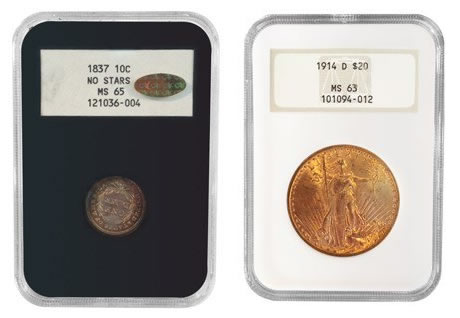
The above information easily explains why the first two generations of NGC holdered coins are so desirable. What about coins that were certified for the next 10-20 years? These are highly sought after by dealers and collectors alike. As mentioned above, the answer to this question is more complicated than is normally thought.
When rare coin certification began in the late 1980s, the owners of NGC were attempting to bring order to the wild world of rare coin grading. It is actually difficult to imagine a rare coin market now without certification. It is almost taken for granted. Could you imagine purchasing a $5,000 coin in a 2x2 holder? Very few have the grading skills to make such a purchase based solely on their knowledge. You would then have to take the word of the dealer selling you the coin. The rare coin business operated in this manner for over 100 years before certification. There was the constant disagreement over minor differences in grade, but there was also plenty of room for absolute fraud. Certification is the primary reason the rare coin market has grown so much in the last few decades.
When NGC and PCGS began operations, the tendency was to be very conservative with grades. No one knew for sure if the concept would actually work. There were also no actual guides or grading sets to compare standards. I actually worked for PCGS as a part time grader when the service first started. There was much discussion about the grading line that was to be applied for individual series. There was training on how to spot altered coins and coaching for about every aspect of grading. The natural tendency was to be very conservative. Grading rare coins at the beginning of certification was a work in progress.
Obviously, many of the early graded NGC coins are highly sought after by dealers and collectors looking for upgrades. The difference in one grading point can mean thousands of dollars. Anyone who has bid in a rare coin auction with a nice selection of coins graded in the early days of certification can vouch for the high demand. Quite a few dealers and some collectors are very knowledgeable about the different types of NGC holders, and when they were produced. In general, the most desirable old holders are those that were used prior to the adoption of the hologram as a security measure.
Whether these coins are worth the huge premiums can be debated. Some coins do upgrade, but many do not. Over the years I have been asked hundreds of times if an old holder coin would upgrade. My usual answer is maybe, but be extremely careful breaking a coin out of its holder. When a coin is broken out of its holder the NGC guarantee is voided. The safer play is to send the coin to NGC for grading review if the upgrade potential merits the investment.
Another reason collectors like old holder coins is the perception of stability of the coins in the holder. Copper coins that have been in an NGC holder for 25 years are probably going to look the same for another 25 years. Collectors like this perceived stability and are willing to pay a premium for coins such as these. The same can be said for brilliant white silver coins and others that may fade with time. NGC holders are state of the art and offer the absolute best protection for long term stability, but nothing is better than a proven winner.
Serious collectors and dealers also seek out early certified material that may have been graded without the benefit of variety attribution. These sorts of services have evolved over the years, and many interesting coins may be found in old holders without attribution. Cherry picking is a favorite game for many collectors and old holder coins can be rich hunting grounds. Again, it is advisable to send the coin to NGC for reholdering and variety attribution instead of taking the risk associated with cracking the coin out.
Some collectors are simply nostalgic for coins certified in the early days of the grading services. Regardless of the reasons, many do sell for premium prices. It's an interesting subject and one that will be revisited every time an old collection is brought to market.










 Posted 04/13/2015 4:19 pm


